
Many thanks and praise to Chris Hanlon, former professor at Eastern Illinois University (EIU) and then at Arizona State University. In 2010, he brought the idea of a name change for Douglas Hall to EIU President David Glassman, who in turn asked the Board of Trustees to consider the idea of changing the name.
Located in proximity to one another, Douglas Hall for men and Lincoln Hall for women were so named to memorialize the fact that Abraham Lincoln and Stephen Douglas held one of their debates in Charleston, Illinois, where Eastern Illinois University is located. The famous Lincoln-Douglas Debates were part of the campaign when both men were running for the Illinois State Senate. A point of contention regarding honoring Douglas is the fact that he was a strong advocate for slavery.
When the reconsideration of a name change became known, some African American alumni gratefully reached out to some of us to write letters of recommendation to support a proposal for having the residence hall named Norton in honor of Ona and Kenneth Norton. When the 10-year campaign and deliberations ended and a vote was before the Board of Trustees, the Nortons received more letters of recommendation than the other worthy candidates.
The competition to be so honored was stiff with the 205 names submitted including notables such as a former Governor of Illinois, a student-athlete and Tuskegee Airman, a former student and later President of EIU, a Black professor who became the first director of the Afro-Studies Program, and Zella Powell, who is believed to be the first Black graduate of EIU. Ultimately, the Board of Trustees voted unanimously to rename the residence hall Powell-Norton Hall.

Powell graduated from EIU in 1910. Her family lived in Mattoon not far from Charleston. One of only two Black families in Mattoon, her family had means to afford them middle-class status. Nevertheless, the family suffered the indignities common then in small rural towns of the United States. Enduring the stress of being the only Black student on campus and then graduating is a victory not many can boast. Powell taught in Mattoon before moving to Chicago, where she continued her career as a teacher and raised a family with her husband.
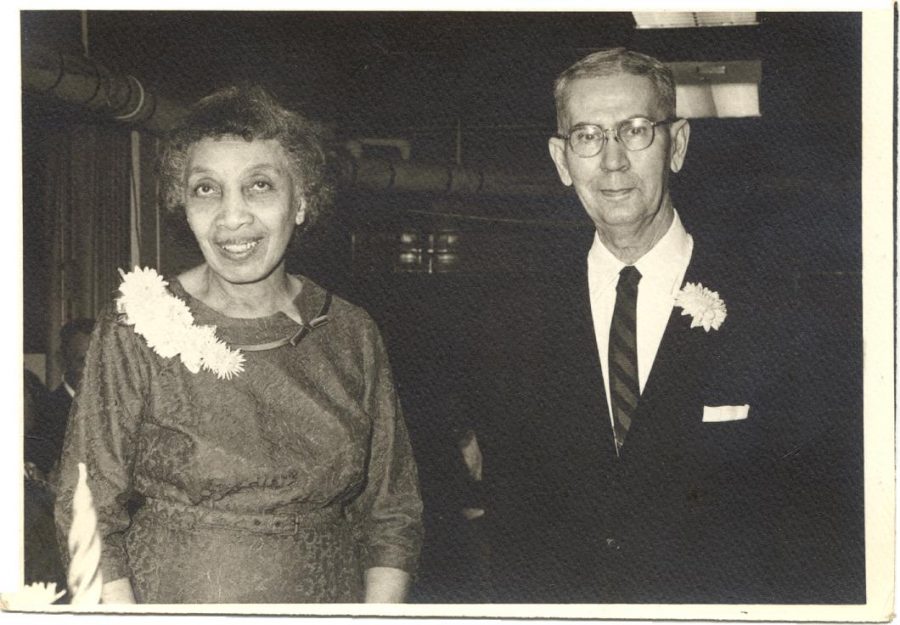
By appearance, Ona Norton and her husband Kenneth were not apparently Black, but they apparently were considered to be Black in their community. Their involvement with EIU began in the 1950s when they were asked to “open their home to Black athletes who could not find housing on campus” (The Daily Eastern News, November 24, 2021).
Providing housing for athletes who were Black led to Mrs. Norton becoming the go-to person for other Black students who found their way to EIU. The Nortons rented two modest houses to accommodate Black students—one for women and one for men. I was in the group of Black women who lived in a Norton House on Second Avenue. If it were not for the agency of the Nortons, I would not have been able to attend the university. I didn’t have money to live in the residence halls and even the $28 a month that the Nortons charged was often hard to come by. Some of the other women were in similar circumstances, but I never knew of anyone who was asked to leave the Norton house for lack of funds for rent.
Although Mrs. Norton has been honored for other acts of charity, and EIU has a scholarship in her name for Black students, the honor that she shares with Powell is the most fitting because of its connection to housing students who, without her help, would never have had the opportunity to attend EIU.
 Gwen Dungy