
On September 15, 2023, Supreme Court Justice Ketanji Brown Jackson spoke at the 16th Street Baptist Church in Birmingham, Alabama, to commemorate the 60th anniversary of the church bombing that killed four Black girls–ages 11 and 14–and caused another 12-year-old girl to lose her eye.
Some of Justice Brown Jackson’s remarks were particularly poignant for me because I had listened to a Smithsonian Associates lecture just the day before entitled, “The Pursuit of Happiness,” by Dr. Richard Bell of the University of Maryland.
Justice Brown Jackson said, “Yes, our past is filled with too much violence, too much hatred, too much prejudice, but can we really say that we are not confronting those same evils now? We have to own even the darkest parts of our past, understand them, and vow never to repeat them.”
In his lecture, Dr. Bell recounted the shattered lives of Black people who pursued happiness during a time of great discontent. He gave numerous examples of the struggles of formerly enslaved Black people who were used as pawns by the British and slaughtered by the Patriots of the American Revolution. Broken promises by the British who changed terms of agreements on certificates and rewrote laws that disenfranchised the freedom seekers resulted in unmitigated violence and treachery and needlessly ended the lives of our ancestors who fought for freedom. It’s asking a lot to understand these dark parts of the past.
Black people who in good faith pursued their freedom by fleeing the slave holders and siding with the British became refugees of the Revolution while fighting to create a post-slavery society. Between 1775 and 1808, freedom seekers continued to petition and pursue their liberty even while fleeing from New York to Nova Scotia to Sierra Leone. Given the magnitude of their sacrifice and the depths of their despair, I don’t think they would see cause for our celebration of what Justice Brown Jackson described as “great strides that have been made since 1963.”
The bombing of the church came just two weeks after the March on Washington and the Rev. Dr. Martin Luther King’s “I Have a Dream” speech—a speech in which King spoke of the “promissory note” spanning from the Declaration of Independence that still had not been made good even 100 years after the Emancipation Proclamation. The bombing—and perhaps tellingly the two boys who also were killed in the chaos of that day in Birmingham, but who are largely still unknown outside of the Black community in that city—reinforces the pattern that our destination to freedom invariably takes us back into the caves of those who seek to enslave us.
Sadly, recurring attitudes of supremacy make the lure of freedom ever so elusive.
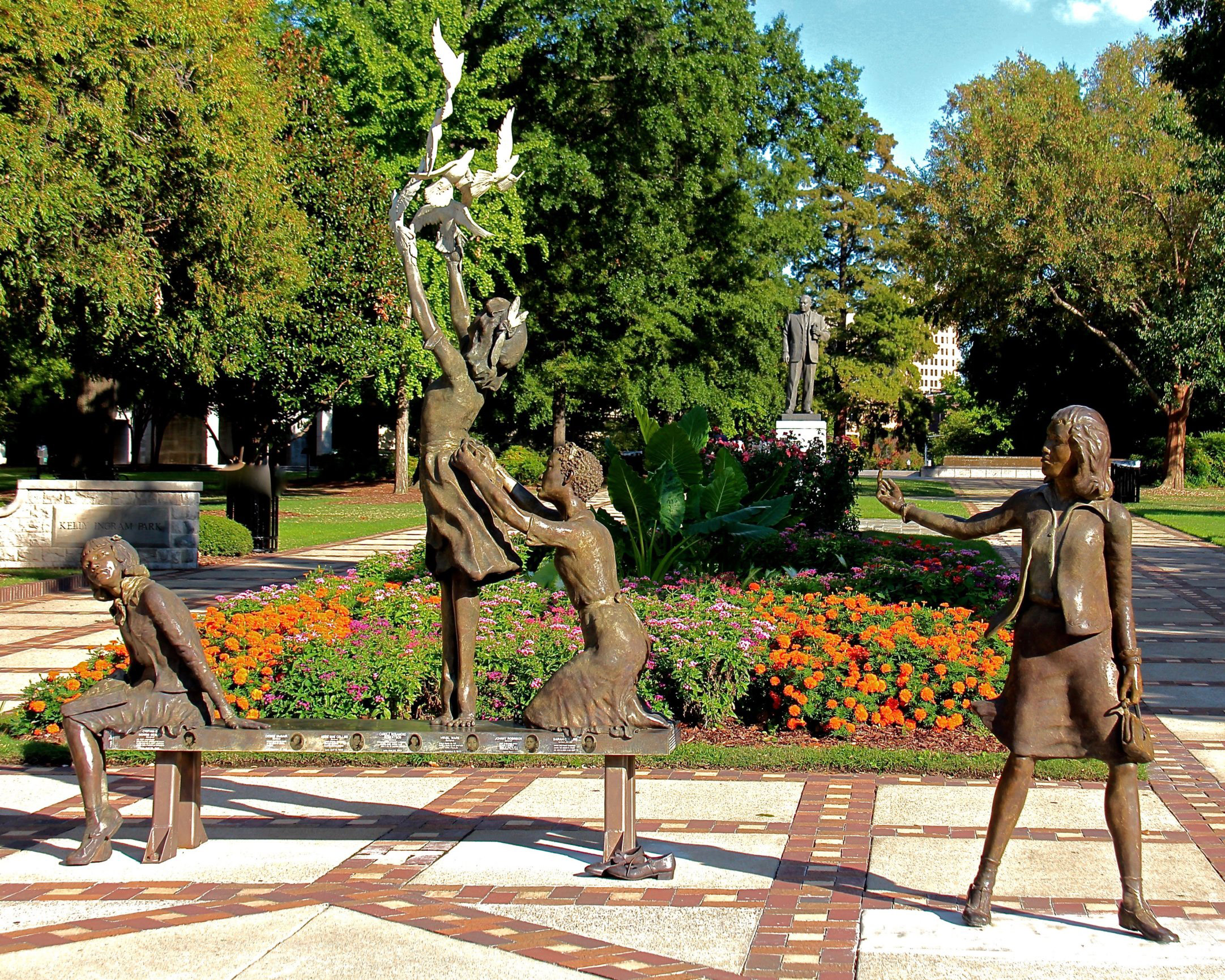
The public memorial for the children killed on September 15, 1963, sits across from the 16th Street Baptist Church in Birmingham, Alabama, at an entrance to Kelly Ingram Park.
 Gwen Dungy