My trove of handwritten journals was rich with details of day-to-day happenings and interactions. The feelings I had when I wrote them were memorialized in my heart and bones. Sometimes I had to take a break from reading them because the visceral reactions were more than I wanted to re-experience.
When I wrote my journals by hand, my engaged emotions helped me see my inner self—that soft place that needed protection. I didn’t judge myself for having unpleasant emotions. As I wrote about the interactions or situations that caused these emotions, I allowed myself to feel merciful toward the “me” that only I understood.
These journals showed me that believing in myself was the kind of faith inculcated within me since I was a very small child. During my middle years, I would have been completely lost without this bedrock faith. In my journals, I recorded how my beliefs in the greater good sustained me time after time.
It was in my handwritten journals that I thanked God for those I encountered who had a generosity of spirit and showed warmth when I needed it. It was in these handwritten journals that I was honest about my limitations and worked hard to be objective and fair in observing others and, more importantly, my responses to them. The real learning and change came from being wholly with myself in reflection and humbleness.
When I switched to keeping my journals online, apparently, I did not trust the medium with my deepest thoughts and tender feelings. For some reason I found myself not sharing my secret voice. In reading excerpts from my digital journals, it’s clear that I was not using them as a source of self-reflection. My journals became one dimensional. I recorded what can be thought of as a public record of what was happening and when.
My epiphany is that journaling is not simply the words recorded; it’s the meditation and process of writing one’s unselfconscious unfiltered thoughts and feelings.
I love the tiny lights and decorated trees of Christmas. Recently, I took a journey through Charles’ and my photos, looking at the various Christmas trees we had over the years.
I remember our first tree. My mother was visiting us from Chicago. Although the tree had few decorations and was small, it was beautiful because it was our first.
As we were admiring our tree, my mother asked, “Where is the angel or star that goes on top of the tree?” Without a word, Charles left the room and came back with a photo of me. He held the photo up to the top of the tree and said, “Here is the angel that will be on the top of our tree.”
That was the moment that my mother fell in love with Charles. From that point on, every time she was with us at Christmas, she recalled the time that Charles put my picture on top of the tree.
Over the years, our trees gradually improved in scale and beauty. Many of the ornaments were made by our son, Dan. Other ornaments were ones we collected through our travels. It always took hours to decorate the trees because we had to tell the story of the ornaments every time.
As much as I love seeing the trees, the photos that give me the greatest joy are the ones in which Dan is opening a gift that he really wanted and, from the surprise and joy in his reaction, he didn’t think he was going to receive. I think most of us cherish that precious moment when we have fulfilled someone else’s wish.
My hope is that you will have your wishes fulfilled, whether material or emotional, and you will experience the warmth and amazement of knowing that you have made someone else happy through the generosity of Christmas spirit.
In a series of posts, I’d like you to meet six Black Catholics from the 19th and 20th centuries on the road to sainthood in the global Catholic Church: Venerable Pierre Toussaint; Venerable Henriette DeLille; Venerable Augustus Tolton; Servant of God Mary Lange; Servant of God Julia Greeley; and Servant of God Thea Bowman. Ordinary people inspired by faith to serve the Common Good, they helped build and transform American Catholicism, advanced a democracy they couldn’t enjoy, and upheld Jesus’ commandment to “Love each other as I have loved you” (John 15:12).
Inspiration can be hard to find when celebrity and socioeconomic status define influence more often than character. But sainthood is an equalizer. Saints inspire people of all faiths or no faith. Saints are rarely sexy, beautiful, rich, or celebrated. They endure hardship, poverty, and social rejection. They sacrifice their bodies— sometimes literally, more often figuratively—to serve as agents of God’s righteousness and unconditional love. Saints don’t wear Chanel or Brioni but lift the spirit higher than a well-cut garment as they model essential elements of humanity: Love and Hope.
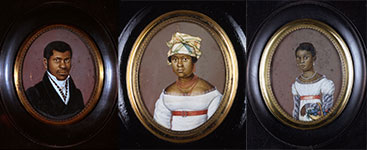
Pierre, Juliette, and Euphemia Toussaint as painted by Anthony Meucci, 1825
Venerable Pierre Toussaint (1766–1853) took his surname from the Haitian general Francois-Dominique Toussaint Louverture, a Black enslaved person turned enslaver turned slave liberator. Venerable Pierre Toussaint was trained as a house servant in his native Saint Domingue (Haiti). He was taught to read and write in French and English and had free reign of his enslavers’ library. Along with his sister Rosalie, his aunt, and two others, Toussaint arrived in New York in 1787, the property of Jacque Berard who had fled the Haitian rebellion with his family. Berard returned to Haiti to secure his property but died there of pleurisy in 1791, nearly destitute.
At the time, the United States was facing its first financial crisis. Although enslaved, hardship seemed to sharpen Toussaint’s resolve and entrepreneurialism. Apprenticed as a hairdresser, his success enabled him to support the Berard family and household, caring for Berard’s widow, Marie, until her death in 1807, after which he gained his freedom. Toussaint’s success also enabled him to purchase the freedom of his sister—whose daughter he would adopt upon Rosalie’s death—as well as the freedom of others who were enslaved. Among those was Juliette Noel, a Haitian woman Toussaint married in 1811. That same year he bought a house in Manhattan to shelter Black orphans and teach them trades.
Hairdressing was Toussaint’s profession, but his intellect, faith, and love for humanity established his character. In addition to working more than 12 hours a day dressing hair, followed by household chores and community service to feed the hungry and nurse the sick, Toussaint was a daily communicant of St. Peter’s Church on Barclay Street, attending Mass at 6:00 a.m. He served the public another 36 years after gaining his freedom and was known to quote from the Sermon on the Mount in French. “The Beatitudes seemed to have found a way into his heart,” wrote his first biographer.
Toussaint inspired all who knew or heard of him. His clients were elite society women. Among them the wife and daughter of Alexander Hamilton. They welcomed him into their estates, sought his counsel and admired his kindness, piety, and charitable works. Many were Protestant socialites like Mary Anna Sawyer Schuyler, a close friend who called him “my Saint Pierre.” Under their patronage, Toussaint earned as much as $1,000 a client annually at a time when the average annual salary was $65.
Pierre and Juliette Toussaint spread their philanthropy widely and diversely, creating a credit bureau and employment agency to help Black people and support the resettlement of Haitian immigrants to New York; founding the First New York City Catholic School for Black children; helping raise funds for Elizabeth Seton’s Sisters of Charity to open an orphanage in New York City even though it only served White children; funding the nation’s first religious order of Black nuns, the Oblate Sisters of Providence; providing aid for retired priests and destitute travelers; and contributing to the founding and building of St. Patrick’s Church that became St. Patrick’s Cathedral.
As his health failed with age, friends pressed the elderly Toussaint to retire and enjoy his success. He responded, “I have enough for myself, but if I stop working, I have not enough for others.” His last recorded words, two days before his death, were, “God is with me.” Asked if he wanted anything, he replied, “Not on this earth.”
Pierre Toussaint died at age 87, two years after his beloved Juliette. Friends and media praised this man defined by his faith, heart, and character and not external circumstances.
An act of racism once barred Toussaint from attending the St. Patrick’s Church he helped found. In a testament to God’s grace and remembrance of Toussaint’s servanthood, Cardinal John O’Connor arranged for Toussaint’s reinterment in 1959 to a vault under the altar of St. Patrick’s Cathedral on Fifth Avenue. He is the only layperson buried among bishops and cardinals.
Sources:George Washington’s Mount Vernon, Ten Facts About the American Economy in the 18th Century; Archdiocese of New York; Archways, the online Magazine of the Archdiocese of New York; Cathecist Cafe.
Joann Stevens is a freelance writer and program specialist promoting unsung and unknown African American jazz, faith, and cultural innovators who have influenced democracy and racial justice for the Common Good.
On May 2, 2000, I was running uncharacteristically late to a meeting with other higher education leaders in Washington, D.C. Our guest for the meeting was the Honorable Joseph R. Biden, Jr., then U.S. Senator from Delaware. Because I was late, instead of being seated in the conference room along with my colleagues waiting for our guest, I ended up in the elevator with Senator Biden and some of his staff on the way to the meeting.
As the elevator ascended, Senator Biden took the opportunity to chat with me, as he’s known to do. During the short exchange, he learned my name and the organization I was with. While some members of Congress might have ignored me and acted as if I were not breathing the same air as they were, then-Senator Biden did not pretend that I was invisible. He was letting me know that he could see a Black woman who was nobody special as far as he knew.
And it didn’t stop there. Once we were in the meeting, he addressed some of his comments to me and called me by name as if we had known one another for some time. What some might see as political charm on the part of a politician, I saw as a person so secure in his own space that he could afford to share some light with others.
The topic for discussion at our meeting was binge drinking among college students. To say that Senator Biden was passionate about decreasing binge drinking among college students is an understatement. He admitted that his “prohibitive approach might not be the way to go at all institutions.” However, he was no less insistent that a light be shined on what he saw as an issue that was “breeding a host of other problems.” He urged us as leaders in higher education to bring the problem to light and encourage college and university leaders to commit to finding ways to reduce binge drinking.
As I listened, I could see that he was willing to brandish a big stick to get results. In his appeal for cooperation, he communicated that he would rather that higher education take the lead on the issue and not allow it to become something requiring government intervention. However, the threat was there if colleges did not react immediately and effectively.
He didn’t leave the burden solely on higher education administrators, however, wanting to know what was needed from legislators to deal with the issue more effectively. In addition to assuring his support for providing colleges and universities with the resources and support needed to address the problem of binge drinking and its consequences, he appealed to the conscience of those responsible for educating our students.
Having intimated that there might be the threat of more government oversight and having offered a carrot for support, his final appeal was to denounce the lack of progress in curbing binge drinking as “moral disapprobation” on the part of college and university leadership.
For me and many others, when the morality bell tolls, we listen. As I’ve listened to speeches and remarks by President Biden I’ve come to believe that, when there is a situation in which the cooperation of others is needed to do what he considers to be the right thing, in the final appeal he will ring the bell for human decency and what he regards as being morally acceptable. This is the kind of leader I can respect and from whom I would expect nothing less. Who wouldn’t?


 Gwen Dungy