
Guest post by Joann Stevens
In a series of posts, I’d like you to meet six Black Catholics from the 19th and 20th centuries on the road to sainthood in the global Catholic Church: Venerable Pierre Toussaint; Venerable Henriette DeLille; Venerable Augustus Tolton; Servant of God Mary Lange; Servant of God Julia Greeley; and Servant of God Thea Bowman. Ordinary people inspired by faith to serve the Common Good, they helped build and transform American Catholicism, advanced a democracy they couldn’t enjoy, and upheld Jesus’ commandment to “Love each other as I have loved you” (John 15:12).
Inspiration can be hard to find when celebrity and socioeconomic status define influence more often than character. But sainthood is an equalizer. Saints inspire people of all faiths or no faith. Saints are rarely sexy, beautiful, rich, or celebrated. They endure hardship, poverty, and social rejection. They sacrifice their bodies— sometimes literally, more often figuratively—to serve as agents of God’s righteousness and unconditional love. Saints don’t wear Chanel or Brioni but lift the spirit higher than a well-cut garment as they model essential elements of humanity: Love and Hope.
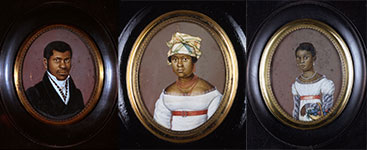
Venerable Pierre Toussaint (1766–1853) took his surname from the Haitian general Francois-Dominique Toussaint Louverture, a Black enslaved person turned enslaver turned slave liberator. Venerable Pierre Toussaint was trained as a house servant in his native Saint Domingue (Haiti). He was taught to read and write in French and English and had free reign of his enslavers’ library. Along with his sister Rosalie, his aunt, and two others, Toussaint arrived in New York in 1787, the property of Jacque Berard who had fled the Haitian rebellion with his family. Berard returned to Haiti to secure his property but died there of pleurisy in 1791, nearly destitute.
At the time, the United States was facing its first financial crisis. Although enslaved, hardship seemed to sharpen Toussaint’s resolve and entrepreneurialism. Apprenticed as a hairdresser, his success enabled him to support the Berard family and household, caring for Berard’s widow, Marie, until her death in 1807, after which he gained his freedom. Toussaint’s success also enabled him to purchase the freedom of his sister—whose daughter he would adopt upon Rosalie’s death—as well as the freedom of others who were enslaved. Among those was Juliette Noel, a Haitian woman Toussaint married in 1811. That same year he bought a house in Manhattan to shelter Black orphans and teach them trades.
Hairdressing was Toussaint’s profession, but his intellect, faith, and love for humanity established his character. In addition to working more than 12 hours a day dressing hair, followed by household chores and community service to feed the hungry and nurse the sick, Toussaint was a daily communicant of St. Peter’s Church on Barclay Street, attending Mass at 6:00 a.m. He served the public another 36 years after gaining his freedom and was known to quote from the Sermon on the Mount in French. “The Beatitudes seemed to have found a way into his heart,” wrote his first biographer.
Toussaint inspired all who knew or heard of him. His clients were elite society women. Among them the wife and daughter of Alexander Hamilton. They welcomed him into their estates, sought his counsel and admired his kindness, piety, and charitable works. Many were Protestant socialites like Mary Anna Sawyer Schuyler, a close friend who called him “my Saint Pierre.” Under their patronage, Toussaint earned as much as $1,000 a client annually at a time when the average annual salary was $65.
Pierre and Juliette Toussaint spread their philanthropy widely and diversely, creating a credit bureau and employment agency to help Black people and support the resettlement of Haitian immigrants to New York; founding the First New York City Catholic School for Black children; helping raise funds for Elizabeth Seton’s Sisters of Charity to open an orphanage in New York City even though it only served White children; funding the nation’s first religious order of Black nuns, the Oblate Sisters of Providence; providing aid for retired priests and destitute travelers; and contributing to the founding and building of St. Patrick’s Church that became St. Patrick’s Cathedral.
As his health failed with age, friends pressed the elderly Toussaint to retire and enjoy his success. He responded, “I have enough for myself, but if I stop working, I have not enough for others.” His last recorded words, two days before his death, were, “God is with me.” Asked if he wanted anything, he replied, “Not on this earth.”
Pierre Toussaint died at age 87, two years after his beloved Juliette. Friends and media praised this man defined by his faith, heart, and character and not external circumstances.
An act of racism once barred Toussaint from attending the St. Patrick’s Church he helped found. In a testament to God’s grace and remembrance of Toussaint’s servanthood, Cardinal John O’Connor arranged for Toussaint’s reinterment in 1959 to a vault under the altar of St. Patrick’s Cathedral on Fifth Avenue. He is the only layperson buried among bishops and cardinals.
Sources: George Washington’s Mount Vernon, Ten Facts About the American Economy in the 18th Century; Archdiocese of New York; Archways, the online Magazine of the Archdiocese of New York; Cathecist Cafe.
Joann Stevens is a freelance writer and program specialist promoting unsung and unknown African American jazz, faith, and cultural innovators who have influenced democracy and racial justice for the Common Good.
 Gwen Dungy