Monthly Archives: January 2024

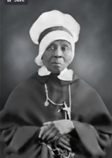
The Inspirational Six, Part 2: Venerable Mary Lange

Guest post by Joann Stevens
(View Part 1 of the series: Venerable Pierre Toussaint)

What is it about the lives of overcomers that inspire awe, even action?  

Learning about the four African American women among the six on the road to sainthood in the Catholic Church, I was in awe of their resistance to personal trials or societal turmoil dampening their faith, or defeating or defining their work to build a multicultural society and Church of love and hope. The women will be presented in chronological order over the coming weeks, concluding with Sr. Thea Bowman, whose evangelism I was privileged to witness at a revival service in Washington, D.C.

Four Women, composed by jazz pianist and singer Nina Simone, narrates trials of colorism and enslavement faced by women.  The stories of the four women on the road to sainthood show us the power of  love and hope as we strive to live and serve Christ in what the U.S. Conference of Catholic Bishops called “…a genuine conversion of heart, a conversion that will compel change and the reform of our institutions and society,” in its 2018 pastoral letter, “Open Wide Our Hearts.”


Venerable Mary Lange

Venerable Mary Lange (1784–1882) immigrated to the United States in the midst of American slavery to achieve the seemingly impossible. In 1818, she and a friend opened a home school to teach Black children in Baltimore. At the time, the city was home to some 1,500 French-speaking Haitian refugees—500 of them Black—fleeing social conflicts in Haiti and France. As a border state, Maryland neither prohibited nor encouraged educating Black children.

The women suffered many indignities, ranging from public insult to Catholic parishes refusing to let them receive communion as they pursued their mission. Lange took in washing to support Saint Frances Academy, which officially became the first Catholic school for Black children in the United States in 1828. The following year, the Oblate Sisters of Providence, the religious order Lange founded, became “the first successful Roman Catholic sisterhood in the world established by women of African descent,” according to Oblate history.  Nearly 200 years later, Mother Lange’s educational and spiritual legacy continues in Baltimore.

Born Elizabeth C. Lange in either Santiago de Cuba or Saint-Domingue, Lange was a French-speaking Creole woman whose plantation owner grandfather, Mardoche Lange, sent his family to Cuba to escape the Haitian Revolution. She once described herself as “French to my soul,” and allegedly immigrated to the United States in resistance to an 1808 law requiring non-Spanish residents of Cuba to make a loyalty oath to the Spanish king.

Most importantly, Lange rejected justifications for slavery made by some Catholic priests and church leaders who sought to appease wealthy White donors.  She knew slavery was wrong and believed keys to Black liberation included spiritual and academic education.  Seeking a White man in America who shared her beliefs, Lange found Father James Hector Nicholas Joubert, a Sulpician order priest and former French soldier and expat from Haiti who became an advocate and spiritual advisor until his death. 

Mother Lange taught at Saint Frances Academy, served as housekeeper to the Sulpician Seminary, extended education to Black adults before and after the Civil War, and managed to overcome social violence and poverty right up until her death. Help always seemed to arrive providentially in the nick of time.

On January 30, during Catholic Schools Week, the Archdiocese of Baltimore will hold a Mass to celebrate Lange’s elevation to Venerable.


(Sources: Elizabeth Clovis Lange, c 1784-1882, Black Religious Leader, by Elaine G. Breslaw and Joan A. Andersen, in Notable Maryland Women; Maryland’s Women Hall of Fame , Maryland State Archives). 


Joann Stevens is a freelance writer and program specialist promoting unsung and unknown African American jazz, faith, and cultural innovators who have influenced democracy and racial justice for the Common Good.

(Read next post: Venerable Henriette DeLille and Servant of God Julia Greeley)

Where Do We Go From Here?

Guest post by Kaaryn McCall

As we start a new year, particularly this new year, it is perhaps good to ask, “Where do we go from here?” The Rev. Dr. Martin Luther King, Jr., began bringing his 1967 Southern Christian Leadership Conference address by that title to a close with the following words we would do well to heed today:

“The road ahead will not always be smooth. There will still be rocky places of frustration and meandering points of bewilderment. There will be inevitable setbacks here and there. And there will be those moments when the buoyancy of hope will be transformed into the fatigue of despair…. But difficult and painful as it is, we must walk on in the days ahead with an audacious faith in the future.”

King’s book of that same title that year was aptly subtitled with the question “Chaos or Community?” This is a choice with which we are always faced and, as we enter 2024 that is, among other things, a presidential election year, and as we near the nation’s 250th anniversary even as some talk of the possibility of a second civil war, I, for one, choose community.

Too often, this can seem like an amorphous concept, so it’s helpful to understand the Beloved Community that was King’s ultimate aim, as reflected in remarks as early as 1956, following the Montgomery Bus Boycott: “The end is reconciliation; the end is redemption; the end is the creation of the Beloved Community.”*

From the religious perspective, King saw Beloved Community as the wholly achievable goal of realizing the kingdom of God on earth, “in which all human beings ha[ve] value in and of themselves, and [a]re subjects worthy of love.” This restored community is the ideal of creation—God’s intention for all of humanity living together in an “inescapable network of mutuality.”

Perhaps more concretely, and from a more universal perspective, this Beloved Community is one in which:

“poverty, hunger and homelessness will not be tolerated because international standards of human decency will not allow it. Racism and all forms of discrimination, bigotry and prejudice will be replaced by an all-inclusive spirit of sisterhood and brotherhood…. Love and trust will triumph over fear and hatred. Peace with justice will prevail over war and military conflict.”*

Achieving such community requires transformation on many levels. In his further remarks following the bus boycott, King noted, “It is this type of spirit and this type of love that can transform opponents into friends. It is this type of understanding goodwill that will transform the deep gloom of the old age into the exuberant gladness of the new age.*

It is important to note that King did not believe Beloved Community would be devoid of conflicts, but that these could always be resolved peacefully,* noting that “true peace is not merely the absence of tension [but] the presence of justice.”

silhouette of the Rev Dr Martin Luther King Jr with the words "BUILDING THE BELOVED COMMUNITY" and a colorful illustration with many components, including a river, trees, hearts, stars, hands, people, rainbow, and various decorative elements

So, “Where do we go from here?”

In a world increasingly divided, let us seek to build increasing levels of trust across difference.

In a world increasingly concerned with domestic and international terrorism, let us embrace the fact that “love [is the] most potent instrument available in humanity’s quest for peace and security.”

In a world increasingly complex and intertwined, let us seek to understand the “enemy-neighbor” as more than a given action on their part.

In a world where prejudices continue to manifest themselves, let us seek a true conception of self instead of “self-deception and … neurosis stemming from repressed truth.”

In a world of zero-sum games, let us demonstrate that there is no need to fear one’s own loss when advocating for justice. (As a popular meme puts it, “Equal rights for others does not mean fewer rights for you. It’s not pie.”)

In a world still plagued with brokenness, separation, suspicion, and deadly conflicts, let us find our points of commonality and shared humanity.

The choice between chaos and community remains for each of us individually and collectively. May this new year and MLK Day be about more than just platitudes. Let us answer the call to action and walk on together not in blind optimism, but an intentional hope and “audacious faith in the future.” Let us not fall into despair as a few loud voices are amplified across various media but recall how far we have come and set forth with renewed purpose to building Beloved Community.


SOURCES

† Hunt, C. Anthony. The Beloved Community Toolkit.

‡ Hunt, C. Anthony. Blessed are the Peacemakers: A Theological Analysis of the Thought of Howard Thurman and Martin Luther King, Jr. Lima, OH: Wyndham Hall Press, 2005.

* The King Center. “The King Philosophy.” thekingcenter.org/king-philosophy


Kaaryn McCall is a communications consultant who, in addition to supporting Dr. Dungy, works with nonprofit organizations across the social justice spectrum to most effectively leverage strategic communications to support their missions. Connect on LinkedIn

Attuning to Ourselves

I wasn’t feeling well and was tempted to stay in bed. By force of habit, I pushed myself to get up and get on with what I had scheduled for the morning, and that included some strenuous exercise. I completed the full hour of the exercise and was whipped at the end.

Usually, I would push myself to move immediately on to what was next on my schedule. But on this day, I took notice of the row of new comfortable-looking black leather chairs outside the space where I had been exercising. No one was sitting on the chairs, probably because—like me—no one understood why they were there and if it was alright to sit on them.  

black armchair in reclined position

I decided to sit on one of the chairs and adjust the back and footrest to my most comfortable position. I relaxed as if I were at home. People who passed looked at me curiously before rushing by to do their exercise routines. As I relaxed and watched people stress themselves with all types of exercises, I began to think about how we are unable to attune to ourselves if we’re in such a rush moving rapidly from one activity to another.  

As I became more relaxed and continued to observe, I wondered how any of us might respond to the question: What would you do today if you knew that today was your last day?

My habit at the beginning of a new calendar year has been to repeat and believe that “the best is yet to come.” I still believe this, but I might behave differently by doing more of what I think I would do if I knew it were my last day.