
Guest post by Joann Stevens
(View Part 1 of the series: Venerable Pierre Toussaint)
What is it about the lives of overcomers that inspire awe, even action?
Learning about the four African American women among the six on the road to sainthood in the Catholic Church, I was in awe of their resistance to personal trials or societal turmoil dampening their faith, or defeating or defining their work to build a multicultural society and Church of love and hope. The women will be presented in chronological order over the coming weeks, concluding with Sr. Thea Bowman, whose evangelism I was privileged to witness at a revival service in Washington, D.C.
Four Women, composed by jazz pianist and singer Nina Simone, narrates trials of colorism and enslavement faced by women. The stories of the four women on the road to sainthood show us the power of love and hope as we strive to live and serve Christ in what the U.S. Conference of Catholic Bishops called “…a genuine conversion of heart, a conversion that will compel change and the reform of our institutions and society,” in its 2018 pastoral letter, “Open Wide Our Hearts.”
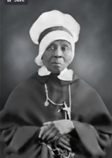
Venerable Mary Lange (1784–1882) immigrated to the United States in the midst of American slavery to achieve the seemingly impossible. In 1818, she and a friend opened a home school to teach Black children in Baltimore. At the time, the city was home to some 1,500 French-speaking Haitian refugees—500 of them Black—fleeing social conflicts in Haiti and France. As a border state, Maryland neither prohibited nor encouraged educating Black children.
The women suffered many indignities, ranging from public insult to Catholic parishes refusing to let them receive communion as they pursued their mission. Lange took in washing to support Saint Frances Academy, which officially became the first Catholic school for Black children in the United States in 1828. The following year, the Oblate Sisters of Providence, the religious order Lange founded, became “the first successful Roman Catholic sisterhood in the world established by women of African descent,” according to Oblate history. Nearly 200 years later, Mother Lange’s educational and spiritual legacy continues in Baltimore.
Born Elizabeth C. Lange in either Santiago de Cuba or Saint-Domingue, Lange was a French-speaking Creole woman whose plantation owner grandfather, Mardoche Lange, sent his family to Cuba to escape the Haitian Revolution. She once described herself as “French to my soul,” and allegedly immigrated to the United States in resistance to an 1808 law requiring non-Spanish residents of Cuba to make a loyalty oath to the Spanish king.
Most importantly, Lange rejected justifications for slavery made by some Catholic priests and church leaders who sought to appease wealthy White donors. She knew slavery was wrong and believed keys to Black liberation included spiritual and academic education. Seeking a White man in America who shared her beliefs, Lange found Father James Hector Nicholas Joubert, a Sulpician order priest and former French soldier and expat from Haiti who became an advocate and spiritual advisor until his death.
Mother Lange taught at Saint Frances Academy, served as housekeeper to the Sulpician Seminary, extended education to Black adults before and after the Civil War, and managed to overcome social violence and poverty right up until her death. Help always seemed to arrive providentially in the nick of time.
On January 30, during Catholic Schools Week, the Archdiocese of Baltimore will hold a Mass to celebrate Lange’s elevation to Venerable.
(Sources: Elizabeth Clovis Lange, c 1784-1882, Black Religious Leader, by Elaine G. Breslaw and Joan A. Andersen, in Notable Maryland Women; Maryland’s Women Hall of Fame , Maryland State Archives).
Joann Stevens is a freelance writer and program specialist promoting unsung and unknown African American jazz, faith, and cultural innovators who have influenced democracy and racial justice for the Common Good.
(Read next post: Venerable Henriette DeLille and Servant of God Julia Greeley)
 Gwen Dungy
Pingback: The Inspirational Six, Part 3: Venerable Henriette DeLille and Servant of God Julia Greeley | Gwen Dungy