
Monthly Archives: March 2024

At the Right Place at the Right Time

It doesn’t take a retrospective view for me to know that I’ve often been at the right place at the right time. I thought of this recently when I was concerned about having enough time to get across town for an appointment. As it turned out, I was lucky that I had not gotten on the highway when planned because I would have just been stuck in traffic until a disabled vehicle blocking the ramp at my exit was removed. A small thing, but I was where I was supposed to be at the right time. I was taking care of my prior business rather than sitting in traffic waiting to exit the highway.

These days, even when small plans don’t turn out just the way I intended, I stop to search for and acknowledge the good that comes from being in that place at that time. I have found that attempting to force things to happen the way I want them to at the time I want them to happen often leads to undue frustration and regret. Allowing the unexpected to reveal the prize inside has been one of the most important lessons I’ve learned and one of the many joys of my life.

In my youth and adolescent years, when I had little control over my care and conditions, I now know that the circumstances that prevailed during these times instilled in me the desire to push harder and the resilience to reach higher. Role models—both positive and negative—provided examples I needed in order to become a caring and responsible adult. The years of wanting to be in some other place with different people and longing to be anybody but myself instilled within me the kind of empathy that has become a lifelong value. Although I didn’t think it then, I now know I needed to be in those places during those times.

When I think about the jobs I have had during my long career, it is evident to me that opportunities were realized when the time was right and I was ripe for the position. Graduating from college with a bachelor’s degree in English and a master’s degree in counseling, I was not optimistic about my chances of a full-time job doing what I wanted to do. I had no desire to teach after a negative experience as a student teacher. I desperately wanted to be a counselor and knew this would be the right career for me.

After three years of teaching, one of the counselors in the high school where I was teaching went on maternity leave and I was asked to take the role during her absence. Getting out of the classroom and into the counseling office was a “sweet Jesus” moment for me. I felt ready for the role of counselor. I knew that I was at the right place at the right time.

As it turned out, this short stint in the role of counselor opened the door for my next position. Moving to a new city to support my husband’s desire to get his MBA, I had no prospects for a job as a counselor.

As luck would have it, the local community college was less than ten minutes from our house. As I’m remembering it now, it was a Saturday, and I may have been out running errands. On a whim, I drove to the college, walked into the administration building and asked the front desk if there was anyone in the counseling office.

I was directed to the second floor of the administration building. The only person in the office was the Director of Counseling. I explained that I was new in town and was curious about community college counseling since I had a degree in counseling. The Director and I had a nice conversation and during our conversation the Director let me know that he was looking to hire a counselor and I should consider applying for the position.

I served as a counselor at this community college for the next ten years. There is no doubt that I was at the right place at the right time.

I think many of us have these same moments. For me, these moments are precious gifts for which I’m always very thankful.
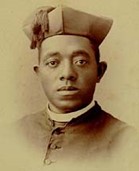
The Inspirational Six, Final Post: Venerable Augustus Tolton

Guest post by Joann Stevens
(Read previous post on Servant of God Sister Thea Bowman)

How does it feel to be “Black and Blue,” traumatized daily by enslavement or racism? A response emerged in the 1929 song, “Black and Blue,” composed by jazz pianist “Fats” Waller, with lyrics by Harry Brooks and Andy Razaf. This song offers a snippet of what 19th-century America was like for Venerable Father Augustus Tolton, one of six African Americans now on the road to sainthood.

Fr. Augustus Tolton

Augustus Tolton (1854–1897) was born into slavery in Bush Creek, Missouri, to Martha and Peter Paul Tolton. The Toltons were married, baptized Catholics enslaved on neighboring Catholic plantations. Peter Paul Tolton escaped to join the Union Army during the Civil War and died in a hospital. Martha Tolton escaped with her children to Quincy, Illinois, in 1862. She was helped by Union soldiers as she paddled a rowboat across the Mississippi River, with bullets from Confederate soldiers splashing the water.

The first Catholic parish the family attended consisted largely of German immigrants. Many scorned the Black family’s presence. In 1865, when Augustus Tolton entered the parish’s St. Boniface School, he was forced to leave a month later due to unrelenting threats to the parish and school from children and adults.

When the family moved to St. Peter Parish, benevolent priests and nuns taught and protected Tolton as he attended St. Peter School when not working to help support his family.

Recognizing his academic and spiritual gifts, he was allowed to instruct Black children in religious education. At age 16, Tolton felt called to the priesthood. Although tutored for entrance into the priesthood, when he graduated at age 18 from St. Peter School, no Catholic seminary in the United States would accept Tolton because of his race. His mentors worked relentlessly to find him a place.

In 1880, at the age of 26, Tolton departed for Rome to enter the Collegium Urbanum de Propaganda Fide to become a missionary priest to Africa. Proficient in languages, Tolton learned Latin, German, Greek, and Italian. After six years of study, he was to be ordained on April 24, 1886, ready for Africa.

On the night before his ordination, Tolton was summoned by his mentor Cardinal Giovanni Simeoni, prefect for the Vatican Congregation for the Propagation of the Faith.

“America has been called the most enlightened nation,” the cardinal told him. “We will see if it deserves that honor. If America has never seen a Black priest, it has to see one now. Can you drink from this cup?”

“Yes, I can” Tolton replied in Latin. He was being sent to St. Joseph Church, a Black parish in his hometown of Quincy, Illinois.

Black Catholics in Quincy were overjoyed. Father Tolton also won the respect of Irish and German Catholics who crossed the color line to hear his inspiring sermons, teaching, and wonderful singing voice.

But in his first two years, unrelenting harassment came from Catholic priests and even Protestant ministers threatened by his popularity, especially with White churchgoers supporting Father Tolton’s church financially.

Pressure intensified until Father Tolton was forced out of Quincy to the diocese of Chicago, where he was assigned to a poor, struggling Black Catholic parish on the south end.

The pressures did not stop as Father Tolton worked tirelessly to move St. Monica Church from borrowed space in a church basement to a storefront. Financial support from Mother Katharine Drexel (later canonized as a saint) helped build St. Monica Church and school.

Father Tolton would later write in a letter to Drexel, “I shall work and pull at it as long as God gives me life, for I am beginning to see that I have powers and principalities to resist anywhere and everywhere I go.”

He spoke throughout the nation, and officiated at the first National Black Catholic Conference held January 1–4, 1889, in Washington, DC, where Father Tolton and delegates met with President Grover Cleveland.

Reviewing the life and cause of Venerable Augustus Tolton, I wondered how a Millennial might view this saint-to-be. I found my answer speaking to Stefanie Miles, a Venerable Father Augustus Tolton Ambassador in Washington, DC.

Tolton’s appeal for Miles doesn’t come from the almost mythical stories about his faith, endurance, and prodigious intellect, but from his Christ-centered humanity and spirituality.

After nearly a decade as an ambassador, Miles still wonders how Tolton trusted God and submitted to his destiny under the unrelenting societal and personal pressures he faced daily. Connecting with that, she said, gives her—and can give others—a spiritual role model to help address human frailties while building a closer relationship with God.

“I identify myself with the human side of his life,” Miles said. “We may not have had the same struggles, but we struggled all the same. I want people to identify with his actual human story. I want people to understand where he came from as a person.”

Miles became an ambassador in 2015, after being “volun-told” to join the group by family elders. “I just went with the process,” she said, glad now that she did.

Early on, Miles learned what she calls “Disney” or “CliffsNotes” versions of the life of the man recognized as the nation’s first African American Catholic priest. Growing closer to him, she began to learn and feel his heart and wounds.

“He literally worked himself to death,” Miles said of Father Tolton, who at the age of 43, collapsed from heat stroke while walking home from the train station during a Chicago heat wave and later died.

“I have a lot of friends who are priests,” Miles continued. “We have to take care of them, especially African American priests who often lack resources. People are constantly pulling at them, as they did with Jesus, saying ‘help me, heal me!’”

Miles said she can imagine the stress and inner doubts Father Tolton must have felt throughout his life, before and after he became a priest, for it is a burden shouldered by many youth today.

“Look we’ve got to make our mark in the church,” she said. “The older generation needs to step aside, but not just drop us as we try to find our way” to accept church leadership roles, and even question and leave the church for awhile, if necessary.

“The younger generation also needs to step up,” and even discern if they are being called to a religious vocation.

Miles says Father Tolton has re-ignited her interest in studying languages, and deepened her reverence for Catholic practices that he loved and said empowered him, such as Adoration and the Eucharist.

“We need role models.” And for Miles that’s Venerable Augustus Tolton.

.     .     .

Sources

Additional Resources


Joann Stevens is a freelance writer and program specialist promoting unsung and unknown African American jazz, faith, and cultural innovators who have influenced democracy and racial justice for the Common Good.

Ahead of Her Time

Anna Julia Cooper

Anna Julia Cooper (1858–1964) put no limits on the intellectual potential of Black people, Black women in particular. Her own intellectual and educational achievements are a testament to her firm belief that women’s opportunities for learning and education should not be less than or different than men based on assumptions about women’s capabilities.

 I’m particularly drawn to the life of Anna Julia Cooper because she did it all: was a leading Black spokeswoman; held leadership in women’s organizations; founded the first chapter of the YWCA Camp Fire Girls for Black girls; served as principal and teacher in the “renowned Dunbar High School in Washington, DC;” started a night school for working people to attend college; and authored a seminal book on Black feminism, A Voice from the South.

Even as she focused her energy and attention on cultivating the potential of marginalized people, she also continued to work on her own education. In 1924, Cooper received her Ph.D. from the University of Paris, becoming only the fourth Black woman in the United States to earn a doctorate degree.

Despite these extraordinary accomplishments of a Black woman born in the South and formerly a slave, what captivates me most about Dr. Cooper is that she didn’t seek attention. Dr. Paul Cooke, one of her biographers, wrote that she chose the “lesser light.”

She was dedicated to a larger cause than herself and refrained from crediting her own achievements. An example of Dr. Cooper’s humility is what Dr. Mary Helen Washington shared in her Introduction to Cooper’s Book in the Shomburg Library Collection of Nineteenth-Century Black Women Writers.

“In 1982, when Louise Hutchinson, staff historian at the Smithsonian Institution, completed her biography of Cooper, she called for an official Smithsonian car and hand-delivered the copy of the biography to Mrs. Regia Haywood Bronson, the eldest of the five children Anna Cooper had adopted in 1915.

“Then in her late seventies, Mrs. Bronson took the book from Hutchinson, and holding it to her breast, she rocked back and forth with tears streaming down her face, but not saying a word. When Hutchinson asked her why she was crying, Bronson said, ‘Nobody ever told me Sis Annie was important.’”

Yes, Anna Julia Cooper was important, indeed, in advocating for social justice and equality of rights for all people and the education of Black women, in particular.  

Living to be 105 years old, she lived to see a celebration of Black History Month and Women’s History Month. She would have been pleased to see the theme of the 2024 Women’s History Month—Women Who Advocate for Equity, Diversity, and Inclusion.

Sources:

Anna Julia Cooper Project: cooperproject.org/about-anna-julia-cooper

Introduction in the Schomburg Library Collection of Nineteenth-Century Black Women Writers: Cooper, Anna Julia. A Voice From the South. (United Kingdom: Oxford University Press, 1988).