
Guest post by Joann Stevens
(Read previous post on Servant of God Sister Thea Bowman)
How does it feel to be “Black and Blue,” traumatized daily by enslavement or racism? A response emerged in the 1929 song, “Black and Blue,” composed by jazz pianist “Fats” Waller, with lyrics by Harry Brooks and Andy Razaf. This song offers a snippet of what 19th-century America was like for Venerable Father Augustus Tolton, one of six African Americans now on the road to sainthood.
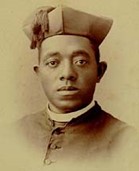
Augustus Tolton (1854–1897) was born into slavery in Bush Creek, Missouri, to Martha and Peter Paul Tolton. The Toltons were married, baptized Catholics enslaved on neighboring Catholic plantations. Peter Paul Tolton escaped to join the Union Army during the Civil War and died in a hospital. Martha Tolton escaped with her children to Quincy, Illinois, in 1862. She was helped by Union soldiers as she paddled a rowboat across the Mississippi River, with bullets from Confederate soldiers splashing the water.
The first Catholic parish the family attended consisted largely of German immigrants. Many scorned the Black family’s presence. In 1865, when Augustus Tolton entered the parish’s St. Boniface School, he was forced to leave a month later due to unrelenting threats to the parish and school from children and adults.
When the family moved to St. Peter Parish, benevolent priests and nuns taught and protected Tolton as he attended St. Peter School when not working to help support his family.
Recognizing his academic and spiritual gifts, he was allowed to instruct Black children in religious education. At age 16, Tolton felt called to the priesthood. Although tutored for entrance into the priesthood, when he graduated at age 18 from St. Peter School, no Catholic seminary in the United States would accept Tolton because of his race. His mentors worked relentlessly to find him a place.
In 1880, at the age of 26, Tolton departed for Rome to enter the Collegium Urbanum de Propaganda Fide to become a missionary priest to Africa. Proficient in languages, Tolton learned Latin, German, Greek, and Italian. After six years of study, he was to be ordained on April 24, 1886, ready for Africa.
On the night before his ordination, Tolton was summoned by his mentor Cardinal Giovanni Simeoni, prefect for the Vatican Congregation for the Propagation of the Faith.
“America has been called the most enlightened nation,” the cardinal told him. “We will see if it deserves that honor. If America has never seen a Black priest, it has to see one now. Can you drink from this cup?”
“Yes, I can” Tolton replied in Latin. He was being sent to St. Joseph Church, a Black parish in his hometown of Quincy, Illinois.
Black Catholics in Quincy were overjoyed. Father Tolton also won the respect of Irish and German Catholics who crossed the color line to hear his inspiring sermons, teaching, and wonderful singing voice.
But in his first two years, unrelenting harassment came from Catholic priests and even Protestant ministers threatened by his popularity, especially with White churchgoers supporting Father Tolton’s church financially.
Pressure intensified until Father Tolton was forced out of Quincy to the diocese of Chicago, where he was assigned to a poor, struggling Black Catholic parish on the south end.
The pressures did not stop as Father Tolton worked tirelessly to move St. Monica Church from borrowed space in a church basement to a storefront. Financial support from Mother Katharine Drexel (later canonized as a saint) helped build St. Monica Church and school.
Father Tolton would later write in a letter to Drexel, “I shall work and pull at it as long as God gives me life, for I am beginning to see that I have powers and principalities to resist anywhere and everywhere I go.”
He spoke throughout the nation, and officiated at the first National Black Catholic Conference held January 1–4, 1889, in Washington, DC, where Father Tolton and delegates met with President Grover Cleveland.
Reviewing the life and cause of Venerable Augustus Tolton, I wondered how a Millennial might view this saint-to-be. I found my answer speaking to Stefanie Miles, a Venerable Father Augustus Tolton Ambassador in Washington, DC.
Tolton’s appeal for Miles doesn’t come from the almost mythical stories about his faith, endurance, and prodigious intellect, but from his Christ-centered humanity and spirituality.
After nearly a decade as an ambassador, Miles still wonders how Tolton trusted God and submitted to his destiny under the unrelenting societal and personal pressures he faced daily. Connecting with that, she said, gives her—and can give others—a spiritual role model to help address human frailties while building a closer relationship with God.
“I identify myself with the human side of his life,” Miles said. “We may not have had the same struggles, but we struggled all the same. I want people to identify with his actual human story. I want people to understand where he came from as a person.”
Miles became an ambassador in 2015, after being “volun-told” to join the group by family elders. “I just went with the process,” she said, glad now that she did.
Early on, Miles learned what she calls “Disney” or “CliffsNotes” versions of the life of the man recognized as the nation’s first African American Catholic priest. Growing closer to him, she began to learn and feel his heart and wounds.
“He literally worked himself to death,” Miles said of Father Tolton, who at the age of 43, collapsed from heat stroke while walking home from the train station during a Chicago heat wave and later died.
“I have a lot of friends who are priests,” Miles continued. “We have to take care of them, especially African American priests who often lack resources. People are constantly pulling at them, as they did with Jesus, saying ‘help me, heal me!’”
Miles said she can imagine the stress and inner doubts Father Tolton must have felt throughout his life, before and after he became a priest, for it is a burden shouldered by many youth today.
“Look we’ve got to make our mark in the church,” she said. “The older generation needs to step aside, but not just drop us as we try to find our way” to accept church leadership roles, and even question and leave the church for awhile, if necessary.
“The younger generation also needs to step up,” and even discern if they are being called to a religious vocation.
Miles says Father Tolton has re-ignited her interest in studying languages, and deepened her reverence for Catholic practices that he loved and said empowered him, such as Adoration and the Eucharist.
“We need role models.” And for Miles that’s Venerable Augustus Tolton.
. . .
Sources
- Braxton, Ph.D., S.T.D., The Most Reverend Bishop Edward K. “A Saint For Our Time: A Lenten Reflection The Servant Of God Father Augustus Tolton (1854-1897).” Diocese of Belleville. March 8, 2011.
- Perry, Bishop Joseph N. “About Fr. Augustus Tolton.” Archdiocese of Chicago. n.d. (Explore the Archdiocese’s full Tolton website at tolton.archchicago.org)
- Smith, Peter Jesserer. “Venerable Augustus Tolton Puts Focus on Black Catholic Insight Into Holiness.” National Catholic Register. July 13, 2019.
- White. C. Vanessa. “Augustus Tolton: Pioneer pastor.” U.S. Catholic. February 14, 2014.
Additional Resources
- Tolton Spirituality Center
- Venerable Fr. Augustus Tolton Ambassadors, Washington, DC. Facebook Page.
Joann Stevens is a freelance writer and program specialist promoting unsung and unknown African American jazz, faith, and cultural innovators who have influenced democracy and racial justice for the Common Good.
 Gwen Dungy