Author Archives: gwendungy

Increasing Capacity to Cope

Monday, September 17, 1996

“The emerging health challenges of the twenty-first century will be novel viruses. We need to begin to build people’s capacity to cope.”

Richard Keeling, MD

(In a NASPA meeting about how to promote HIV/AIDS prevention as an issue of overall health and wellness at colleges and universities.)

Reflections on Thanksgivings Past

Thanksgiving was the time when Charles and I were most giving of our hospitality and love. There was always someone to invite to share the holiday meal with us. It was a most joyous and exhausting time. Both of us had demanding jobs that left little time to clean the house, shop for groceries, and prepare the food. As a result of our anxiety about pulling everything together, we’d always get crosswise with one another about some little thing or another during these hectic times.

We always prepared Thanksgiving dinner staples, along with any new, experimental dishes. The staples included ham, turkey, broccoli cheese casserole, green beans, potato salad, corn bread dressing, and sweet potato and pecan pies. At some point, the ham disappeared altogether, the store-bought rolls were replaced by my attempt to duplicate Larry’s squash rolls, and the canned cranberry sauce gave way to cranberry apple relish (which eventually ceded the spot back to the canned cranberry sauce).

Our happiest times were when we had to add the card table and chairs to the end of our long dining room table in order to accommodate our Thanksgiving family of friends. No matter how late the dinner ended and friends departed or stayed overnight, Charles and I would clear all the dishes and put everything back in order. We loved this time together to laugh about how silly we were when we got cross with one another, and discuss how well we thought the celebration was received.

I will be forever grateful for the opportunities we had to express our love for others and for one another. It was during these times that we knew that we were truly blessed and made for one another.

I talked with Mother today…

Tuesday, November 8, 1994

I talked with Mother today.

When I asked her how she was doing, she said, “Same old, same old. A man was breaking into the apartment and my German Shepherd bit him. I gave the guy $20.”  

Down to Mike’s

We lived on the West Side of Chicago on a street that was only one short block. It was a nice street with well-kept buildings all owned by Black families. Our building was the tallest on the street with three floors and a basement. Before we moved in, each of the floors was divided into two apartments for maximum profit.

That changed when we moved in. Instead of profits, we were “house poor” because we converted the six small apartments into three large ones. Two of the apartments housed our family, and the third was usually rented to someone who could not pay on a regular basis.

Upon arriving home from school, I would be happy if I stepped into the foyer and smelled the stink of greens simmering on the stove with salt pork or the aroma of pinto beans and corned bread. I dreaded the days when there were no olfactory indications that my grandmother was cooking. On these occasions, there were two scenarios for the evening meal: “every man for himself” or my grandmother sending me “down to Mike’s.”

There were no chain grocery stores or supermarkets within miles of our neighborhood. Walking north from our home past the building next door and across a clean alley and a small vacant lot, the next structure was a three-step-down compact store on the corner of Jackson Boulevard and our street.

The store was called “Mike’s” because Mr. Mike, as I addressed him, owned the store. Mr. Mike had owned the store since before “White flight,” and he was the only one who didn’t move immediately as the neighborhood transitioned from all White to all Black.  

Mr. Mike was a ruddy complected, short, round man with a shiny dome fringed with black hair around the edges. I think he was a nice man. But because he was beleaguered by folks like us who would run up a tab and not pay when promised, he often seemed harsh when he would cut us off from our running credit line.

I was ashamed to go to Mr. Mike without money, but I had no choice when my grandmother told me to go. There was always a line of customers in front of Mr. Mike’s counter and cash register. I would meander around the little store aisles as if I were searching for something so I could be the last person in line and hopefully avoid the neighbors hearing me beg for credit. 

In as nice a voice and demeanor as I could muster, I would say, “Mr. Mike, my grandmother said that I should ask you if you would please add a small piece of salt pork or just one roll of toilet paper, or a small bar of Lifebuoy soap, or the smallest bag of corn meal, or just one box of snuff, or only one pack of cigarettes to my grandfather’s bill, and he will pay you on Friday because that’s when he gets paid.”

I think Mr. Mike had a soft spot in his heart for me because I only experienced him being harsh occasionally. Those times, I was crushed when the bell on the store’s front door announced my entrance, causing Mr. Mike to look up from his accounting ledgers to see me and yell, “Get out of my store until you have the money to pay what you already owe!” 

In spite of the humiliation of having to beg for credit, our crazy family almost always found a way to laugh at our situation. When relatives or friends would visit and yell, “Where’s the soap for the bathroom?” or the toilet paper or anything that was missing, one or all of us within earshot of the question would yell back, “Down to Mike’s!”

Circa 1958-1960

The Nouveau and Real Poor

There was a time when a family’s having meager means was an embarrassment, something to hide. Nowadays, it seems that just about everybody was “born by the river in a little tent.” 

With pride, the nouveau poor assert that their family was really poor, but they didn’t know it. What the just-discovered-that-they-were-poor need to know is that real poor people know that they are poor. Indeed, having always lived in a house and had enough food to eat qualifies one as rich in the eyes of real poor people.

When I hear the nouveau poor tell sad stories, then, about what they describe as a hard life, I sometimes wonder if these stories are just a way for people to boast and pat themselves on the back for overcoming. And because of this overcoming, they seek praise, respect, admiration, and perhaps your vote.

When these rags-to-riches bootstrapping stories seem inauthentic to me, I think how real poor people don’t have anything–not even their stories.

Seeing Humanity Through Film

Recently I saw two memorable films: MAID, a Netflix limited series, and Mass, shown only in theaters.

I’m not qualified to speak to the technical aspects of films or the quality of the performances of the actors. Here, I want to briefly share what struck me hard as I watched these films.

In MAID, we watch as a young woman, Alex, attempts to escape from what she feels is an emotionally abusive situation. She is living with the father of their two-year-old daughter, Maddy. Along this road to freedom, Alex cleaned 338 toilets, had 7 types of government assistance, made 9 separate moves, and spent 1 night on the floor of a ferry station. All of this happened during the entire third year of her daughter’s life. And not only is Alex a mother, herself, but she also feels responsible for her own mother.

Watching Alex on this journey is exhausting. But beyond all the hard work as a maid and the toll taken by complicated relationships, her journey exposes a world that is impossibly complicated and restrictive when someone in need attempts to access government-funded programs created to assist people in situations similar to the one portrayed by Alex in MAID. Although Alex had a hard way to go, her homelessness was not nearly as humiliating and terrifying as it is for most people who can’t find a safety net when they fall into this category.

The movie Mass is about two sets of parents meeting six years after a tragic mass shooting at a school. The parents of the school shooter agree to the conversation, which is hoped to be therapeutically healing for the parents of one of the victims of the shooting. As the conversation unfolds, it is obvious that feelings of profound grief have been devastating for both sets of parents.

As we witness the excruciatingly painful toll the tragedy has taken on both sets of parents, we begin to understand the essence and the core of what it means to be human. These actors show us naked humanity. Naked humanity experiences a range of feelings such as anger, blame, and hate tumbling over one another in order to be recognized as the priority. And yet, in the course of a conversation, we also witness that intangible unique aspect of humans called grace. Indeed, we have the capacity to change powerfully negative feelings into something that resembles sympathy and empathy.

I Can Laugh Now

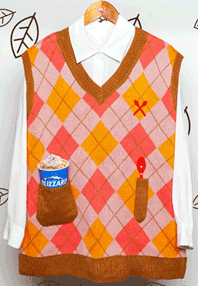
A couple of weeks ago, I laughed out loud when I saw the Dairy Queen “Sweeter” Vest on CBS This Morning, and I knew that I had to have one. I immediately went online to order one and they were already sold out. Though disappointed that I couldn’t order this goofy sweater vest (especially when it likely turned out to be more of a marketing ploy than actual merchandise), I was happy for the laugh, especially since it wasn’t at anyone’s expense.

It seems that most things that make us laugh are at the expense of another’s misfortune. We tend to laugh when someone is socially awkward in some way. In silent films, the funniest scenes were when someone slipped on a banana peel, ran into a door, or in some other way did something that would make them feel embarrassed.

People also find it funny when someone does their best but ultimately fails or “falls on their face.”  I have fallen on my face in many areas of my life.   

For example, I’m a terrible cook. I love cooking, but it is not intuitive for me. Some of my most embarrassing moments have been associated with my cooking.

When our son brought his then-girlfriend (now spouse) home for dinner for the first time, he prepared her for my cooking by telling her, “When Mom cooks, it’s a lab experiment.” 

A glutton for punishment and foolhardy at best, when we have guests, I usually try new recipes because I want the meal to be special. Everybody knows not to do this. I can’t resist.  

There was the time when I invited a colleague I really wanted to impress to dinner. I was going to roast lamb accompanied by mint jelly, as I had read that mint jelly made the dish extra special. I’d never had lamb before and had no idea how it was supposed to smell as it roasted.  As the roasting progressed, I became more and more distressed by the intense and unusual aroma. Luckily, I had a chicken that I could roast.

Upon entering our house, my colleague gleefully exclaimed about the aroma of the roasted lamb and said roasted lamb was her favorite dish. As I placed the roasted chicken on the table, my colleague asked about the lamb that she had smelled. When I told her that I had thrown the lamb in the trash because the aroma made me think there was something wrong with it, the look of shock on her face indicated that I had certainly made an impression…just not the one that for which I had hoped. I can laugh now.

On another occasion I invited a colleague and his family for Sunday dinner. They had two young children who were impatient for dessert because they could see the beautiful pound cake on the sideboard. They were excited when I told them that there would be ice cream, as well. I was excited about this cake because I used the recipe from a dear friend who made the best pound cakes ever. As we grown-ups ate my very, very dry cake in silence, their 5-year-old screamed, “This is the worst cake I ever taste!.” I can laugh now.

Even when we were not having guests, cooking a meal was never routine. I had a library of cookbooks, collected favorite recipes from friends, and even had an onsite tutorial from a friend on how to make the best brown gravy.

My best dishes were by accident. I would make a dish that was praised but would have no idea why the dish turned out the way it did. Invariably, wanting to replicate what was previously praised, I would try to improve on it when I made it again. Apparently, I had been successful in pleasing our son on a simple dish—green beans. Trying something new, I added whole green peppers to the green beans to spice them up. Unfortunately, if one were not paying close attention, one could have both green beans and peppers on the end of one’s fork. When our son got the pepper surprise, he abruptly stood up from the table, threw his napkin down beside his plate and asked accusingly, “Why did you have to ruin them?” I can laugh now.

My husband never wanted to hurt my feelings about my cooking, but I knew when the meal was an ordeal for him. On these occasions, while holding his fork with his right hand to eat, he would have his left forearm on the table with his fist clenched tightly. During one of these fist-clenching times, after taking two bites of one of my “lab experiments,” he looked at me with the saddest expression on his face and in a soft plaintive voice said, “Hon, I just can’t eat this.” I can laugh now.