
Category Archives: adult learners

Sensitivity

The sun is bright in a perfectly blue sky and the water aerobics class is in full swing. There are so many of us in the pool that we must keep checking to make sure we don’t kick someone. We all love this class with the music classics that give us the beat to help us move our bodies as if we’re young again.

Most of us just follow the instructor and try to keep up. I’m sure I’m not the only one who loves to hear the loud whoops and comments from one zany, fun-loving woman who makes an early morning class feel like an afternoon fiesta. She sometimes repeats what the instructor directs us to do as if she’s a microphone and sometimes she makes comments about what we love and what we dread doing as an exercise. She makes it fun and not work.

There must have been something in the air on this particular morning because a woman near me who seemed to enjoy the cheerleader on previous occasions said to me that she wished someone had tape for the mouth of our cheerleader. A short time later, another woman approached our cheerleader and said something to her about keeping it down. Then there was silence and it felt strange to be in the water going through our routines without our cheerleader.

Not long after the forced silence except for the music and instructions for the exercises, our zany cheerleader, apparently feeling admonished, made her way to the back of the pool. As she passed me, she said, “Some people don’t like the noise I make.” I said, “I love the noise you make!”

After she found a spot in the very back of the pool, I beckoned her to come back to her spot. She shook her head, no. The instructor who, like many of us enjoyed her cheerleading, asked her if she was all right. She nodded that she was. When I checked a few minutes later, she had left the pool.

I watched as a few people rallied around the woman who admonished the cheerleader, and I could see that she was explaining how minimal her comment was.

I felt sad for both women. As tough as women may be in making their bodies strong, as aggressive as they might be in their careers, and as in charge as they may be in their own household, there are not many who can allow what is considered a slight or admonishment to roll off like water.

Often onlookers of our shame and our reaction to feeling diminished will say that we’re “too sensitive.” Perhaps those of us deemed “too sensitive” are resigned to care too much about the connections between ourselves and others. For those who navigate the world immune to slights and prejudices, one wonders what the impact of this posture might have on their ability to empathize with those who are not immune to the judgments of others.

Rather than feel embarrassed about being described as too sensitive, one might feel sad for those who are not sensitive enough.
Removing Roadblocks

Many community college students are true immigrants to higher education. To them, going to college is as foreign as finding themselves put ashore in a strange land.

Once they embark upon a college education at the community college, often their main concerns include how to pay for their course work and how to juggle their myriad responsibilities in order to find time to study.

Often, their plans include getting as many courses done as possible at the community college at lower costs before continuing toward their four-year degree.  

They are proud of these hard-earned credits. However, too often they find their safe harbor disrupted when they discover that many of the credits earned at the community college will not transfer or be accepted by their choice of a four-year college.

More than 40 years ago when I worked at a community college, the most time-consuming and frustrating parts of my job as a counselor and academic adviser were to work with students who were being stymied in their progress because the community colleges and four-year colleges could not come to agreement on which courses taken at the community college were “equivalent” to courses at the four-year college. I think now as I did then: If community colleges are “colleges” and faculty who teach the courses are qualified and students meet the requirements, why are there questions about equivalences?

A recent story on Marketplace Morning Report noted that when transferring from a community college to a four-year college, about “43% of college credits don’t end up counting toward a new degree.” The reasons for this lack of cooperation and consistency between community and four-year colleges seem to be about money and hierarchy.

With less funding from states and counties and increasing infrastructure costs for colleges and universities, four-year colleges continue to raise tuition as a source of revenue. Done intentionally or not, having students repeat courses already taken at community colleges is another source of revenue.

Then there is the hierarchy. Community colleges that were created to give opportunities to a broader spectrum of students in their own communities are often described in unflattering terms. Rather than being seen as a way to level the playing field, the hierarchy is preserved when the gatekeepers at four-year colleges stand in judgment as to the worth of the credits earned at community colleges.

Students have little say or control about the transfer of credits and suffer the consequences of being stuck in the middle. If faculty from the two types of institutions cannot agree on what is acceptable in courses of the same or similar names and descriptions, then it may be time for outsiders to interfere further in the business of the professionals in higher education.

If outsiders are allowed to make decisions about what is appropriate to be in the curriculum, how teachers teach, and what books are in the library, why not take this interference further and mandate articulation on course transfer between community and four-year colleges? The time is long overdue for leadership to require that the roadblocks to complete articulation between community and four-year colleges be removed.

Reflections on Adult Learners from the Jersey Shore

Children were everywhere! Toddlers were digging holes in the sand, pre-schoolers were building sand castles, babies were getting their diapers changed, and most of the children were racing out to meet the waves.

As I sat next to my husband in a low-slung canvas chair under a bright orange umbrella enjoying the exquisite beauty of the Jersey Shore, I marveled at how these children are completely fearless and comfortable in this environment. They are comfortable because they have been coming to the beach since before they could remember, and many learned to swim before they could walk.

Being near the ocean during the summer months is as natural to these children as riding bikes in their neighborhood. Being close to the ocean is not natural for me. I was 23 years old before I felt wet sand between my toes. Although I’m a swimmer now, I don’t venture into the ocean to swim, not even close to shore. I sit and I watch.

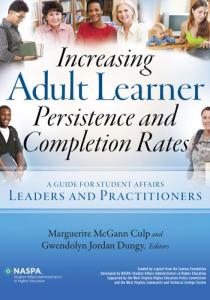
Increasing Adult Learner Persistence and Completion Rates A Guide for Student Affairs Leaders and Practitioners

If you want to better understand the needs of adult learners and how to effectively meet them, I recommend a NASPA publication funded by a grant from the Lumina Foundation and supported by the West Virginia Higher Education Policy Commission and the West Virginia Community and Technical College System, Increasing Adult Learner Persistence and Completion Rates: A Guide for Student Affairs Leaders and Practitioners, edited by Marguerite McGann Culp and Gwendolyn Jordan Dungy.

Students who see college as part of a continuum, a natural progression of what is expected for their educational career, are like these children who grow up going to the beach – or “down the Shore” in New Jersey. By contrast, those who decide to attend college as adult learners may feel more like “watchers,” never quite comfortable in a college environment. Comfort level, however, is just one of the challenges facing adult learners. These learners can feel like outsiders taking a chance on college.

In addition to beautiful beaches, New Jersey also is home to Atlantic City, the Las Vegas of the East Coast. Beaches and casinos! What more can one ask for from a single state? Just for fun, my husband and I drove north to Atlantic City one evening. After relaxing on the beach for hours, I just wanted to be where the action was. I wanted to experience what the advertisements promised. I wanted to try my luck.

Entering the casinos, I could not tell one from the other, either by sound, appearance, or ways to gamble. My eyes were dazzled by the colorful lights; my ears were bombarded by the pings, ringing bells, and R2-D2 sounds of the blinking machines; and I was entranced by the spins of the roulette wheels. It had been a while since I was in a casino not attached to an airport, and as I wandered through eyeing the machines and the people, I definitely felt out of time and place.

I was tentative and hesitant about sitting on one of the stools facing the slot machines. It seemed that these spaces were for real gamblers who knew what they were doing. The spots in front of the machines were not for a fish out of water like me.

When I finally took a position in front of one of the noisy blinking machines, I remembered that the slot machines used to jokingly be called “one-armed bandits.” This time, I didn’t see any machines with one arm. The machines are so technologically advanced, I don’t know if they are even called slot machines any more.

I had to push a “HELP” button to see how to begin playing the machines. The “HELP” button was not much help, so I just put my money in the place for bills and pushed some buttons. The few times in the past when I played the slot machines, I used to be thrilled to see the three cherries straight across because that meant I had won something. I guess these cheap thrills are no longer available. Even when I had three of a kind of something on these machines, it was not enough for me to win. I needed five of a kind or more!

As I looked around at those who appeared to know what they were doing, I knew that the thrill I had hoped to get from being where the action was supposed to be was not real. It was just an illusion for an outsider like me. After feeding the hungry, blinking, groaning monster $7.00, my winnings totaled $0.53. One does not have to be good at math to know that this was not a good return on my money.

Just as the casinos dazzle potential gamblers with how much they could win by playing the games, our colleges and universities spend a lot of money on appealing to the dreams of prospective students. For me, the casino experience was a diversion. For most adult learners, college is no diversion – these learners are motivated by a desire for self-improvement that could potentially change their lives.

Just as I was dazzled by the many lights and sounds, adult learners may be confused by the array of opportunities found on a college’s website. And as I could not tell one casino from another, they might not be able to discern the quality or fit of a particular college. Just as I had no idea how to play the games, adult learners tend not to know how the bureaucratic process of higher education works. Just as I was looking for the one-armed bandits of yesteryear, they may be looking for something that no longer exists.

The “HELP” button on the machine did not enlighten me. I wonder if the service equivalents to the slot machine “HELP” button at colleges and universities are better at meeting the needs of adult learners. Adult learners are putting their money into the game of college and hoping they will get back more than they wagered.