Into my feelings as I drove the familiar streets in my neighborhood, I could still see videos of the aftermath of the brutal attack on innocent people celebrating the new year in New Orleans. I recalled the image I had seen on TV of the president-elect and a phalanx of White men all wearing black suits, black ties, and white shirts as they were leaving a meeting with members of the Senate. Images and news of the wildfires in California were so omnipresent that I imagined I could smell the smoke. For distraction I turned up the car radio and heard commentary on the farewell program for former President Jimmy Carter that was being held at the Washington National Cathedral.
After a few minutes of listening to the reporting, sounds from the radio began to change the vibrations of my body. Garth Brooks and Trisha Yearwood were singing President Carter’s favorite song, Imagine, by John Lennon. Unbidden and unexpected, tears rolled down my cheeks as I allowed myself to imagine.
Imagine by John Lennon
Imagine there’s no Heaven It’s easy if you try No Hell below us Above us, only sky Imagine all the people Living for today
Imagine there’s no countries It isn’t hard to do Nothing to kill or die for And no religion too Imagine all the people Living life in peace
You may say I’m a dreamer But I’m not the only one I hope someday you’ll join us And the world will be as one
Imagine no possessions I wonder if you can No need for greed or hunger A brotherhood of man Imagine all the people Sharing all the world
You may say I’m a dreamer But I’m not the only one I hope someday you’ll join us And the world will live as one
With the recent release of The Six Triple Eight on Netflix, it seemed appropriate to reshare this guest blog by Carmen Jordan-Cox, PhD, shedding more light on this remarkable group of women too long overlooked…
I just finished listening on Audible to April Ryan’s book, Black Women Will Save The World: An Anthem. This is a powerful and emotional reflection on the toils and unwavering leadership of Black women in a world in which our contributions are not valued and, in fact, our very selves often are devalued.
This book made me think about those women—“hidden figures” —who, over the decades, have provided the very foundation for all the successes of subsequent generations of Black families. One such group of “hidden figures” is the 6888th Central Postal Directory Battalion from World War II.
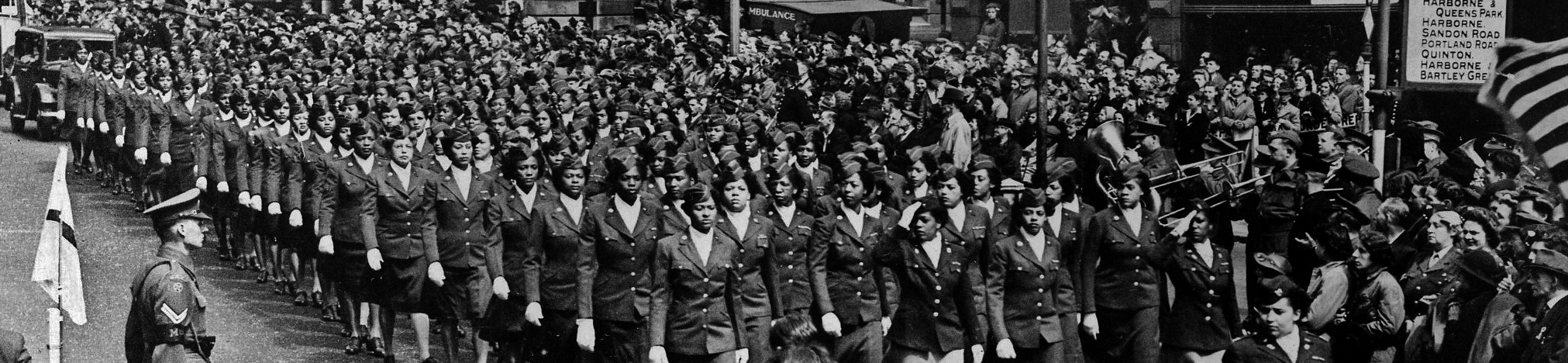
The 6888th was a unique U.S. Army unit that had the distinction of being the only all-female, African American battalion to serve in the European Theater of Operations during World War II. Made up of 855 women—824 enlisted and 31 officers—this Women’s Army Corps Battalion was commissioned in Europe between February 1945 and March 1946, and was led by 26-year-old Major Charity Adams.
The specific mission of the 6888th was to sort and clear a multi-year backlog of mail for the American Army, Navy, Air Force, the Red Cross, and uniformed civilian specialists who were stationed in Europe. This represented seven million people awaiting mail.
In February 1945, the first contingent of the 6888th embarked from Camp Shank, New York, to sail for Britain. They survived close encounters with Nazi U-boats and arrived in Glasgow, Scotland, where a German V-1 rocket exploded near the dock. The second contingent of 6888th soldiers docked in March 1945 in Gourock, Scotland.
Upon arrival by train in Birmingham, England, the Battalion confronted warehouses stacked to the ceiling with letters and packages. They endured inhumane working conditions, including dark, unheated, rat-infested aircraft hangars with broken windows and air raids. Despite these conditions, the Battalion created a new mail tracking system, worked 3 separate 8-hour shifts, 7 days a week to process an average of 65,000 parcels per shift (which is 195,000 daily), and cleared the 6-month backlog of mail in 3 months.
After resolving the immense mail backlog in Birmingham, the 6888th Battalion sailed to France for their next assignment in Rouen. They encountered undelivered mail dating back two to three years, which the Battalion again successfully processed and cleared in just three months.
Upon concluding their final assignment in Paris, the last of the Battalion returned to the United States by ship and was disbanded in March 1946 at Fort Dix, New Jersey. There were no parades, public appreciation, or official recognition of their accomplishments.
Adhering to the motto, “No mail, low morale,” the Battalion provided essential support to the U.S. military in the European Theater of Operations by linking service members to their loved ones back home. The 6888th achieved unprecedented success and efficiency in solving the military’s postal problems. The Battalion was the largest contingent of African American women to ever serve overseas, dispelling stereotypes and representing a change in racial and gender roles in the military.
It was not until nearly 80 years later that the 6888th received the well-deserved recognition for their service to the United States. In March 2022, the Battalion became the only women’s military unit to be awarded the Congressional Gold Medal, which was first awarded to General George Washington in 1776.
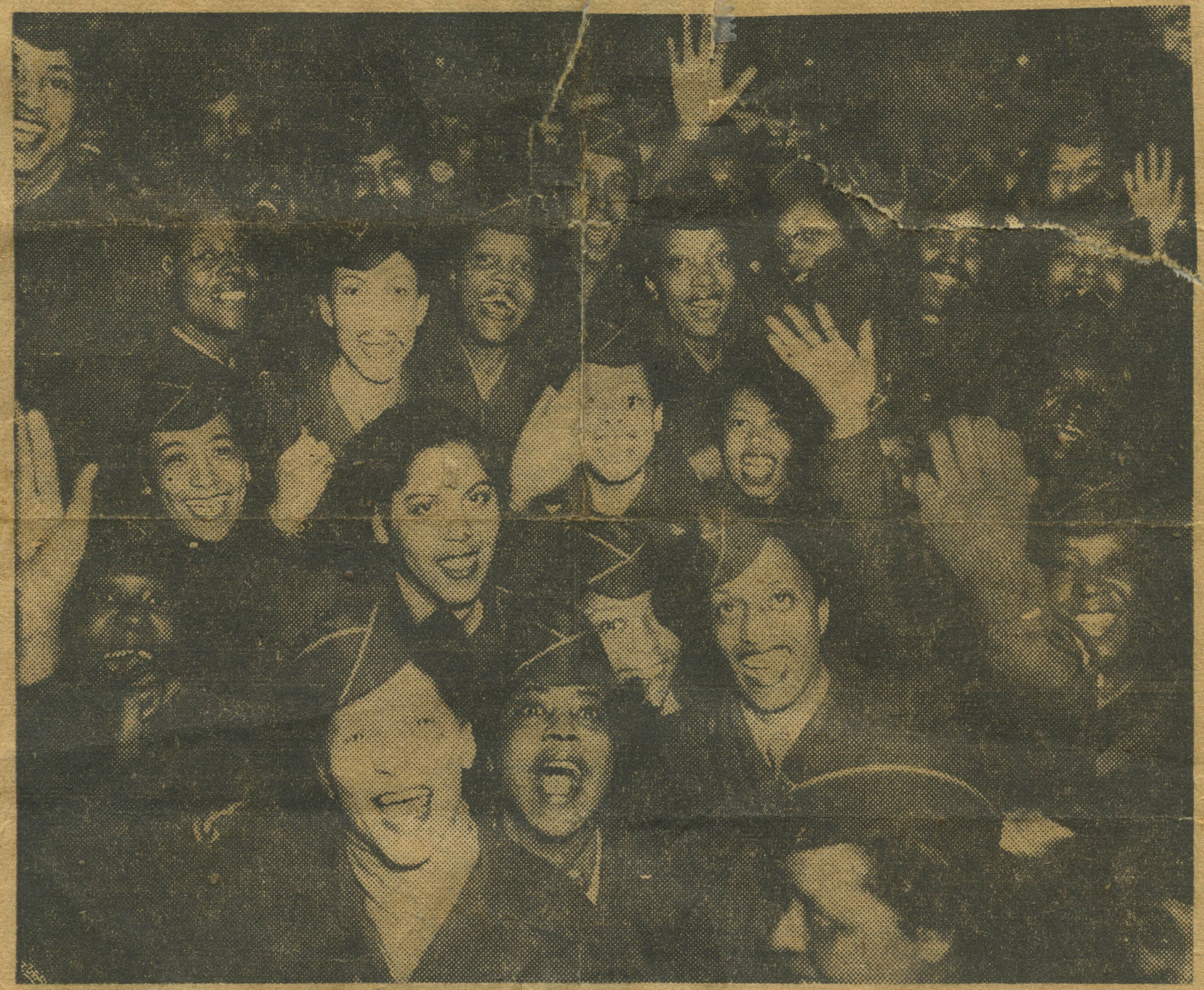
Iconic photo from when the last of the Women’s Army Corps (WAC) returned home from France. Annie Knight (Jordan) is the woman with the big smile in the top left corner.
The 6888th has a very special significance for me. My mother, Private First Class Annie Knight (Jordan), was one of those brave Battalion soldiers. As kids, my siblings and I always knew that she was in the Women’s Army Corps (something about which she was extremely proud). She mentioned to us that she did Morse code. We just thought of that as being like another language of sorts. It was not until Fall 2022 that we understood that her enlistment classification was not military postal worker. In fact, mom was in a special category called “Cryptographic Code Compiler.” Cryptographers, also known as code breakers, were secretly trained to crack code that provided intelligence information for the Army. Very little is known of the Black women who served in this capacity.
As I learned more about the 6888th, I began to think about how many ”hidden figures” there are and wonder how we might ensure that their stories are shared and their legacies known. I asked questions like, “What inspired these 855 African American women to enlist and pursue the 6888th?” “What gave them the internal fortitude to take on unknown ventures in a dangerous foreign land?” “What made them so different?” and “How did that very difference change the course of their lives post-military service and influence their legacies?”
So, in 2022, I became a first-time podcaster: NextUs818 Podcast is a reflective platform for connecting past successes with future progress in the African American community. There are many African American heroes—some known and many unsung men and women—who helped build this country. Some were the first or only in their fields of endeavor, like the 6888th. Yet little is known about how their unique journeys influenced the trajectory of their familial legacies…such as their children, grandchildren, nieces, nephews. The NextUs818 Podcast introduces the multi-generational descendants of these heroes. On the first and third Wednesdays of each month, I interview descendants of an African American hero and explore family lore, traditions, and values, and how the descendant’s journey was directly impacted.
The inaugural season of the NextUS818 Podcast features the descendants of the 6888th Central Postal Directory Battalion. [Four] themes have emerged to help me better understand what inspired the 6888th soldiers and how their service has influenced subsequent generations: patriotism, fearlessness, adventurousness, and unwavering commitment to lifelong learning.
Patriotism: Despite the rampant racial and gender discrimination of early 1940s America, these women were exceptionally patriotic. With the country at war, they felt that it was their DUTY to contribute to the war efforts against the Hitler regime. They eagerly embraced this chance to serve.
Fearlessness: The notion of a young African American woman going into war zones would be darn right scary, even today. Yet these brave women exhibited a remarkable degree of fearlessness.
Adventurousness: Not only did these women demonstrate fearlessness, but they were excited to explore the unknown. As kids, mom always spoke about her adventures, especially once the Battalion moved on to France. In all the stories I heard about the women, they saw serving in the Army as a way of giving them broad exposure and opening post-military opportunities otherwise unavailable to them.
Commitment to lifelong learning: Many of the women went on to attend college after their military service, some using the G.I. Bill when the opportunity was available. (See How the GI Bill’s Promise Was Denied to a Million Black WWII Veterans.) Their unwavering commitment to education deeply influenced their children and grandchildren.
In the NextUs818 Podcast, I enjoy hearing the stories of the soldiers’ civilian lives after World War II. The women of the 6888th were college graduates, teachers, nurses, college deans, and entrepreneurs. As important, they influenced the trajectory of their children and grandchildren who, among other things, are PhDs, physicians, engineers, lawyers, educators, professional musicians, and financial and advertising executives. All of the descendants with whom I have spoken emphasize that their successes are directly attributable to the foundation laid by the women of the 6888th. From them, they learned how to be focused, tenacious, and how to persevere under adverse circumstances. They learned how to survive and thrive. So when we are tempted to live in the moment and think we got here solely on our merit, we must never forget those shoulders on which we stand!
Five final notes:
Fort Lee Redesignation: The U.S. Department of Defense has made a commitment to rename military bases named after individuals associated with the Confederacy and other dark periods in American history. On April 27, 2023, Fort Robert E. Lee [was] renamed “Fort Gregg–Adams” in honor of two trailblazing African American officers: Retired Lt. General Arthur Gregg and the late Lt. Col. Charity Adams (commander of the 6888th Battalion).
6888th Legacy Tour: A group of 6888th descendants and advocates will return to Scotland, England, and France, walking on the grounds where the brave soldiers made history as part of an upcoming 6888th Legacy Tour [in October 2025].
Tyler Perry Studios and Netflix [released their] movie about the 6888th [on December 6, 2024].
Carmen Jordan-Cox, PhD, is a retired university vice president and judge/magistrate. Currently, she is producer and host of NextUs818 Podcast and a freelance curator of stories about descendants of World War II soldiers.
According to TheWashington Post exit polls, 92% of Black women voted for Kamala Harris to be president. Other polls also indicated that more than 90% of Black women voted for Harris. While the number of Black women voting for Harris is overwhelming, it took large numbers of other women and men to generate the number of votes the candidate received. I’m especially grateful that women showed what enthusiasm and sisterhood could accomplish. All who voted for Harris should feel proud of what we accomplished.
Pride aside, no one should be surprised that those men and women who worked to get Harris elected were let down after the election. “Let down” is surely an understatement for those who pushed a boulder up a mountain higher than they thought was possible. When it came crashing back down, many dedicated Black women, in particular, felt crushed.
People react to disappointment in different ways. Some are angry and get some kind of release in blaming those who didn’t help with the nearly impossible task. Some are disillusioned and blame themselves for daring to hope when the system never changes. Some are speaking out about not participating in what they see as futile efforts in a nation that hates them and is rigged against them.
We can’t ignore the overwhelming feelings of anger and frustration after so much effort and hope has been expended toward what was an incredible goal of electing our candidate as president of the United States. Although our feelings and reactions are as varied as we are as individuals, we are similar and consistent in not succumbing to what others might see as defeat.
Like any powerful fighters, taking time to rest and regroup is natural and necessary in order to come back strong to fight another day.
Before we get into the next presidential administration, I want to recall the well-deserved praise exhibited at the Democratic National Convention for President Joe Biden. I hope he was able to feel the love and admiration of fellow party members despite the hurt and disappointment he must have felt by being strongly encouraged to give up his bid for a second term.
Despite the fact that Congress blocked his progress by locking the door on many of his initiatives and policies, he kept banging on that door and trying to find another entrance. Besieged and bloodied, he persisted.
He tried to do a course correction to bring the nation in line with its ideals and to take care of the basics that affected not only the nation and what we see as a democracy, but to propose policies that would ensure deserved benefits for those who work for a wage. In his cabinet selections and judicial appointments, he had the courage to address the negative impact of past prejudices and hatred.
Most impressive has been his drive to keep the promises he made. Many of his policies that support his promises regarding infrastructure and job creation will not be realized until well after his administration ends. I hope history will give him the credit he deserves.
I encourage us to take the time to read about the policies that will have the Biden fingerprints on them. President Biden deserves credit for what he accomplished and for what he set in motion that may come to fruition in the future.
I thank President Biden for the sacrifices he made in giving so much of his life to the ideals and promises of this nation and for doing his best in the short time he had to get the job done.
Make no mistake, the upcoming presidential election is consequential. Americans on both sides see this race as being about the future of democracy. By all accounts, the race will be close. No matter what happens, a good portion of the electorate will feel a certain kinda way…
But we’ll be all right BECAUSE this is about the future of democracy.
And the future of democracy is US. It is as much about what we do on November 6, and every day thereafter, as what we do on Election Day. It is about how we carry on. It is about the peaceful transfer of power. It is about checks and balances so no one person or branch wields too much of that power. It is about what we want our communities to be like, and the legacy we want to leave the next generation.
In the heightened media fervor that surrounds elections, it may be hard to see, but people across the country are hard at work building bridges. While polarization is real, the majority (silent as it may be) still resides closer to the middle.
Groups like Braver Angels, One America Movement, and others, are working to turn down the temperature. Democracy and peacebuilding groups like the Carter Center and Search for Common Ground are bringing decades of experience working overseas to address risk factors that they’ve seen arise domestically.
PACE (Philanthropy for Active Civic Engagement) has been focusing on civic language and perceptions for a few years now. Their most recent research finds people are more positive about a host of civic terms than they were just a couple of years prior. This is not a fluke, but the result of people getting to work, as is the hallmark of democracy and our self-governing society.
As we look ahead to the 250th anniversary of the signing of the Declaration of Independence in 2026, let us remember that the next 250 years are not promised to us. No one is going to do the hard work of democracy for us. What the nation will be is always ours to determine.* Our vote is just the start…
*As President Barak Obama noted in his farewell address, the inalienable rights noted in the Declaration of Independence, “while self-evident, have never been self-executing.”
Kaaryn McCall is a communications consultant who, in addition to supporting Dr. Dungy, works with nonprofit organizations to most effectively leverage strategic communications to support their missions.
This is my most important vote, ever. During this messy present, it may be the last time I have the right to vote as an African American woman and the fact that my expiration date is nearing based on statistical data.
I took my sweet time completing my ballot. I started at the bottom and worked my way up to the top of the ballot because I know how important our state and local legislators are to the well-being of the communities in which we live.
Prior to receiving my ballot, I took every opportunity to hear and see candidates and to explore their past records.
When I was not sure about propositions, I didn’t just guess. I took time to learn as much as I could, and I relied on those in the know who I trust to tell me what they knew about judges and others on various boards.
I feel good about the seriousness with which I completed my ballot. If it is my last opportunity to vote, I gave it my best.
Listening to the radio on my way to work, I flinched in annoyance when I heard then-presidential candidate Bill Clinton reference benefits expressly for the “middle class.” Never having the luxury of financial security myself—as I’ve lived from paycheck to paycheck and I’m a Black woman always fearful of losing my job regardless of the merits of my work—the candidate was not speaking to me.
I think most people see themselves as middle class even if they meet the criteria for what is referred to as “working class” or the “working poor.” Therefore, it makes sense that the public relations teams for those making appeals for votes want their candidates to speak to the largest number of voters. These voters want to be called by name when it comes to policies that may have an impact on their financial and social status.
I just wish that good-hearted smart people would not buy in to the cultural and societal habit of categorizing people into a class or caste system based on arbitrary criteria such as income and social status. I feel better when I hear politicians talk about all the people and how what they champion will benefit everyone who needs help.
In addition to calling out the middle class, most candidates say that they represent all the people when they speak in different venues and in many of their campaign ads. It’s the calling out of the middle class that makes me wish that the constituent message would be more like President Lyndon B. Johnson’s reference to the people as the “Great Society.” This positive outlook for everyone feels better to me than identifying and thus ranking people according to class.
As I write this, I ask myself, “Why does this matter to me?” It matters to me because calling out the middle class is just another way of excluding people who don’t have the requisite income and societal status deemed good enough to be middle class.
In the end, I will support candidates who champion inclusion in their policies and who seek solutions that are helpful and not harmful to any people. We owe it to ourselves and to our country to champion leaders who strive to promote a society for all the people even if they must call out the middle class in their efforts to be elected.
It’s funny how sometimes I can’t remember what I had for breakfast, and yet I’ll remember a comment that I heard weeks ago.
Like many others, I watched CNN’s interview with Vice President Kamala Harris and Tim Walz. I thought the questions and responses were what would be expected. Journalist Dana Bash asked the hard questions, and the interviewees gave the kind of responses that one would expect from people running for political office.
What has been unsettling for me is Vice President Harris’ response regarding the evolution of her positions on several critical issues. Rather than an explanation about why she changed her stances, Vice President Harris stated, as I recall it, “My values have not changed.”
What must it be like to feel compelled to make decisions that do not align with one’s values?
I began to try to think of instances in my own life when I made decisions that did not align with my values. What stood out for me was my values about what it means to be a mother. Parenting is one thing, but to me, mothering is on a whole other plane. I value what I think is the innate urge and responsibility to always nurture and protect one’s child at any costs. I value being present when the child says, “Mommie.”
There is a dull ache in my chest and tears on the brink when I think about the decisions I have made that did not align with my values as a mother. Three instances come immediately to mind:
I gave the nurturing and protection of my child to a babysitter when he was six months old. Against my values as a mother, I chose to give more time to my job than to my child. I cried when I had to leave him with the sitter. But I thought, at the time, that I had no choice.
When my child was four years old, his father and I agreed to chaperon a community college student trip. Though we trusted the sitter’s family like our own, I was crying when we left our son with them. It was gut wrenching when he stood at the big picture window and waved goodbye to us. There was no way for him to understand that I would not come for him at the end of the workday as usual. We had never been apart overnight. When his Dad and I reached our destination, we called to talk with him. Without tears and apparent emotion, he asked us, “Are you all coming back?” I didn’t think my broken heart would ever recover from hearing this question from the child I wanted to nurture and protect more than anything in the world. Not intentionally, but in reality, I put my job before my values of mothering.
The most gut-wrenching memory of not living my values of mothering was when our tiny little boy, no more than five or six years, instead of walking the one block to the sitter’s house as usual, walked more than a mile, crossing busy streets, to find his Mommie at her job at the community college. He had the courage to find me; I hadn’t had the courage to live my values of mothering to nurture and protect him at any cost.
Vice President Harris gave me a lot to think about with her comment. I don’t think I was a bad or neglectful mother when it came to the essentials, but like many others who put their job high on their list of priorities, I hid behind the term “quality time.” We assuaged our guilt in not spending more time with our children by saying that the amount of time was not the most important thing, it was what we did during the time we were with them. Regardless of how I might have colored it during my time as the mother of a child, I made decisions that did not align with my values as a mother.
I can say from experience that the feelings provoked when making decisions that don’t align with one’s values are not fleeting but forever imprinted on a heart that wanted to do the right thing—to make decisions that aligned with one’s values.
It’s generally understood that topics such as money, politics, and religion are not to be brought up if one wants to have a calm conversation and be seen as a pleasant and well-mannered person. Today, politics looms large among the topics on everyone’s mind, yet only a courageous or foolish person would initiate such a conversation even with family and friends.
Why is this happening now? I think we are becoming a people who lack respect for others and ourselves. Our arguments lack grace and mercy with anyone who has an opinion different from ours.
We have come to a sad place where politics is beyond debate. We have lost perspective about what matters, and because of that, we have given up on meaningful conversations. No one is willing to listen because there are strong feelings and hardened opinions that are not open to seeing other points of view.
Those who want to engage in conversations about the current forbidden topic often do so because they think that they can convince the other person that their way of thinking is the right and only way to see the situation. They evangelize from a strongly righteous point of view.
There are consequences to speaking freely. When we hear arguments for free speech, the First Amendment is often cited. What we forget is that the First Amendment is about protecting citizens from government restrictions on speech. My question is how we address the loss of our right to express our opinion when it’s our neighbors, community members, or even strangers in public places who overhear a conversation with which they disagree and decide to take issue.
The right to speak freely is a gift to humanity and a bridge to community. I do not believe that we, the people, are willing to pay the costs of losing the freedom to speak.
Call me old-fashioned for an expectation of decorum and socially acceptable behavior in certain circumstances and in particular places. Because it’s so rare and certainly not a requirement, I am moved in a good way when someone demonstrates politeness in even the smallest of ways.
A weird example of my appreciation for politeness is after an interaction with automated customer service. It is most frustrating when there are no humans with whom one can speak when one needs information that is “none of the above” among the choices offered. I’m ecstatic when what I think is a human being speaks to me, gives me their name, listens, and attempts to help.
It makes my day when I’m walking closely behind someone and that person holds the door for me rather than letting it shut in my face.
Basic words like “please” and “thank you” given with a semblance of sincerity harkens back to a time when parents used to tell their children to “behave like you have home training.” Or they might say, “Don’t embarrass us when you go out in public,” or, “Don’t be uncouth.”
I’m not saying that “back in the day” most people were courteous and today no one is polite. It just seems to me that the expectation of decorum and socially acceptable behavior is seen as an infringement on another’s rights to be as disrespectful and undignified as they want to be.
I also support the idea of being able to be free to act and behave as one desires whether it’s uncouth or not. I think the line needs to be drawn, however, when your freedom to be who you want to be infringes on the freedom and sensibilities of another person.
I hope some of you who know me realize that my complaining about manners is just a way to distract myself from onset disenchantment as I fear a future of conflict rather than community.



 Gwen Dungy