Category Archives: collaboration

Notes on a Napkin

Twenty-three years ago—once again finding myself in a restaurant eating alone, a consequence of traveling around the country to be among members in their regions and to make speeches on various subjects—I often jotted my musings on a napkin.

On one such napkin, I wrote about what I wanted to say at the association’s business meeting as an introduction to reporting on the statistics and successes since the last annual meeting:

“We have to attend to the demographics of the profession to insure that what we as an association offer is relevant not just for today and today’s members, but for the future and tomorrow’s members. Student affairs and other support services are projecting the largest number of retirees within the next 5-10 years that the profession has experienced.

“Our challenge is to meet the needs of professionals up and down the demographic ladder. We can do this by broadening our definition of diversity among our membership to include age, gender, race, socioeconomic factors, and different perspectives.

“We need good people who are eyeing retirement to remain active in the profession as mentors and sages. We must find a way to capitalize on the gifts and legacies of our retiring professionals.

“At the same time, we need to look to mid-level, new and potential professionals to rejuvenate the field and the association. Determining what they need from their professional association is a particular challenge. In addition to meeting their professional needs, we want the talents they bring to move the association forward.

“We need to help the burgeoning number of mid-level professionals to assume leadership roles. What is the best way to show them that we need their participation and leadership to accomplish our vision?

“One of our tasks is to emphasize the power of leading from the middle.”

From what I can glean, as an outsider today, the association has been successful in bringing to fruition what were notes on a napkin a long time ago.

White empty napkin and pen on gray background

A Recipe Box Down Memory Lane

close-up of recipe box with handwritten index cards and alphabet dividers

Every time I open the door to the cabinet, I see—on top of a few Martha Stewart cookbooks that my husband liked—the little gray plastic box with the alphabet tabs for recipe index cards. The box was so stuffed that the lid never closed.  When I hesitate a moment before getting what I opened the cabinet for, I tell myself that I really need to take time to go through those old recipes and get rid of those I know I’ll never use again.

The day finally came for me to weed the box of some tattered and yellowed index cards. What a trip down memory lane of good times and good people.

I was surprised at the number of recipes to which I attributed an “owner’s” name. Weeks after clearing out most of the recipes, I wish I had written down the names of the people I owe for the recipes.

Some that I remember include Grace’s Gooey Butter Cake and Potato Salad, Ginny’s Lettuce Bacon Salad, Bob’s Chicken Curry Casserole, Bettie’s Cornbread Dressing, Maw’s Pecan Crescents, Anne’s Marinara Sauce, Jacki’s Gravy, Jackie’s Mac & Cheese, Mary’s Broccoli Cheese Bake, Larry’s Squash Rolls, and Aunt Evelyn’s Fried Corn. And then there’s “What’s Her Face,” who gave me the recipe for the Texas Chocolate Cake. I didn’t have her name attached but I remember her clearly…except for her name, that is.

Each of these recipes found its way into my box because I had enjoyed the dishes made by the recipe-giver and wanted more. I thought I could replicate the dishes and make them for my family. I can say with all candor that my attempts at the dishes were never as tasty as the originals, but they were good enough for me to keep trying.

The best part of attempting these dishes was that the process always brought back memories of the people who unselfishly shared their recipes with me.

Ahead of Her Time

Anna Julia Cooper

Anna Julia Cooper (1858–1964) put no limits on the intellectual potential of Black people, Black women in particular. Her own intellectual and educational achievements are a testament to her firm belief that women’s opportunities for learning and education should not be less than or different than men based on assumptions about women’s capabilities.

 I’m particularly drawn to the life of Anna Julia Cooper because she did it all: was a leading Black spokeswoman; held leadership in women’s organizations; founded the first chapter of the YWCA Camp Fire Girls for Black girls; served as principal and teacher in the “renowned Dunbar High School in Washington, DC;” started a night school for working people to attend college; and authored a seminal book on Black feminism, A Voice from the South.

Even as she focused her energy and attention on cultivating the potential of marginalized people, she also continued to work on her own education. In 1924, Cooper received her Ph.D. from the University of Paris, becoming only the fourth Black woman in the United States to earn a doctorate degree.

Despite these extraordinary accomplishments of a Black woman born in the South and formerly a slave, what captivates me most about Dr. Cooper is that she didn’t seek attention. Dr. Paul Cooke, one of her biographers, wrote that she chose the “lesser light.”

She was dedicated to a larger cause than herself and refrained from crediting her own achievements. An example of Dr. Cooper’s humility is what Dr. Mary Helen Washington shared in her Introduction to Cooper’s Book in the Shomburg Library Collection of Nineteenth-Century Black Women Writers.

“In 1982, when Louise Hutchinson, staff historian at the Smithsonian Institution, completed her biography of Cooper, she called for an official Smithsonian car and hand-delivered the copy of the biography to Mrs. Regia Haywood Bronson, the eldest of the five children Anna Cooper had adopted in 1915.

“Then in her late seventies, Mrs. Bronson took the book from Hutchinson, and holding it to her breast, she rocked back and forth with tears streaming down her face, but not saying a word. When Hutchinson asked her why she was crying, Bronson said, ‘Nobody ever told me Sis Annie was important.’”

Yes, Anna Julia Cooper was important, indeed, in advocating for social justice and equality of rights for all people and the education of Black women, in particular.  

Living to be 105 years old, she lived to see a celebration of Black History Month and Women’s History Month. She would have been pleased to see the theme of the 2024 Women’s History Month—Women Who Advocate for Equity, Diversity, and Inclusion.

Sources:

Anna Julia Cooper Project: cooperproject.org/about-anna-julia-cooper

Introduction in the Schomburg Library Collection of Nineteenth-Century Black Women Writers: Cooper, Anna Julia. A Voice From the South. (United Kingdom: Oxford University Press, 1988).

Mr. Fantastic

Laurence N Smith

Once in a lifetime, if you’re lucky, you will know a Mr. or Ms. FANTASTIC!

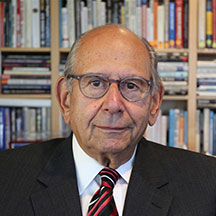
Laurence N. Smith is my Mr. Fantastic! He was the vice president for University Marketing and Student Affairs at Eastern Michigan University from 1975–2000.

I give him this title because he stands out from the rest in every way. He’s always the tallest in the room and the smartest in the room. And when asked how he’s doing, invariably, he responds, “FAANTASTIC!”

Leadership in a volunteer organization based in higher education can be a different experience than what a leader might be able to do in a top-down organization where the people responsible for making the trains run on time are paid and can be released at-will.

When I was in such a leadership position, willing volunteers were the key to success. Many stepped forward to let me know that I could count on them to help me achieve the goals of the organization. They used words like “help you,” “support you,” “here when you need me.”

In my imaginative recall, Larry Smith, towering over the heads of his colleagues, fixed his eyes on me, made a beeline to me, and asked, “What is your vision for this organization?” With confidence, I summarized my mandate from the volunteer board of directors and added my own vision, which could be described as fantastical given the structure and history of the organization. Mr. Fantastic’s eyes communicated, “Are you sure?” The gaze I returned indicated that I was.

Lyrics from songs best describe his response: “Come along with me,” “I’ll take you there,” “I believe I can fly!” My leadership vision was the perfect vehicle for Mr. Fantastic to test drive his ideas about what student affairs administration in higher education could “truly be.”

On the journey with Mr. Fantastic, it was obvious that when we were talking about using listservs to bring our members together in conversation from various locations, he was already thinking about what we now call Zoom meetings. When we were talking about Palm Pilots, he was envisioning what is now Chat GPT. Always looking toward the possibilities for the future, never fearing failure, and always optimistic is my Mr. Fantastic.

And I’m not the only one that found Larry to be fantastic. In 1999, he was named a NASPA Pillar of the Profession, and in 2002, he was the recipient of the Fred Turner Award for Outstanding Service to NASPA. The equivalent of a Lifetime Achievement Award, the Turner Award recognizes NASPA members who have brought honor and dignity to the student affairs profession and to NASPA as an association for a sustained period. Among Larry’s extensive activities, he was founder and chair of the NASPA National Academy for Leadership and Executive Effectiveness and executive editor of NASPA’s online management magazine.

I spoke with Larry recently and told him that to have him as a colleague and friend during my time at NASPA was a blessing of pain and glory. The pain was tempering the projections of where the organization could go and modulating the speed of change in order to be in sync with the volunteer leadership. The glory was the innovations NASPA achieved through its volunteers when we were flying with Mr. FAANTASTIC!

Thank you, Larry. I am truly grateful for your colleagueship and friendship.

Removing Roadblocks

Many community college students are true immigrants to higher education. To them, going to college is as foreign as finding themselves put ashore in a strange land.

Once they embark upon a college education at the community college, often their main concerns include how to pay for their course work and how to juggle their myriad responsibilities in order to find time to study.

Often, their plans include getting as many courses done as possible at the community college at lower costs before continuing toward their four-year degree.  

They are proud of these hard-earned credits. However, too often they find their safe harbor disrupted when they discover that many of the credits earned at the community college will not transfer or be accepted by their choice of a four-year college.

More than 40 years ago when I worked at a community college, the most time-consuming and frustrating parts of my job as a counselor and academic adviser were to work with students who were being stymied in their progress because the community colleges and four-year colleges could not come to agreement on which courses taken at the community college were “equivalent” to courses at the four-year college. I think now as I did then: If community colleges are “colleges” and faculty who teach the courses are qualified and students meet the requirements, why are there questions about equivalences?

A recent story on Marketplace Morning Report noted that when transferring from a community college to a four-year college, about “43% of college credits don’t end up counting toward a new degree.” The reasons for this lack of cooperation and consistency between community and four-year colleges seem to be about money and hierarchy.

With less funding from states and counties and increasing infrastructure costs for colleges and universities, four-year colleges continue to raise tuition as a source of revenue. Done intentionally or not, having students repeat courses already taken at community colleges is another source of revenue.

Then there is the hierarchy. Community colleges that were created to give opportunities to a broader spectrum of students in their own communities are often described in unflattering terms. Rather than being seen as a way to level the playing field, the hierarchy is preserved when the gatekeepers at four-year colleges stand in judgment as to the worth of the credits earned at community colleges.

Students have little say or control about the transfer of credits and suffer the consequences of being stuck in the middle. If faculty from the two types of institutions cannot agree on what is acceptable in courses of the same or similar names and descriptions, then it may be time for outsiders to interfere further in the business of the professionals in higher education.

If outsiders are allowed to make decisions about what is appropriate to be in the curriculum, how teachers teach, and what books are in the library, why not take this interference further and mandate articulation on course transfer between community and four-year colleges? The time is long overdue for leadership to require that the roadblocks to complete articulation between community and four-year colleges be removed.