Category Archives: faith

Where Do We Go From Here?

Guest post by Kaaryn McCall

As we start a new year, particularly this new year, it is perhaps good to ask, “Where do we go from here?” The Rev. Dr. Martin Luther King, Jr., began bringing his 1967 Southern Christian Leadership Conference address by that title to a close with the following words we would do well to heed today:

“The road ahead will not always be smooth. There will still be rocky places of frustration and meandering points of bewilderment. There will be inevitable setbacks here and there. And there will be those moments when the buoyancy of hope will be transformed into the fatigue of despair…. But difficult and painful as it is, we must walk on in the days ahead with an audacious faith in the future.”

King’s book of that same title that year was aptly subtitled with the question “Chaos or Community?” This is a choice with which we are always faced and, as we enter 2024 that is, among other things, a presidential election year, and as we near the nation’s 250th anniversary even as some talk of the possibility of a second civil war, I, for one, choose community.

Too often, this can seem like an amorphous concept, so it’s helpful to understand the Beloved Community that was King’s ultimate aim, as reflected in remarks as early as 1956, following the Montgomery Bus Boycott: “The end is reconciliation; the end is redemption; the end is the creation of the Beloved Community.”*

From the religious perspective, King saw Beloved Community as the wholly achievable goal of realizing the kingdom of God on earth, “in which all human beings ha[ve] value in and of themselves, and [a]re subjects worthy of love.” This restored community is the ideal of creation—God’s intention for all of humanity living together in an “inescapable network of mutuality.”

Perhaps more concretely, and from a more universal perspective, this Beloved Community is one in which:

“poverty, hunger and homelessness will not be tolerated because international standards of human decency will not allow it. Racism and all forms of discrimination, bigotry and prejudice will be replaced by an all-inclusive spirit of sisterhood and brotherhood…. Love and trust will triumph over fear and hatred. Peace with justice will prevail over war and military conflict.”*

Achieving such community requires transformation on many levels. In his further remarks following the bus boycott, King noted, “It is this type of spirit and this type of love that can transform opponents into friends. It is this type of understanding goodwill that will transform the deep gloom of the old age into the exuberant gladness of the new age.*

It is important to note that King did not believe Beloved Community would be devoid of conflicts, but that these could always be resolved peacefully,* noting that “true peace is not merely the absence of tension [but] the presence of justice.”

silhouette of the Rev Dr Martin Luther King Jr with the words "BUILDING THE BELOVED COMMUNITY" and a colorful illustration with many components, including a river, trees, hearts, stars, hands, people, rainbow, and various decorative elements

So, “Where do we go from here?”

In a world increasingly divided, let us seek to build increasing levels of trust across difference.

In a world increasingly concerned with domestic and international terrorism, let us embrace the fact that “love [is the] most potent instrument available in humanity’s quest for peace and security.”

In a world increasingly complex and intertwined, let us seek to understand the “enemy-neighbor” as more than a given action on their part.

In a world where prejudices continue to manifest themselves, let us seek a true conception of self instead of “self-deception and … neurosis stemming from repressed truth.”

In a world of zero-sum games, let us demonstrate that there is no need to fear one’s own loss when advocating for justice. (As a popular meme puts it, “Equal rights for others does not mean fewer rights for you. It’s not pie.”)

In a world still plagued with brokenness, separation, suspicion, and deadly conflicts, let us find our points of commonality and shared humanity.

The choice between chaos and community remains for each of us individually and collectively. May this new year and MLK Day be about more than just platitudes. Let us answer the call to action and walk on together not in blind optimism, but an intentional hope and “audacious faith in the future.” Let us not fall into despair as a few loud voices are amplified across various media but recall how far we have come and set forth with renewed purpose to building Beloved Community.


SOURCES

† Hunt, C. Anthony. The Beloved Community Toolkit.

‡ Hunt, C. Anthony. Blessed are the Peacemakers: A Theological Analysis of the Thought of Howard Thurman and Martin Luther King, Jr. Lima, OH: Wyndham Hall Press, 2005.

* The King Center. “The King Philosophy.” thekingcenter.org/king-philosophy


Kaaryn McCall is a communications consultant who, in addition to supporting Dr. Dungy, works with nonprofit organizations across the social justice spectrum to most effectively leverage strategic communications to support their missions. Connect on LinkedIn
Unselfconscious Unfiltered Thoughts and Feelings

My trove of handwritten journals was rich with details of day-to-day happenings and interactions. The feelings I had when I wrote them were memorialized in my heart and bones. Sometimes I had to take a break from reading them because the visceral reactions were more than I wanted to re-experience.

When I wrote my journals by hand, my engaged emotions helped me see my inner self—that soft place that needed protection. I didn’t judge myself for having unpleasant emotions. As I wrote about the interactions or situations that caused these emotions, I allowed myself to feel merciful toward the “me” that only I understood.

These journals showed me that believing in myself was the kind of faith inculcated within me since I was a very small child. During my middle years, I would have been completely lost without this bedrock faith. In my journals, I recorded how my beliefs in the greater good sustained me time after time.   

It was in my handwritten journals that I thanked God for those I encountered who had a generosity of spirit and showed warmth when I needed it. It was in these handwritten journals that I was honest about my limitations and worked hard to be objective and fair in observing others and, more importantly, my responses to them. The real learning and change came from being wholly with myself in reflection and humbleness.

When I switched to keeping my journals online, apparently, I did not trust the medium with my deepest thoughts and tender feelings. For some reason I found myself not sharing my secret voice. In reading excerpts from my digital journals, it’s clear that I was not using them as a source of self-reflection. My journals became one dimensional. I recorded what can be thought of as a public record of what was happening and when.

My epiphany is that journaling is not simply the words recorded; it’s the meditation and process of writing one’s unselfconscious unfiltered thoughts and feelings.

The Inspirational Six, Part 1: Venerable Pierre Toussaint

Guest post by Joann Stevens

In a series of posts, I’d like you to meet six Black Catholics from the 19th and 20th centuries on the road to sainthood in the global Catholic Church: Venerable Pierre Toussaint; Venerable Henriette DeLille; Venerable Augustus Tolton; Servant of God Mary Lange; Servant of God Julia Greeley; and Servant of God Thea Bowman. Ordinary people inspired by faith to serve the Common Good, they helped build and transform American Catholicism, advanced a democracy they couldn’t enjoy, and upheld Jesus’ commandment to “Love each other as I have loved you” (John 15:12).

Inspiration can be hard to find when celebrity and socioeconomic status define influence more often than character. But sainthood is an equalizer. Saints inspire people of all faiths or no faith. Saints are rarely sexy, beautiful, rich, or celebrated. They endure hardship, poverty, and social rejection. They sacrifice their bodies— sometimes literally, more often figuratively—to serve as agents of God’s righteousness and unconditional love. Saints don’t wear Chanel or Brioni but lift the spirit higher than a well-cut garment as they model essential elements of humanity: Love and Hope.

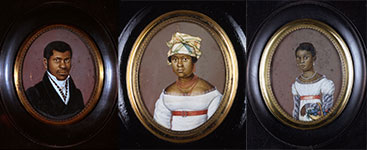
Pierre, Juliette, and Euphemia Toussaint as painted by Anthony Meucci, 1825

Venerable Pierre Toussaint (1766–1853) took his surname from the Haitian general Francois-Dominique Toussaint Louverture, a Black enslaved person turned enslaver turned slave liberator. Venerable Pierre Toussaint was trained as a house servant in his native Saint Domingue (Haiti). He was taught to read and write in French and English and had free reign of his enslavers’ library. Along with his sister Rosalie, his aunt, and two others, Toussaint arrived in New York in 1787, the property of Jacque Berard who had fled the Haitian rebellion with his family. Berard returned to Haiti to secure his property but died there of pleurisy in 1791, nearly destitute.

At the time, the United States was facing its first financial crisis. Although enslaved, hardship seemed to sharpen Toussaint’s resolve and entrepreneurialism. Apprenticed as a hairdresser, his success enabled him to support the Berard family and household, caring for Berard’s widow, Marie, until her death in 1807, after which he gained his freedom. Toussaint’s success also enabled him to purchase the freedom of his sister—whose daughter he would adopt upon Rosalie’s death—as well as the freedom of others who were enslaved. Among those was Juliette Noel, a Haitian woman Toussaint married in 1811. That same year he bought a house in Manhattan to shelter Black orphans and teach them trades.

Hairdressing was Toussaint’s profession, but his intellect, faith, and love for humanity established his character.  In addition to working more than 12 hours a day dressing hair, followed by household chores and community service to feed the hungry and nurse the sick, Toussaint was a daily communicant of St. Peter’s Church on Barclay Street, attending Mass at 6:00 a.m. He served the public another 36 years after gaining his freedom and was known to quote from the Sermon on the Mount in French. “The Beatitudes seemed to have found a way into his heart,” wrote his first biographer.

Toussaint inspired all who knew or heard of him. His clients were elite society women. Among them the wife and daughter of Alexander Hamilton. They welcomed him into their estates, sought his counsel and admired his kindness, piety, and charitable works. Many were Protestant socialites like Mary Anna Sawyer Schuyler, a close friend who called him “my Saint Pierre.” Under their patronage, Toussaint earned as much as $1,000 a client annually at a time when the average annual salary was $65.

Pierre and Juliette Toussaint spread their philanthropy widely and diversely, creating a credit bureau and employment agency to help Black people and support the resettlement of Haitian immigrants to New York; founding the First New York City Catholic School for Black children; helping raise funds for Elizabeth Seton’s Sisters of Charity to open an orphanage in New York City even though it only served White children; funding the nation’s first religious order of Black nuns, the Oblate Sisters of Providence; providing aid for retired priests and destitute travelers; and contributing to the founding and building of St. Patrick’s Church that became St. Patrick’s Cathedral.

As his health failed with age, friends pressed the elderly Toussaint to retire and enjoy his success. He responded, “I have enough for myself, but if I stop working, I have not enough for others.” His last recorded words, two days before his death, were, “God is with me.” Asked if he wanted anything, he replied, “Not on this earth.”

Pierre Toussaint died at age 87, two years after his beloved Juliette. Friends and media praised this man defined by his faith, heart, and character and not external circumstances.

An act of racism once barred Toussaint from attending the St. Patrick’s Church he helped found. In a testament to God’s grace and remembrance of Toussaint’s servanthood, Cardinal John O’Connor arranged for Toussaint’s reinterment in 1959 to a vault under the altar of St. Patrick’s Cathedral on Fifth Avenue. He is the only layperson buried among bishops and cardinals.


Sources: George Washington’s Mount Vernon, Ten Facts About the American Economy in the 18th Century; Archdiocese of New York; Archways, the online Magazine of the Archdiocese of New York; Cathecist Cafe


Joann Stevens is a freelance writer and program specialist promoting unsung and unknown African American jazz, faith, and cultural innovators who have influenced democracy and racial justice for the Common Good.

Dousing the Fires of Inhumanity

I woke up and looked at the clock. It really was 3:00 in the morning. “Oh no,” I thought. “I hope I can get back to sleep.” Because I usually sleep well, I tried to recall my activities from the day and evening to try to figure out what could be causing me to wake up and not get back to sleep.

After about an hour of tossing and turning, searching for the best position to invoke sleep and playing mind games equivalent to counting sheep, my mind was pulled toward the ubiquitous, never-ending negative news stories of the day.

Wars and their devastating physical and psychological human toll and our inhumanity to one another as exhibited through political maneuverings, the cutting cruelty of social media, and random killings, some out of a belief that some people are worthy to live and others are not. As I ruminated about these things, I was overwhelmed by a deep sadness and tears slowly leaked out of the corners of my eyes.

My sadness caused me to think about the title of my website: The F.I.R.E. This Time. Inspired by Baldwin’s The Fire Next Time, the title I chose in some ways reflects my pessimism about us humans.

Though there are ebbs and flows, there is always Fire. Sometimes there are Fires all over the world and little fires everywhere all the time. What are these Fires?

What I call Fires is what David Brooks describes as “the rising culture of dehumanization . . . tribalism, racism, ideological dogmatism, and social media.”  (“A Humanist Manifesto: The world feels like an awful place right now. Here’s how to make it better.” The Atlantic, October 24, 2023.)

Brooks describes dehumanization as “any way of seeing and acting that covers the human face, that refuses to recognize and respect the full dignity of each person.”

Described as such, dehumanization is the root cause of all the Fires. What ignites these Fires is humans thinking that there is only one right way, one right answer, one point of view and other ways of thinking or viewing are wrong or bad and must be vanquished, destroyed, and annihilated.

Some ideas Brooks suggest for conserving humanity that resonate with me are what he calls humanistic wisdom and empathy.*

Brooks shares that it takes humanistic wisdom “to be able to understand one another to some degree, to see one another’s viewpoints, to project respect across difference and disagreements.” If this is all we must do, why do we feel helpless to confront the problems we see and hear about? What can we do as individuals? How can we exhibit humanistic wisdom and empathy?

It’s obvious that we can’t contain world Fires, but we can contribute to dousing the flames of little fires. While even controlling little fires is no easy task, it is something that each of us can do in our everyday interactions, even our casual encounters. Instead of accusing as a first instinct, we can practice the habit of first accepting and hearing.  

An attitude of acceptance and hearing sets the tone for humanistic wisdom and is a meaningful step toward empathy. Brooks’ understanding of empathy is “first mirroring—accurately reflecting the emotions of the person in front of you. Second, mentalizing using your own similar experiences to project a theory about what the other person is going through. Third, caring…. To care, you not only have to understand another person: you also have to perform an action that will make them know that you understand how they feel.”

We should be grateful for the many good people who try to be empathetic by mirroring and mentalizing in their encounters with others. It’s the third part of Brooks’ description of empathy—caring—that is often missing from our relationships with “the other.” If more people could care about “the other” because it’s the humane thing to do, we could chip away at the kindling that keeps these Fires of hate and aggression smoldering and eventually bursting into flames.

Our history demonstrates that there was fire last time, and sleepless nights cause us to ruminate on the fire this time. Sadly, if there are not more demonstrations of humanistic wisdom and empathy, there will undoubtedly be Fire the Next Time.

word cloud in shape of two hands reaching toward each other with primary words in one being "I HEAR YOU" and "CONNECT" and the primary word in the other hand being "EMPATHY"

*In fact, the FIRE in the title of my blog is an acronym that’s long been a touchstone for me, of which ‘empathy’ is a component, so I guess I’m not entirely pessimistic. Following are the components of the acronym:

  • Fate/Faith
  • Integrity/Initiative
  • Reflection/Respect
  • Energy/Empathy

First-Generation High School Graduates

Maybe you attended a high school reunion recently or talked with someone who attended one. Most likely these reunions are commemorating graduations that occurred 20-50 years ago. It’s likely that the majority of those classmates attending these reunions were the first in their families to receive a high school diploma. Graduating from high school was quite an accomplishment and source of pride for these graduates’ families.

What is stunning and puzzling to me is the number of young people born in the United States who—in 2023—are the first in their family to graduate from high school.

These thoughts led me to these notes from my mother:

What Gwen’s Graduation from High School Meant to Me

Yes, her graduation meant much to me in terms of my life and the chance to make up for disappointments and lost opportunities. It meant that the naysayers and name-callers were wrong about me and my child. It meant that despite the circumstances of her conception and the mess her father and I made of our lives together after her birth, through faith, I knew that God was watching over her. His eyes were on her as he watched over the sparrows.

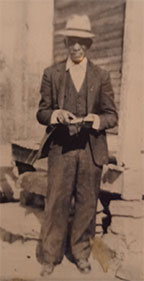
What Gwen did not know was on the occasion of her high school graduation, I remembered my Grandpapa Agnew, my daddy’s father, who was a slave. With joy in my heart, I thought about how far we had come to finally have someone in our family graduate from high school.

Grandpapa Agnew in a suit and hat with a building in the background
Grandpapa Agnew

I recalled the times when I was a little girl and Grandpapa Agnew stayed with us. I would sit on his lap and he would tell me stories about when he was growing up. The message I got from his stories was about how much better things were for us Negroes now than when he was born and how it was so important that we worked hard to find opportunities to better ourselves and our race.

When Mama and Daddy moved to Memphis, Grandpapa Agnew stayed in Mississippi with his daughter. He visited us when we lived in Memphis and Gwen was a little girl. He had the most beautiful silver, not gray, hair; walked with a cane, and wore a suit and a dress hat. It was such a blessing that he could see his great grandchild, one who would accomplish what he could not have had the imagination to realize.

Broken Promises, Shattered Lives, and the Pursuit of Happiness

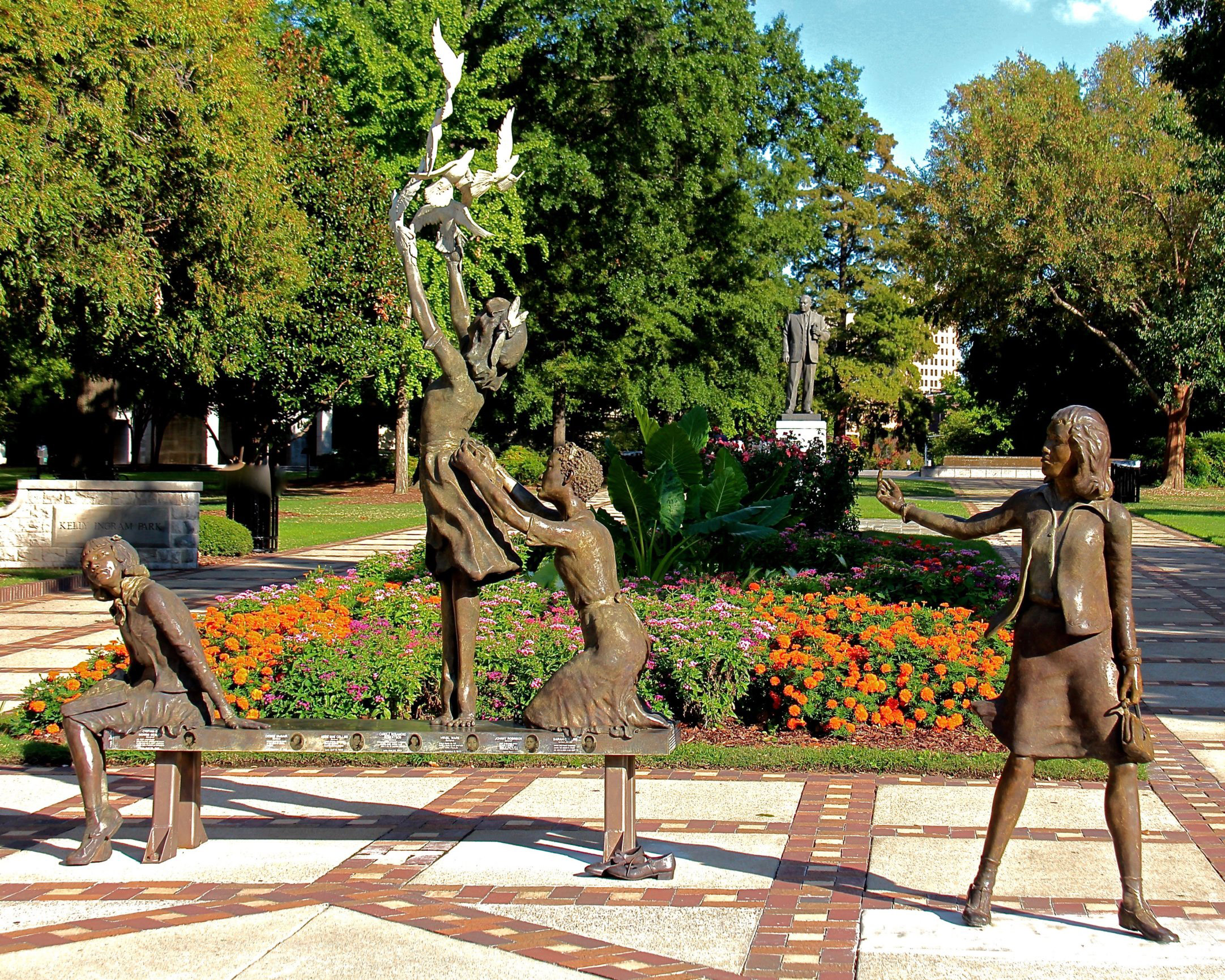
On September 15, 2023, Supreme Court Justice Ketanji Brown Jackson spoke at the 16th Street Baptist Church in Birmingham, Alabama, to commemorate the 60th anniversary of the church bombing that killed four Black girls–ages 11 and 14–and caused another 12-year-old girl to lose her eye.

Some of Justice Brown Jackson’s remarks were particularly poignant for me because I had listened to a Smithsonian Associates lecture just the day before entitled, “The Pursuit of Happiness,” by Dr. Richard Bell of the University of Maryland.

Justice Brown Jackson said, “Yes, our past is filled with too much violence, too much hatred, too much prejudice, but can we really say that we are not confronting those same evils now? We have to own even the darkest parts of our past, understand them, and vow never to repeat them.”

In his lecture, Dr. Bell recounted the shattered lives of Black people who pursued happiness during a time of great discontent. He gave numerous examples of the struggles of formerly enslaved Black people who were used as pawns by the British and slaughtered by the Patriots of the American Revolution. Broken promises by the British who changed terms of agreements on certificates and rewrote laws that disenfranchised the freedom seekers resulted in unmitigated violence and treachery and needlessly ended the lives of our ancestors who fought for freedom. It’s asking a lot to understand these dark parts of the past.

Black people who in good faith pursued their freedom by fleeing the slave holders and siding with the British became refugees of the Revolution while fighting to create a post-slavery society. Between 1775 and 1808, freedom seekers continued to petition and pursue their liberty even while fleeing from New York to Nova Scotia to Sierra Leone. Given the magnitude of their sacrifice and the depths of their despair, I don’t think they would see cause for our celebration of what Justice Brown Jackson described as “great strides that have been made since 1963.”

The bombing of the church came just two weeks after the March on Washington and the Rev. Dr. Martin Luther King’s “I Have a Dream” speech—a speech in which King spoke of the “promissory note” spanning from the Declaration of Independence that still had not been made good even 100 years after the Emancipation Proclamation. The bombing—and perhaps tellingly the two boys who also were killed in the chaos of that day in Birmingham, but who are largely still unknown outside of the Black community in that city—reinforces the pattern that our destination to freedom invariably takes us back into the caves of those who seek to enslave us.

Sadly, recurring attitudes of supremacy make the lure of freedom ever so elusive.

bronze art installation at Kelly Ingram Park representing the four girls killed in the 16th Street Baptist Church bombing on September 15, 1963, in Birmingham Alabama. The girls are depicted in play with one reaching for a group of ascending doves.

The public memorial for the children killed on September 15, 1963, sits across from the 16th Street Baptist Church in Birmingham, Alabama, at an entrance to Kelly Ingram Park.

Are you lucky?

Recently, I have been thinking about the concept and nature of luck. Throughout time there have been omens, signs and symbols that purport to predict or indicate good or bad luck.  

Following are some common superstitions around luck:

If you break a looking-glass you will have seven years of bad luck.

If the palm of your right hand itches, money is coming to you. If your left hand itches, money will be leaving you.

If you see a shooting star, make a wish and it will come true.

If you find a four-leaf clover it is a sign of good luck.

If you can, don’t plan anything on Friday the 13th because if anything could go wrong, it will on this date.

Before considering my question about whether or not you’re lucky, it may be helpful to first consider a definition of luck that may have common agreement. According to the Cambridge English Dictionary, luck is “the force that causes things, especially good things, to happen to you by chance and not as a result of your own efforts or abilities.”

Starting with the premise of good things happening—hence being lucky—do you think that being lucky is solely by chance, a proverbial roll of the dice? Or do you think that nothing happens serendipitously?

While enjoying a lovely dinner and an enviable view of Camelback Mountain at sunset with a dear friend, I asked my friend to tell me her thoughts on being lucky. Her cogent and assured response was impressive. As I listened, it seemed that the idea of being lucky was not something that she would ordinarily forward as the cause of good fortune. That became clear as she used three powerful terms to elucidate her idea of having good fortune: faith; surrender; and free will.

We were in complete agreement and harmony on the idea of faith or belief as a foundational requirement for positive outcomes. Having a strong faith is a touchstone of both of our lives. However, I needed to have her tell me more about what free will and surrender meant to her in responding to the question about being lucky. Though I dare not attempt to relay or summarize her ideas about free will and surrender, I was inspired to think about what these concepts meant to me in regard to luck.

As I continue to mull around with ideas about being lucky, I encounter big questions about the universe and our very existence. What I’m finding is that to live as a human, if we’re lucky—and though some of us may be uncomfortable with this kind of thinking—we will be open to conflating the ideas of logic, chance, serendipity, synchronicity with faith, free will, and surrender.

Jews of the Wild West

On Palm Sunday, April 2, 2023, I went to the Scottsdale Museum of the West to see a screening of the documentary film, Jews of the Wild West.

As I watched the film, I kept thinking about how the stories of Jewish people who immigrated to the United States and later to the Western United States appear to be missing from American history. The absence continues to be perpetuated in books and films today. A special thanks is owed to the nonprofit production company and to the filmmaker, Amanda Kinsey, for uncovering and sharing such a significant part of American history.

Notable Jewish migrants to the West are Levi Strauss, who we can thank for the jeans we wear; Isaac Shwayder, whose son, Jesse, founded the premier luggage line Samsonite; and Meyer Guggenheim, patriarch of the philanthropic Guggenheim family whose wealth came from the mining and smelting business. Women such as Golda Meir were also prominent in establishing a Jewish presence in the West. To say that these families had humble beginnings is an understatement.

They used their ingenuity, persistence, grit, and desire to make a life without persecution—one in which they not only survived the hardships of the frontier but thrived. They found that the Wild West had less antisemitism than New York City. In general, people who moved West had one thing on their minds: taking advantage of the riches the frontier would eventually offer.

The Jews who migrated West, for the most part, were not panning streams and mining for gold. They understood that people needed practical products and clothes as they pursued their dreams of a better life and their road to riches. The Jewish migrants may have started out as peddlers who made enough money to open a dry goods store as in the case of Shwayder. Eventually, they found markets within their communities and beyond that became their road to success. Because they were usually the only people in the community with a business, they often became the mayors of these frontier towns.

Jews of the Wild West is rich with the personal stories of the Jews who struck out for the Wild West and made good. Check out streaming platforms and American Public Television to see this film.