When I first heard about Percival Everett’s James, I thought rewriting Mark Twain’s Huckleberry Finn from the slave’s perspective was an inventive idea. When I finished reading the book, I thought exploring the interior life of and giving voice to the slave, Jim, was genius.
Evidently, I was not alone, as James won the National Book Award for 2024, and was selected by both The Washington Post and The New York Times Book Review as one of the best books of 2024.
It’s not only the idea of “translating” Huckleberry Finn that’s so incredible to me. It’s the rare and raw telling of what life was like for enslaved people just a couple of decades before the 20th century. Like many others, to more fully appreciate James, I felt compelled to reread Huckleberry Finn.
What struck me most intensely in Twain’s telling of the storywere the ordeals Jim had to suffer for the amusement of Huck Finn and Tom Sawyer. The boys were not being purposely malicious toward Jim. They—Tom Sawyer in particular—were having an adventure at Jim’s expense, seemingly ignorant of the physical hardship their plans required and apparently oblivious to Jim’s urgent need to rescue his family.
In contrast to Huckleberry Finn, in James, Huck and Jim were friends helping one another. Their trials were shared. Often it was essential for them to be united in plans and purposes to be safe from discovery.The human connection between Huck and Jim is deeper than their status as slave and White boy. Both were seeking their own respective freedoms and they relied on one another for what each could bring to their endeavor.
In Huckleberry Finn, Jim had no agency. If he wanted help he had to acquiesce to every whim of the boys. However, though he appears an unwitting victim in the games the boys played and served as their human toy, he knew the ways of White folks.
In James, it’s clear that knowing the ways of White folks was the best defense against some of the hard realities of being a slave. The next best defense was knowing White folks better than White folks knew the slaves.
In James, Everett expertly describes code switching as if it were a foreign language spoken by people who understood that to be seen as intelligent or even having the desire to learn—such as opening a book or harboring a pencil—could be the difference between life and death.
James is not only genius in its approach as a novel but does what art does best in challenging those who behold it and allow themselves to consider the important questions raised. In what ways do we continue to code switch and employ survival techniques? How can we be more responsible with our own agency, acknowledge and respect the inherent agency and dignity of others, and find balance in it all? How can understanding the varying perspectives of those with whom we travel different parts of life’s journey help all of the parties involved?
The explosion of Black creativity 100 years ago—known as the “New Negro Movement” or “Harlem Renaissance”—saw Black creatives boldly demonstrating their unique artistic gifts in traditional representations as well as in angry and political forms.
Aspiration, by Aaron Douglas (1936)
Though it may not have been the impetus for this explosion of creativity, it was occurring in the midst of the greatest migration of Black people from the South to other parts of the country. Pushed by poverty, injustices inherent in sharecropping, the prevalence of Jim Crow laws, and the constant threat of inhumane violence, Black people left the only places most of them knew as home and ventured on faith and a prayer into unknown lands that were also suspect.
Having found a refuge from sanctioned violence and a way out of abject poverty, many Black people were able to allow their creativity to flourish. Though many of the most prominent and celebrated creatives had not experienced first-hand the cruelest injustices their Black brothers and sisters from the South were fleeing, proximity and knowledge of suffering and resilience, alike, served as the impetus to create and invested the artists’ creativity with meaning.
Also, in utilizing these realities as subject matter, creatives were able to elevate and reveal to the world the state of most Black Americans fleeing the South. Out of pain came genius and culture in which Black artists seemed unified in purpose, if not style, in showing what the world of Black people was and what it could be.
With the recent release of The Six Triple Eight on Netflix, it seemed appropriate to reshare this guest blog by Carmen Jordan-Cox, PhD, shedding more light on this remarkable group of women too long overlooked…
I just finished listening on Audible to April Ryan’s book, Black Women Will Save The World: An Anthem. This is a powerful and emotional reflection on the toils and unwavering leadership of Black women in a world in which our contributions are not valued and, in fact, our very selves often are devalued.
This book made me think about those women—“hidden figures” —who, over the decades, have provided the very foundation for all the successes of subsequent generations of Black families. One such group of “hidden figures” is the 6888th Central Postal Directory Battalion from World War II.
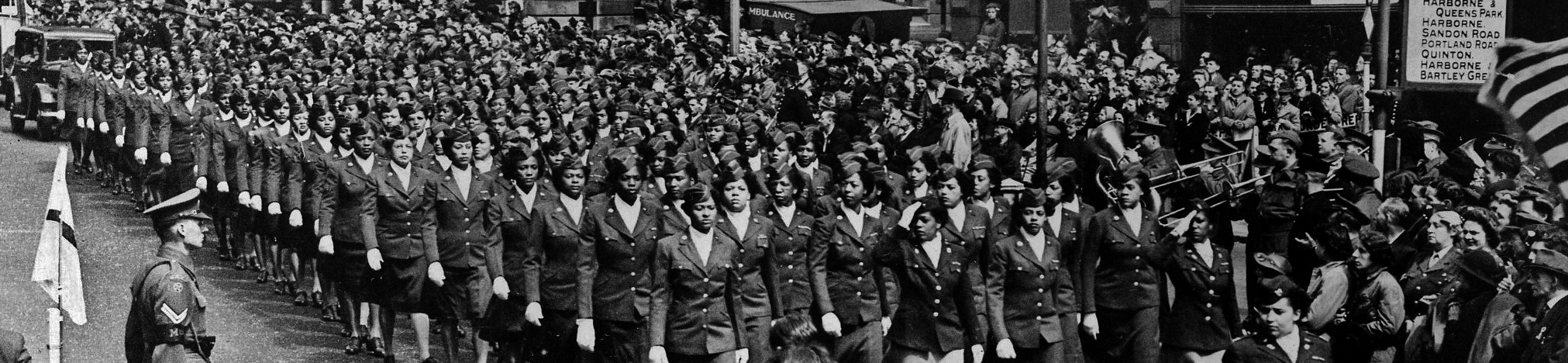
The 6888th was a unique U.S. Army unit that had the distinction of being the only all-female, African American battalion to serve in the European Theater of Operations during World War II. Made up of 855 women—824 enlisted and 31 officers—this Women’s Army Corps Battalion was commissioned in Europe between February 1945 and March 1946, and was led by 26-year-old Major Charity Adams.
The specific mission of the 6888th was to sort and clear a multi-year backlog of mail for the American Army, Navy, Air Force, the Red Cross, and uniformed civilian specialists who were stationed in Europe. This represented seven million people awaiting mail.
In February 1945, the first contingent of the 6888th embarked from Camp Shank, New York, to sail for Britain. They survived close encounters with Nazi U-boats and arrived in Glasgow, Scotland, where a German V-1 rocket exploded near the dock. The second contingent of 6888th soldiers docked in March 1945 in Gourock, Scotland.
Upon arrival by train in Birmingham, England, the Battalion confronted warehouses stacked to the ceiling with letters and packages. They endured inhumane working conditions, including dark, unheated, rat-infested aircraft hangars with broken windows and air raids. Despite these conditions, the Battalion created a new mail tracking system, worked 3 separate 8-hour shifts, 7 days a week to process an average of 65,000 parcels per shift (which is 195,000 daily), and cleared the 6-month backlog of mail in 3 months.
After resolving the immense mail backlog in Birmingham, the 6888th Battalion sailed to France for their next assignment in Rouen. They encountered undelivered mail dating back two to three years, which the Battalion again successfully processed and cleared in just three months.
Upon concluding their final assignment in Paris, the last of the Battalion returned to the United States by ship and was disbanded in March 1946 at Fort Dix, New Jersey. There were no parades, public appreciation, or official recognition of their accomplishments.
Adhering to the motto, “No mail, low morale,” the Battalion provided essential support to the U.S. military in the European Theater of Operations by linking service members to their loved ones back home. The 6888th achieved unprecedented success and efficiency in solving the military’s postal problems. The Battalion was the largest contingent of African American women to ever serve overseas, dispelling stereotypes and representing a change in racial and gender roles in the military.
It was not until nearly 80 years later that the 6888th received the well-deserved recognition for their service to the United States. In March 2022, the Battalion became the only women’s military unit to be awarded the Congressional Gold Medal, which was first awarded to General George Washington in 1776.
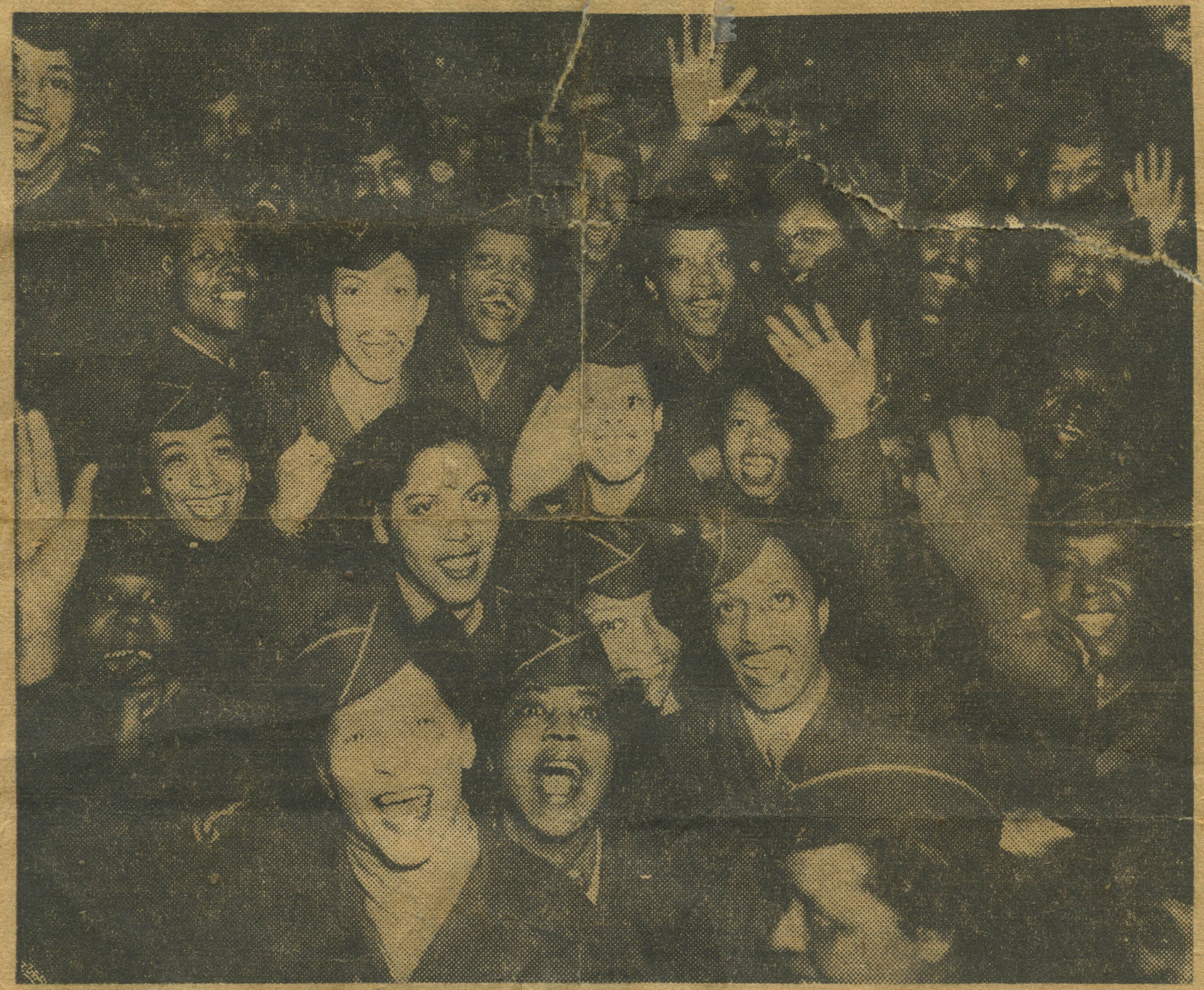
Iconic photo from when the last of the Women’s Army Corps (WAC) returned home from France. Annie Knight (Jordan) is the woman with the big smile in the top left corner.
The 6888th has a very special significance for me. My mother, Private First Class Annie Knight (Jordan), was one of those brave Battalion soldiers. As kids, my siblings and I always knew that she was in the Women’s Army Corps (something about which she was extremely proud). She mentioned to us that she did Morse code. We just thought of that as being like another language of sorts. It was not until Fall 2022 that we understood that her enlistment classification was not military postal worker. In fact, mom was in a special category called “Cryptographic Code Compiler.” Cryptographers, also known as code breakers, were secretly trained to crack code that provided intelligence information for the Army. Very little is known of the Black women who served in this capacity.
As I learned more about the 6888th, I began to think about how many ”hidden figures” there are and wonder how we might ensure that their stories are shared and their legacies known. I asked questions like, “What inspired these 855 African American women to enlist and pursue the 6888th?” “What gave them the internal fortitude to take on unknown ventures in a dangerous foreign land?” “What made them so different?” and “How did that very difference change the course of their lives post-military service and influence their legacies?”
So, in 2022, I became a first-time podcaster: NextUs818 Podcast is a reflective platform for connecting past successes with future progress in the African American community. There are many African American heroes—some known and many unsung men and women—who helped build this country. Some were the first or only in their fields of endeavor, like the 6888th. Yet little is known about how their unique journeys influenced the trajectory of their familial legacies…such as their children, grandchildren, nieces, nephews. The NextUs818 Podcast introduces the multi-generational descendants of these heroes. On the first and third Wednesdays of each month, I interview descendants of an African American hero and explore family lore, traditions, and values, and how the descendant’s journey was directly impacted.
The inaugural season of the NextUS818 Podcast features the descendants of the 6888th Central Postal Directory Battalion. [Four] themes have emerged to help me better understand what inspired the 6888th soldiers and how their service has influenced subsequent generations: patriotism, fearlessness, adventurousness, and unwavering commitment to lifelong learning.
Patriotism: Despite the rampant racial and gender discrimination of early 1940s America, these women were exceptionally patriotic. With the country at war, they felt that it was their DUTY to contribute to the war efforts against the Hitler regime. They eagerly embraced this chance to serve.
Fearlessness: The notion of a young African American woman going into war zones would be darn right scary, even today. Yet these brave women exhibited a remarkable degree of fearlessness.
Adventurousness: Not only did these women demonstrate fearlessness, but they were excited to explore the unknown. As kids, mom always spoke about her adventures, especially once the Battalion moved on to France. In all the stories I heard about the women, they saw serving in the Army as a way of giving them broad exposure and opening post-military opportunities otherwise unavailable to them.
Commitment to lifelong learning: Many of the women went on to attend college after their military service, some using the G.I. Bill when the opportunity was available. (See How the GI Bill’s Promise Was Denied to a Million Black WWII Veterans.) Their unwavering commitment to education deeply influenced their children and grandchildren.
In the NextUs818 Podcast, I enjoy hearing the stories of the soldiers’ civilian lives after World War II. The women of the 6888th were college graduates, teachers, nurses, college deans, and entrepreneurs. As important, they influenced the trajectory of their children and grandchildren who, among other things, are PhDs, physicians, engineers, lawyers, educators, professional musicians, and financial and advertising executives. All of the descendants with whom I have spoken emphasize that their successes are directly attributable to the foundation laid by the women of the 6888th. From them, they learned how to be focused, tenacious, and how to persevere under adverse circumstances. They learned how to survive and thrive. So when we are tempted to live in the moment and think we got here solely on our merit, we must never forget those shoulders on which we stand!
Five final notes:
Fort Lee Redesignation: The U.S. Department of Defense has made a commitment to rename military bases named after individuals associated with the Confederacy and other dark periods in American history. On April 27, 2023, Fort Robert E. Lee [was] renamed “Fort Gregg–Adams” in honor of two trailblazing African American officers: Retired Lt. General Arthur Gregg and the late Lt. Col. Charity Adams (commander of the 6888th Battalion).
6888th Legacy Tour: A group of 6888th descendants and advocates will return to Scotland, England, and France, walking on the grounds where the brave soldiers made history as part of an upcoming 6888th Legacy Tour [in October 2025].
Tyler Perry Studios and Netflix [released their] movie about the 6888th [on December 6, 2024].
Carmen Jordan-Cox, PhD, is a retired university vice president and judge/magistrate. Currently, she is producer and host of NextUs818 Podcast and a freelance curator of stories about descendants of World War II soldiers.
I guess it’s because of the holiday season that my mind is on food and who’s cooking.
It’s a puzzlement to me that I can only remember one meal that my mother cooked. I recall that the meal was very special even though there was no special occasion. She was just in the mood to cook something that we had never eaten before.
This was a rare treat that I longed to have repeated, but between her migraines, moods, and messy life, there was no time for simple necessities such as cooking. And further, she didn’t like to eat. Just toast and tea for breakfast, and if she decided to eat something in the evening it would be just a bit of food and more tea. With more than a little disdain for someone who she thought was eating too much, she would say, “We’re supposed to eat to live, not live to eat.”
Though my reminisces about my mother might seem harsh and unforgiving sometimes, I believe that the migraines, moods, and messiness of her life were the result of emotional and physical abuse, as well as a life that fell far short of her potential and ambitions.
From what she told me of her very early years, it is obvious to me that she had many gifts. As early as five years of age, when she first became a babysitter, she said that she understood that she was supposed to work hard, love, and have faith in God. I believe that she tried to do this.
Being an only child of sharecroppers “way back in the woods,” as she described where they lived, she had few interactions with other children. Her companions were animals found near where she lived. Instead of a dog like children usually have, she had a pig that she loved and was devastated when it was finally slaughtered for food.
During those early years, her only playmate as she referred to him, was a boy shunned and abused by other children because of the way he looked and his inability to speak normally. When others did not know what the little boy was trying to say, she would translate for him.
From what she told me, it seems that she had an innate sense for understanding both animals and humans and a natural empathy for those who were seen as outsiders or mistreated.
My mother had many virtues and attributes that one would only know by listening to her talk about her life. When I listened to her, I always got the sense that she thought that she was never loved enough.
During this holiday season, I want to think about her and be grateful that she was my mother. I hope that some of the goodness that was innate in her has been gifted to me.
According to TheWashington Post exit polls, 92% of Black women voted for Kamala Harris to be president. Other polls also indicated that more than 90% of Black women voted for Harris. While the number of Black women voting for Harris is overwhelming, it took large numbers of other women and men to generate the number of votes the candidate received. I’m especially grateful that women showed what enthusiasm and sisterhood could accomplish. All who voted for Harris should feel proud of what we accomplished.
Pride aside, no one should be surprised that those men and women who worked to get Harris elected were let down after the election. “Let down” is surely an understatement for those who pushed a boulder up a mountain higher than they thought was possible. When it came crashing back down, many dedicated Black women, in particular, felt crushed.
People react to disappointment in different ways. Some are angry and get some kind of release in blaming those who didn’t help with the nearly impossible task. Some are disillusioned and blame themselves for daring to hope when the system never changes. Some are speaking out about not participating in what they see as futile efforts in a nation that hates them and is rigged against them.
We can’t ignore the overwhelming feelings of anger and frustration after so much effort and hope has been expended toward what was an incredible goal of electing our candidate as president of the United States. Although our feelings and reactions are as varied as we are as individuals, we are similar and consistent in not succumbing to what others might see as defeat.
Like any powerful fighters, taking time to rest and regroup is natural and necessary in order to come back strong to fight another day.
Reading the November issue of the AARP Bulletin about “super agers,” people who seem to defy the common complications of aging and appear destined to live a very long life, I recalled a recent conversation with a friend I’ve known since high school. We laughed as we talked about some of the experiences we’re having as people of a certain age and generation.
We laughed and made jokes about not wanting to live as long as science predicts that super agers might live. We agreed that the most unthinkable downside of living a long life would be outliving loved ones younger than us.
Another major downside of living a long life is the specter of becoming a living, breathing, walking ghost in our own time. Having experienced the loss of friends our age, we find ourselves in communities where we have fewer and fewer peers and no matter where we are, we think we are the oldest in the room.
As we have always done, we looked for the humor in our situation. We decided that we were living ghosts because younger people don’t really see us. They know that we’re here as a presence but not really an entity with whom they should engage. They feel our ghostly presence but not as contributors to the life they’re living.
We don’t blame them for not engaging with us. We understand that they don’t seek conversations with us because they “know” that we probably can’t connect with what they’re talking about regarding their social media interests, music they’re listening to, movies that appeal to them, and the fashions that are most fun and attractive to them. They see us as old-fashioned as we saw our elders when we were young.
We laughed as we shared anecdotes that supported our understanding that we were living, breathing, walking ghosts.
I told her about an experience I had some time ago when I was thrilled to be with a young friend at a club enjoying music and conversation while people-watching. A couple of seats at our table were empty. After some time, a young couple took the seats. After a while they asked “us” if “we” had heard this music group before.
That was the opening to talk about other things that “they” had in common. I care about my young friend, so I was not upset. I was just observant. The three of them engaged in animated conversation throughout the evening, never seeming to notice that I was a living, breathing human sitting with them at this very small table.
I couldn’t believe how unaware they were that I was excluded from the conversation. I don’t think ignoring me was out of malice or even bad manners. It was just how things are.
Thankfully, the situation at the club was the most blatant demonstration of exclusion and being treated as a void that I have had.
My long-time friend and I concluded that we ought to keep these rare instances in perspective and not allow the behavioral inclinations of the young to influence our worth and self-esteem. As we reminded ourselves, we have always swum against the tide and don’t plan to stop swimming any time soon.
According to notes in one of my older journals, I was struck by comments that Oprah and Tyler Perry made in an interview for Essence. Both attributed experiences growing up as catalysts that propelled them to their extraordinary success. Perry said that he thought it took “all of that hell, all of that darkness, to become who I am now.” Oprah expressed a similar sentiment, saying, “being born in Mississippi, in the year I was born, was Providence.”
But what if their experiences had nothing to do with their subsequent lives, especially their good fortune? What if Oprah and Tyler Perry are the lucky ones? Many, if not most, people who had a hard life growing up get caught in a cycle of hard times and never escape. They can never seem to get a break. Is a hard life their destiny?
Then there are those of us who see ourselves as fortunate and blessed, not on the same kind of scale of success as Oprah and Tyler Perry, but lucky, nonetheless, because we have attained a better life than might have been predicted for us based on our younger life experiences.
I get a lot of satisfaction out of remembering the times that I thought were devastating when they happened and realized at a later time that it was these experiences that helped me develop some of the skills and values that have been most important in creating the life I want and cherish.
Most of all, I cherish those experiences that may have caused tears of sadness or anger and now bring laughter and sometimes tears of joy.
Remembering my brush with learning to play the piano makes me realize that I don’t give my mother enough credit for all she did to show her love.
When I was 14 or 15, I told my mother that I wanted to learn to play the piano and asked if it would be possible for me to take lessons. This was a big ask for someone in a family often just scraping by. But Muhdear did all the legwork of finding a piano, a music teacher, the $10 per lesson, and someone to drive me miles from home for lessons as often as possible.
The lessons were a disaster from the start. I thought the music teacher was too old, he had bad breath, and his method of teaching made me feel stupid. He was always harping about how I needed to practice. He had no idea what that was like for me.
No matter when I would practice, it was the wrong time for someone. If I practiced after school, my grandmother (and sometimes my mother when she was out of a job) would be watching one of their soap operas. They would beg me to practice later so they could hear the television. My grandmother would say, “Child, have some mercy on us and practice later.”
If I practiced on Saturday afternoon, in addition to relatives and friends just dropping by, my grandmother would have customers in the kitchen waiting to get their hair done, and my grandfather would have customers for haircuts sitting in the dining room waiting their turn.
The piano was in the dining room. Out of the corner of my eye, I could see the men waiting for haircuts shaking their heads, covering their mouth, and trying not to laugh out loud as I practiced. My grandfather would say, “Gal, stop all that noise and find something else to do.”
Despite the discouragement, I tried to practice. The last straw, however, was when my favorite aunt—my grandmother’s sister—and her husband, Uncle, came by one Saturday when I was practicing.
As they were approaching the door to the apartment, they heard me practicing. I don’t know what she said, but I could tell by the tone and subsequent laughter that my aunt had said something derisive about my playing. When she passed behind my bench on the way to the kitchen where women were waiting to get their hair done, uncharacteristically, I ignored her. Uncle followed behind my aunt and, as he was passing, he placed a quarter on the piano near the keyboard and asked in his deep voice, “Is this enough for you to stop practicing?”
Apparently, there was already tension in the air because as the insult traveled like a rushing wind from the men waiting for haircuts to the women waiting to get their hair done, like the burst of a balloon, no one could hold in their laughter any longer. All the hair-cutting and hair-fixing stopped for a while so the pent-up laughter could come out throughout the apartment. Some laughed so hard tears streamed out and others had to go to the bathroom.
At the time, I was devastated. Years later, I could see the humor and would share the story with friends because it was funny!
Taking nothing away from the humor of this tale, in this young and ignorant phase of my life, I made some decisions based on this one incident that were rash, hurtful, and disrespectful. My decisions and subsequent actions as an ignorant teenager do not reflect who I have continued to become. They lacked values that I now hold dear such as reflection, respect, and empathy.
Though we may never know and understand the causes of events in our lives, we can use the experiences to shape the kind of person we want to be.
Make no mistake, the upcoming presidential election is consequential. Americans on both sides see this race as being about the future of democracy. By all accounts, the race will be close. No matter what happens, a good portion of the electorate will feel a certain kinda way…
But we’ll be all right BECAUSE this is about the future of democracy.
And the future of democracy is US. It is as much about what we do on November 6, and every day thereafter, as what we do on Election Day. It is about how we carry on. It is about the peaceful transfer of power. It is about checks and balances so no one person or branch wields too much of that power. It is about what we want our communities to be like, and the legacy we want to leave the next generation.
In the heightened media fervor that surrounds elections, it may be hard to see, but people across the country are hard at work building bridges. While polarization is real, the majority (silent as it may be) still resides closer to the middle.
Groups like Braver Angels, One America Movement, and others, are working to turn down the temperature. Democracy and peacebuilding groups like the Carter Center and Search for Common Ground are bringing decades of experience working overseas to address risk factors that they’ve seen arise domestically.
PACE (Philanthropy for Active Civic Engagement) has been focusing on civic language and perceptions for a few years now. Their most recent research finds people are more positive about a host of civic terms than they were just a couple of years prior. This is not a fluke, but the result of people getting to work, as is the hallmark of democracy and our self-governing society.
As we look ahead to the 250th anniversary of the signing of the Declaration of Independence in 2026, let us remember that the next 250 years are not promised to us. No one is going to do the hard work of democracy for us. What the nation will be is always ours to determine.* Our vote is just the start…
*As President Barak Obama noted in his farewell address, the inalienable rights noted in the Declaration of Independence, “while self-evident, have never been self-executing.”
Kaaryn McCall is a communications consultant who, in addition to supporting Dr. Dungy, works with nonprofit organizations to most effectively leverage strategic communications to support their missions.
This is my most important vote, ever. During this messy present, it may be the last time I have the right to vote as an African American woman and the fact that my expiration date is nearing based on statistical data.
I took my sweet time completing my ballot. I started at the bottom and worked my way up to the top of the ballot because I know how important our state and local legislators are to the well-being of the communities in which we live.
Prior to receiving my ballot, I took every opportunity to hear and see candidates and to explore their past records.
When I was not sure about propositions, I didn’t just guess. I took time to learn as much as I could, and I relied on those in the know who I trust to tell me what they knew about judges and others on various boards.
I feel good about the seriousness with which I completed my ballot. If it is my last opportunity to vote, I gave it my best.
Listening to the radio on my way to work, I flinched in annoyance when I heard then-presidential candidate Bill Clinton reference benefits expressly for the “middle class.” Never having the luxury of financial security myself—as I’ve lived from paycheck to paycheck and I’m a Black woman always fearful of losing my job regardless of the merits of my work—the candidate was not speaking to me.
I think most people see themselves as middle class even if they meet the criteria for what is referred to as “working class” or the “working poor.” Therefore, it makes sense that the public relations teams for those making appeals for votes want their candidates to speak to the largest number of voters. These voters want to be called by name when it comes to policies that may have an impact on their financial and social status.
I just wish that good-hearted smart people would not buy in to the cultural and societal habit of categorizing people into a class or caste system based on arbitrary criteria such as income and social status. I feel better when I hear politicians talk about all the people and how what they champion will benefit everyone who needs help.
In addition to calling out the middle class, most candidates say that they represent all the people when they speak in different venues and in many of their campaign ads. It’s the calling out of the middle class that makes me wish that the constituent message would be more like President Lyndon B. Johnson’s reference to the people as the “Great Society.” This positive outlook for everyone feels better to me than identifying and thus ranking people according to class.
As I write this, I ask myself, “Why does this matter to me?” It matters to me because calling out the middle class is just another way of excluding people who don’t have the requisite income and societal status deemed good enough to be middle class.
In the end, I will support candidates who champion inclusion in their policies and who seek solutions that are helpful and not harmful to any people. We owe it to ourselves and to our country to champion leaders who strive to promote a society for all the people even if they must call out the middle class in their efforts to be elected.







 Gwen Dungy