The explosion of Black creativity 100 years ago—known as the “New Negro Movement” or “Harlem Renaissance”—saw Black creatives boldly demonstrating their unique artistic gifts in traditional representations as well as in angry and political forms.
Aspiration, by Aaron Douglas (1936)
Though it may not have been the impetus for this explosion of creativity, it was occurring in the midst of the greatest migration of Black people from the South to other parts of the country. Pushed by poverty, injustices inherent in sharecropping, the prevalence of Jim Crow laws, and the constant threat of inhumane violence, Black people left the only places most of them knew as home and ventured on faith and a prayer into unknown lands that were also suspect.
Having found a refuge from sanctioned violence and a way out of abject poverty, many Black people were able to allow their creativity to flourish. Though many of the most prominent and celebrated creatives had not experienced first-hand the cruelest injustices their Black brothers and sisters from the South were fleeing, proximity and knowledge of suffering and resilience, alike, served as the impetus to create and invested the artists’ creativity with meaning.
Also, in utilizing these realities as subject matter, creatives were able to elevate and reveal to the world the state of most Black Americans fleeing the South. Out of pain came genius and culture in which Black artists seemed unified in purpose, if not style, in showing what the world of Black people was and what it could be.
With the recent release of The Six Triple Eight on Netflix, it seemed appropriate to reshare this guest blog by Carmen Jordan-Cox, PhD, shedding more light on this remarkable group of women too long overlooked…
I just finished listening on Audible to April Ryan’s book, Black Women Will Save The World: An Anthem. This is a powerful and emotional reflection on the toils and unwavering leadership of Black women in a world in which our contributions are not valued and, in fact, our very selves often are devalued.
This book made me think about those women—“hidden figures” —who, over the decades, have provided the very foundation for all the successes of subsequent generations of Black families. One such group of “hidden figures” is the 6888th Central Postal Directory Battalion from World War II.
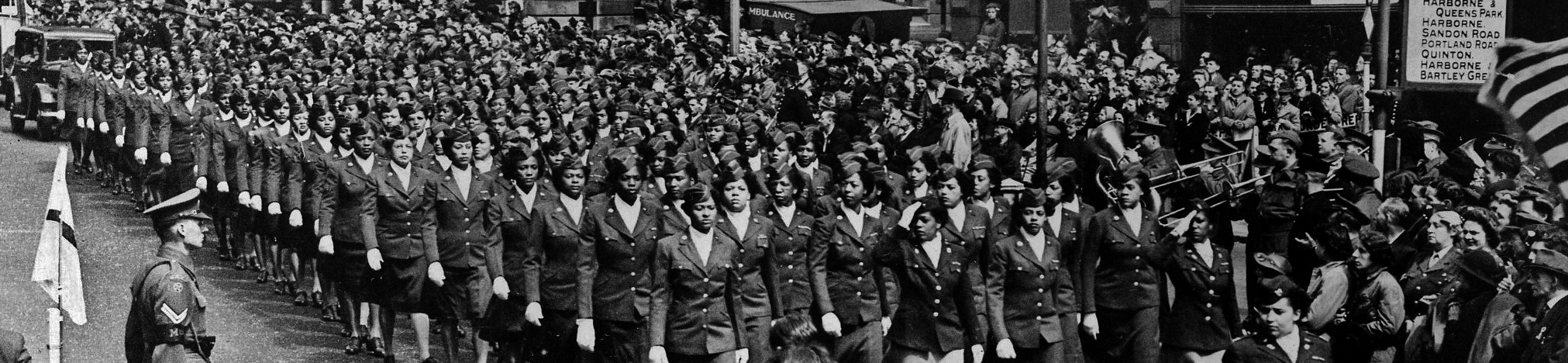
The 6888th was a unique U.S. Army unit that had the distinction of being the only all-female, African American battalion to serve in the European Theater of Operations during World War II. Made up of 855 women—824 enlisted and 31 officers—this Women’s Army Corps Battalion was commissioned in Europe between February 1945 and March 1946, and was led by 26-year-old Major Charity Adams.
The specific mission of the 6888th was to sort and clear a multi-year backlog of mail for the American Army, Navy, Air Force, the Red Cross, and uniformed civilian specialists who were stationed in Europe. This represented seven million people awaiting mail.
In February 1945, the first contingent of the 6888th embarked from Camp Shank, New York, to sail for Britain. They survived close encounters with Nazi U-boats and arrived in Glasgow, Scotland, where a German V-1 rocket exploded near the dock. The second contingent of 6888th soldiers docked in March 1945 in Gourock, Scotland.
Upon arrival by train in Birmingham, England, the Battalion confronted warehouses stacked to the ceiling with letters and packages. They endured inhumane working conditions, including dark, unheated, rat-infested aircraft hangars with broken windows and air raids. Despite these conditions, the Battalion created a new mail tracking system, worked 3 separate 8-hour shifts, 7 days a week to process an average of 65,000 parcels per shift (which is 195,000 daily), and cleared the 6-month backlog of mail in 3 months.
After resolving the immense mail backlog in Birmingham, the 6888th Battalion sailed to France for their next assignment in Rouen. They encountered undelivered mail dating back two to three years, which the Battalion again successfully processed and cleared in just three months.
Upon concluding their final assignment in Paris, the last of the Battalion returned to the United States by ship and was disbanded in March 1946 at Fort Dix, New Jersey. There were no parades, public appreciation, or official recognition of their accomplishments.
Adhering to the motto, “No mail, low morale,” the Battalion provided essential support to the U.S. military in the European Theater of Operations by linking service members to their loved ones back home. The 6888th achieved unprecedented success and efficiency in solving the military’s postal problems. The Battalion was the largest contingent of African American women to ever serve overseas, dispelling stereotypes and representing a change in racial and gender roles in the military.
It was not until nearly 80 years later that the 6888th received the well-deserved recognition for their service to the United States. In March 2022, the Battalion became the only women’s military unit to be awarded the Congressional Gold Medal, which was first awarded to General George Washington in 1776.
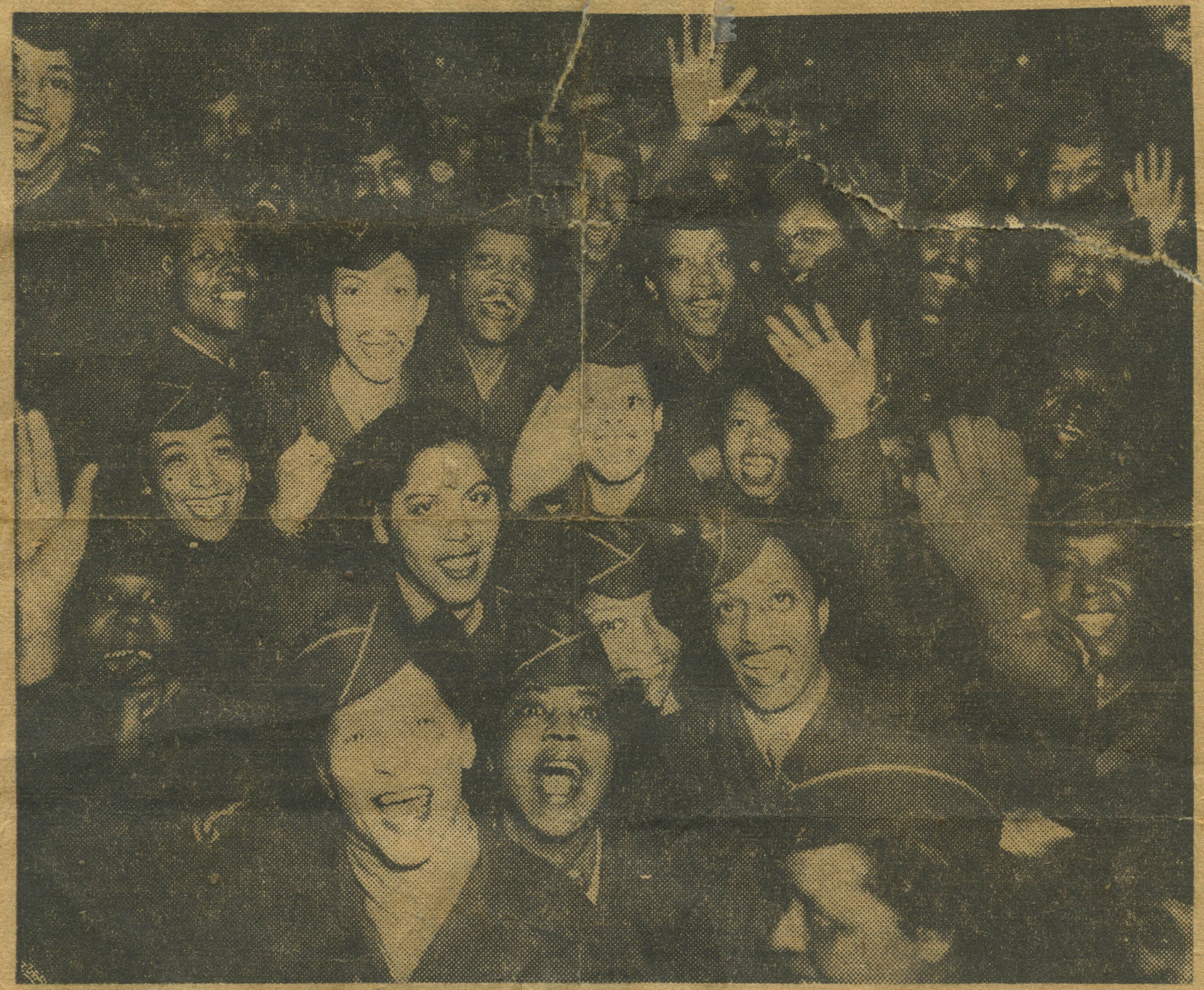
Iconic photo from when the last of the Women’s Army Corps (WAC) returned home from France. Annie Knight (Jordan) is the woman with the big smile in the top left corner.
The 6888th has a very special significance for me. My mother, Private First Class Annie Knight (Jordan), was one of those brave Battalion soldiers. As kids, my siblings and I always knew that she was in the Women’s Army Corps (something about which she was extremely proud). She mentioned to us that she did Morse code. We just thought of that as being like another language of sorts. It was not until Fall 2022 that we understood that her enlistment classification was not military postal worker. In fact, mom was in a special category called “Cryptographic Code Compiler.” Cryptographers, also known as code breakers, were secretly trained to crack code that provided intelligence information for the Army. Very little is known of the Black women who served in this capacity.
As I learned more about the 6888th, I began to think about how many ”hidden figures” there are and wonder how we might ensure that their stories are shared and their legacies known. I asked questions like, “What inspired these 855 African American women to enlist and pursue the 6888th?” “What gave them the internal fortitude to take on unknown ventures in a dangerous foreign land?” “What made them so different?” and “How did that very difference change the course of their lives post-military service and influence their legacies?”
So, in 2022, I became a first-time podcaster: NextUs818 Podcast is a reflective platform for connecting past successes with future progress in the African American community. There are many African American heroes—some known and many unsung men and women—who helped build this country. Some were the first or only in their fields of endeavor, like the 6888th. Yet little is known about how their unique journeys influenced the trajectory of their familial legacies…such as their children, grandchildren, nieces, nephews. The NextUs818 Podcast introduces the multi-generational descendants of these heroes. On the first and third Wednesdays of each month, I interview descendants of an African American hero and explore family lore, traditions, and values, and how the descendant’s journey was directly impacted.
The inaugural season of the NextUS818 Podcast features the descendants of the 6888th Central Postal Directory Battalion. [Four] themes have emerged to help me better understand what inspired the 6888th soldiers and how their service has influenced subsequent generations: patriotism, fearlessness, adventurousness, and unwavering commitment to lifelong learning.
Patriotism: Despite the rampant racial and gender discrimination of early 1940s America, these women were exceptionally patriotic. With the country at war, they felt that it was their DUTY to contribute to the war efforts against the Hitler regime. They eagerly embraced this chance to serve.
Fearlessness: The notion of a young African American woman going into war zones would be darn right scary, even today. Yet these brave women exhibited a remarkable degree of fearlessness.
Adventurousness: Not only did these women demonstrate fearlessness, but they were excited to explore the unknown. As kids, mom always spoke about her adventures, especially once the Battalion moved on to France. In all the stories I heard about the women, they saw serving in the Army as a way of giving them broad exposure and opening post-military opportunities otherwise unavailable to them.
Commitment to lifelong learning: Many of the women went on to attend college after their military service, some using the G.I. Bill when the opportunity was available. (See How the GI Bill’s Promise Was Denied to a Million Black WWII Veterans.) Their unwavering commitment to education deeply influenced their children and grandchildren.
In the NextUs818 Podcast, I enjoy hearing the stories of the soldiers’ civilian lives after World War II. The women of the 6888th were college graduates, teachers, nurses, college deans, and entrepreneurs. As important, they influenced the trajectory of their children and grandchildren who, among other things, are PhDs, physicians, engineers, lawyers, educators, professional musicians, and financial and advertising executives. All of the descendants with whom I have spoken emphasize that their successes are directly attributable to the foundation laid by the women of the 6888th. From them, they learned how to be focused, tenacious, and how to persevere under adverse circumstances. They learned how to survive and thrive. So when we are tempted to live in the moment and think we got here solely on our merit, we must never forget those shoulders on which we stand!
Five final notes:
Fort Lee Redesignation: The U.S. Department of Defense has made a commitment to rename military bases named after individuals associated with the Confederacy and other dark periods in American history. On April 27, 2023, Fort Robert E. Lee [was] renamed “Fort Gregg–Adams” in honor of two trailblazing African American officers: Retired Lt. General Arthur Gregg and the late Lt. Col. Charity Adams (commander of the 6888th Battalion).
6888th Legacy Tour: A group of 6888th descendants and advocates will return to Scotland, England, and France, walking on the grounds where the brave soldiers made history as part of an upcoming 6888th Legacy Tour [in October 2025].
Tyler Perry Studios and Netflix [released their] movie about the 6888th [on December 6, 2024].
Carmen Jordan-Cox, PhD, is a retired university vice president and judge/magistrate. Currently, she is producer and host of NextUs818 Podcast and a freelance curator of stories about descendants of World War II soldiers.
According to notes in one of my older journals, I was struck by comments that Oprah and Tyler Perry made in an interview for Essence. Both attributed experiences growing up as catalysts that propelled them to their extraordinary success. Perry said that he thought it took “all of that hell, all of that darkness, to become who I am now.” Oprah expressed a similar sentiment, saying, “being born in Mississippi, in the year I was born, was Providence.”
But what if their experiences had nothing to do with their subsequent lives, especially their good fortune? What if Oprah and Tyler Perry are the lucky ones? Many, if not most, people who had a hard life growing up get caught in a cycle of hard times and never escape. They can never seem to get a break. Is a hard life their destiny?
Then there are those of us who see ourselves as fortunate and blessed, not on the same kind of scale of success as Oprah and Tyler Perry, but lucky, nonetheless, because we have attained a better life than might have been predicted for us based on our younger life experiences.
I get a lot of satisfaction out of remembering the times that I thought were devastating when they happened and realized at a later time that it was these experiences that helped me develop some of the skills and values that have been most important in creating the life I want and cherish.
Most of all, I cherish those experiences that may have caused tears of sadness or anger and now bring laughter and sometimes tears of joy.
Remembering my brush with learning to play the piano makes me realize that I don’t give my mother enough credit for all she did to show her love.
When I was 14 or 15, I told my mother that I wanted to learn to play the piano and asked if it would be possible for me to take lessons. This was a big ask for someone in a family often just scraping by. But Muhdear did all the legwork of finding a piano, a music teacher, the $10 per lesson, and someone to drive me miles from home for lessons as often as possible.
The lessons were a disaster from the start. I thought the music teacher was too old, he had bad breath, and his method of teaching made me feel stupid. He was always harping about how I needed to practice. He had no idea what that was like for me.
No matter when I would practice, it was the wrong time for someone. If I practiced after school, my grandmother (and sometimes my mother when she was out of a job) would be watching one of their soap operas. They would beg me to practice later so they could hear the television. My grandmother would say, “Child, have some mercy on us and practice later.”
If I practiced on Saturday afternoon, in addition to relatives and friends just dropping by, my grandmother would have customers in the kitchen waiting to get their hair done, and my grandfather would have customers for haircuts sitting in the dining room waiting their turn.
The piano was in the dining room. Out of the corner of my eye, I could see the men waiting for haircuts shaking their heads, covering their mouth, and trying not to laugh out loud as I practiced. My grandfather would say, “Gal, stop all that noise and find something else to do.”
Despite the discouragement, I tried to practice. The last straw, however, was when my favorite aunt—my grandmother’s sister—and her husband, Uncle, came by one Saturday when I was practicing.
As they were approaching the door to the apartment, they heard me practicing. I don’t know what she said, but I could tell by the tone and subsequent laughter that my aunt had said something derisive about my playing. When she passed behind my bench on the way to the kitchen where women were waiting to get their hair done, uncharacteristically, I ignored her. Uncle followed behind my aunt and, as he was passing, he placed a quarter on the piano near the keyboard and asked in his deep voice, “Is this enough for you to stop practicing?”
Apparently, there was already tension in the air because as the insult traveled like a rushing wind from the men waiting for haircuts to the women waiting to get their hair done, like the burst of a balloon, no one could hold in their laughter any longer. All the hair-cutting and hair-fixing stopped for a while so the pent-up laughter could come out throughout the apartment. Some laughed so hard tears streamed out and others had to go to the bathroom.
At the time, I was devastated. Years later, I could see the humor and would share the story with friends because it was funny!
Taking nothing away from the humor of this tale, in this young and ignorant phase of my life, I made some decisions based on this one incident that were rash, hurtful, and disrespectful. My decisions and subsequent actions as an ignorant teenager do not reflect who I have continued to become. They lacked values that I now hold dear such as reflection, respect, and empathy.
Though we may never know and understand the causes of events in our lives, we can use the experiences to shape the kind of person we want to be.
Before we get into the next presidential administration, I want to recall the well-deserved praise exhibited at the Democratic National Convention for President Joe Biden. I hope he was able to feel the love and admiration of fellow party members despite the hurt and disappointment he must have felt by being strongly encouraged to give up his bid for a second term.
Despite the fact that Congress blocked his progress by locking the door on many of his initiatives and policies, he kept banging on that door and trying to find another entrance. Besieged and bloodied, he persisted.
He tried to do a course correction to bring the nation in line with its ideals and to take care of the basics that affected not only the nation and what we see as a democracy, but to propose policies that would ensure deserved benefits for those who work for a wage. In his cabinet selections and judicial appointments, he had the courage to address the negative impact of past prejudices and hatred.
Most impressive has been his drive to keep the promises he made. Many of his policies that support his promises regarding infrastructure and job creation will not be realized until well after his administration ends. I hope history will give him the credit he deserves.
I encourage us to take the time to read about the policies that will have the Biden fingerprints on them. President Biden deserves credit for what he accomplished and for what he set in motion that may come to fruition in the future.
I thank President Biden for the sacrifices he made in giving so much of his life to the ideals and promises of this nation and for doing his best in the short time he had to get the job done.
Make no mistake, the upcoming presidential election is consequential. Americans on both sides see this race as being about the future of democracy. By all accounts, the race will be close. No matter what happens, a good portion of the electorate will feel a certain kinda way…
But we’ll be all right BECAUSE this is about the future of democracy.
And the future of democracy is US. It is as much about what we do on November 6, and every day thereafter, as what we do on Election Day. It is about how we carry on. It is about the peaceful transfer of power. It is about checks and balances so no one person or branch wields too much of that power. It is about what we want our communities to be like, and the legacy we want to leave the next generation.
In the heightened media fervor that surrounds elections, it may be hard to see, but people across the country are hard at work building bridges. While polarization is real, the majority (silent as it may be) still resides closer to the middle.
Groups like Braver Angels, One America Movement, and others, are working to turn down the temperature. Democracy and peacebuilding groups like the Carter Center and Search for Common Ground are bringing decades of experience working overseas to address risk factors that they’ve seen arise domestically.
PACE (Philanthropy for Active Civic Engagement) has been focusing on civic language and perceptions for a few years now. Their most recent research finds people are more positive about a host of civic terms than they were just a couple of years prior. This is not a fluke, but the result of people getting to work, as is the hallmark of democracy and our self-governing society.
As we look ahead to the 250th anniversary of the signing of the Declaration of Independence in 2026, let us remember that the next 250 years are not promised to us. No one is going to do the hard work of democracy for us. What the nation will be is always ours to determine.* Our vote is just the start…
*As President Barak Obama noted in his farewell address, the inalienable rights noted in the Declaration of Independence, “while self-evident, have never been self-executing.”
Kaaryn McCall is a communications consultant who, in addition to supporting Dr. Dungy, works with nonprofit organizations to most effectively leverage strategic communications to support their missions.
Twenty-three years ago—once again finding myself in a restaurant eating alone, a consequence of traveling around the country to be among members in their regions and to make speeches on various subjects—I often jotted my musings on a napkin.
On one such napkin, I wrote about what I wanted to say at the association’s business meeting as an introduction to reporting on the statistics and successes since the last annual meeting:
“We have to attend to the demographics of the profession to insure that what we as an association offer is relevant not just for today and today’s members, but for the future and tomorrow’s members. Student affairs and other support services are projecting the largest number of retirees within the next 5-10 years that the profession has experienced.
“Our challenge is to meet the needs of professionals up and down the demographic ladder. We can do this by broadening our definition of diversity among our membership to include age, gender, race, socioeconomic factors, and different perspectives.
“We need good people who are eyeing retirement to remain active in the profession as mentors and sages. We must find a way to capitalize on the gifts and legacies of our retiring professionals.
“At the same time, we need to look to mid-level, new and potential professionals to rejuvenate the field and the association. Determining what they need from their professional association is a particular challenge. In addition to meeting their professional needs, we want the talents they bring to move the association forward.
“We need to help the burgeoning number of mid-level professionals to assume leadership roles. What is the best way to show them that we need their participation and leadership to accomplish our vision?
“One of our tasks is to emphasize the power of leading from the middle.”
From what I can glean, as an outsider today, the association has been successful in bringing to fruition what were notes on a napkin a long time ago.
There was once a woman, in a land far away, who made a New Year’s resolution about how she wanted to best serve the organization for which she was given the privilege of being executive director.
While membership increase and satisfaction were always at the top of her mind, she wanted to move forward with intention on what some called leading-edge innovations. She wanted to play a role in helping the organization realize its potential.
When she was oriented to her position, it was made clear that she was not to think of herself as the leader representing the organization. She was staff in service to the board who represented the membership. Her role was to carry out the wishes of the board.
After being in the executive position for a while, it became clear to her that in addition to carrying out the directives of the board, she—in collaboration with volunteer members and the staff team—had an incredible opportunity to move the organization forward in ways that would meet members’ needs and be good for higher education.
On the occasions when she ventured beyond the boundaries of how the board envisioned her role, she was chastised and directed to pull back and stay within the bailiwick of what one in her position had always done. She was to keep the mechanics of the machine running smoothly.
These cautions and restrictions puzzled her because colleagues in similar roles were not only allowed visibility but encouraged and rewarded for exhibiting leadership. In her heart, she knew that those who hired her did so because they saw that she wanted to fly and had the determination and courage to test the power of the organization.
After moving forward and often standing up without permission, she eventually learned that in her position, if she wanted to survive, she had to shape-shift depending on the characteristics of the board as a whole and the agendas of specific members of the board.
When there were board leaders who had vision beyond merely maintaining the good standing of the organization, she knew that it was possible not only to claim the organization’s tag line, but to realize what it meant to be the leading voice for student affairs in higher education.
With these forward-thinking leaders, there were test flights into the unknown. Invariably, following such visionary leaders, however, there would be new leaders who thought they had a mandate to rein her in and ground her before there were future flights. They feared that there was too much change too fast.
They thought that there were too many innovations, too many new partnerships outside of student affairs, too much attention to seeking grant support, and a need to be careful about positioning the organization in areas that other organizations had traditionally had a role.
Dismayed but not discouraged by these attitudes, she had faith that what, at times, seemed like the curse and most difficult part of her role was also the best and saving grace. Unlike many organizations with board members who had long tenure, members of her board rotated off in two-year cycles—except for the chair who, given their role as part of the executive committee, served for an additional year. She counted on leaders with whom she could work in partnership to help the organization move toward its highest potential.
In the end, it was not about being seen as a leader. It was about keeping those new year’s resolutions. Being the invisible leader worked just fine in this land far away.
It’s that special period in life when, in retrospect, one realizes that this was the point at which the boundary between childhood and adulthood begins to blur. It’s the time to suffer through regardless of one’s economic circumstances or relative place within culture and society. It’s that bridge that we all cross if we live long enough. That’s why the popularity of coming-of-age films, performances, and books never wane. Coming-of-age stories are relatable because we’ve all been there in one form or another.
I used to feel embarrassed when I didn’t know references to characters in children’s books. I didn’t know these characters because these stories were never read to me, and the books were not available to me when I learned to read for myself. I’m not placing blame or feeling sorry for myself. It’s just a fact.
My various families were doing the best they could to keep me housed, fed, and churched. There was no time nor money for story books. In my formative pre-teen years, I was grateful for Webster’s Dictionary and a few books from school. During my teen years in a different family home, there was a Bible, a dictionary, and just before I finished high school, there were the World Book encyclopedias.
Though I didn’t know it at the time, I needed books and the stories they told to create a virtual world in which I could imagine beyond my circumscribed world. Once I had the freedom to read the books that I wanted to read, I would do anything to keep them in my life.
In fact, the only crimes I’ve committed are related to books. I still feel badly when I think about the incidents. I’m guessing that there was not a public library in my community because I had to take a bus to a library that was a good distance from where I lived in what was considered a White neighborhood. I wasn’t sure I would be able to get a library card, but thankfully I was given one. After a few borrowings and returns, there was one book that I wanted to keep. The return date came and went. I received overdue notices in the mail. Though I was afraid of what might happen, I chose to give up my privilege of borrowing future books in order to keep the book that I felt I had to have. I made the sacrifice because having the book was worth the risk.
After assuming that I had lost my privileges at the library because I had not returned the book, innocently, I committed another book crime. Lured by advertisements about real books for $1.00 sent by mail, I subscribed. When I realized that subsequent books would cost more, I attempted to stop the subscription to no avail. My family did not have money to pay for my foolishness. All I could do was wait to be arrested. Eventually, the books stopped coming and no one came to arrest me. My mother may have found a way to stop the subscription and pay for the books I had received. I only remember how awful I felt about the situation.
Done with book subscriptions and probably banned from the library in the neighboring community, I had to find a way to read. I don’t remember how I was able to convince my family to allow me to stop doing forced labor in order to have a few free Saturdays. I wish I could recall the conversation I had with my mother that afforded me the money and freedom to take the bus downtown to the Chicago Public Library. This privilege was, indeed, a miracle.
I can picture myself being self-consciously aware of my difference sitting at a table at the rear of the reading room. Whether it’s reality or not, the ambience as I recall my time at the library is warm, brown, wood-paneled walls and shelves of books. I liked the smell, the soft lights, the quiet. I was away where I had freedom to read undisturbed.
A book not returned and therefore stolen; books received and likely not paid for; feeling small and insignificant in spaces not welcoming to me—these are some of the significant events in my coming-of-age story.
The sun is bright in a perfectly blue sky and the water aerobics class is in full swing. There are so many of us in the pool that we must keep checking to make sure we don’t kick someone. We all love this class with the music classics that give us the beat to help us move our bodies as if we’re young again.
Most of us just follow the instructor and try to keep up. I’m sure I’m not the only one who loves to hear the loud whoops and comments from one zany, fun-loving woman who makes an early morning class feel like an afternoon fiesta. She sometimes repeats what the instructor directs us to do as if she’s a microphone and sometimes she makes comments about what we love and what we dread doing as an exercise. She makes it fun and not work.
There must have been something in the air on this particular morning because a woman near me who seemed to enjoy the cheerleader on previous occasions said to me that she wished someone had tape for the mouth of our cheerleader. A short time later, another woman approached our cheerleader and said something to her about keeping it down. Then there was silence and it felt strange to be in the water going through our routines without our cheerleader.
Not long after the forced silence except for the music and instructions for the exercises, our zany cheerleader, apparently feeling admonished, made her way to the back of the pool. As she passed me, she said, “Some people don’t like the noise I make.” I said, “I love the noise you make!”
After she found a spot in the very back of the pool, I beckoned her to come back to her spot. She shook her head, no. The instructor who, like many of us enjoyed her cheerleading, asked her if she was all right. She nodded that she was. When I checked a few minutes later, she had left the pool.
I watched as a few people rallied around the woman who admonished the cheerleader, and I could see that she was explaining how minimal her comment was.
I felt sad for both women. As tough as women may be in making their bodies strong, as aggressive as they might be in their careers, and as in charge as they may be in their own household, there are not many who can allow what is considered a slight or admonishment to roll off like water.
Often onlookers of our shame and our reaction to feeling diminished will say that we’re “too sensitive.” Perhaps those of us deemed “too sensitive” are resigned to care too much about the connections between ourselves and others. For those who navigate the world immune to slights and prejudices, one wonders what the impact of this posture might have on their ability to empathize with those who are not immune to the judgments of others.
Rather than feel embarrassed about being described as too sensitive, one might feel sad for those who are not sensitive enough.
Recently, a friend and I went to see the play Hamilton. Like so many others, we never tire of the experience. For us, the musical does not lose its luster no matter how many times we see it. Whether it’s on Broadway or in the desert, we love it. There are so many songs and so much dialogue that just become a part of us. After this recent show, the song that stuck in my mind was Who Lives, Who Dies, Who Tells Your Story.
Innumerable biographies tell stories of extraordinary people who leave great and lasting legacies as a result of their talents, activism, and contributions to the uplift of humankind and to the sustainability of life as we know it. These legendary people leave their mark through acts that become a part of the history of the world. Their impact is usually broad and powerful.
One does not have to die famous to leave a mark. Not all people who leave their mark are widely known and celebrated. Ordinary people also leave their mark. A brief obituary does not mean that the deceased did not leave their mark.
Leaving your mark is not always about the number and magnitude of notable public contributions. It’s not about the number of people who knew about you. Your circle may be small including a few friends and relatives who will remember you and the influence you had on them. Leaving your mark is the impact you had on others, no matter the number or magnitude.
During an interview for Esquire, renowned author Stephen King, said that he would like to be known “as somebody who died merry—who did his work the best he could and was decent to other people.”
With this statement, the author left his mark on me because he put into words my heart’s final desires.





 Gwen Dungy