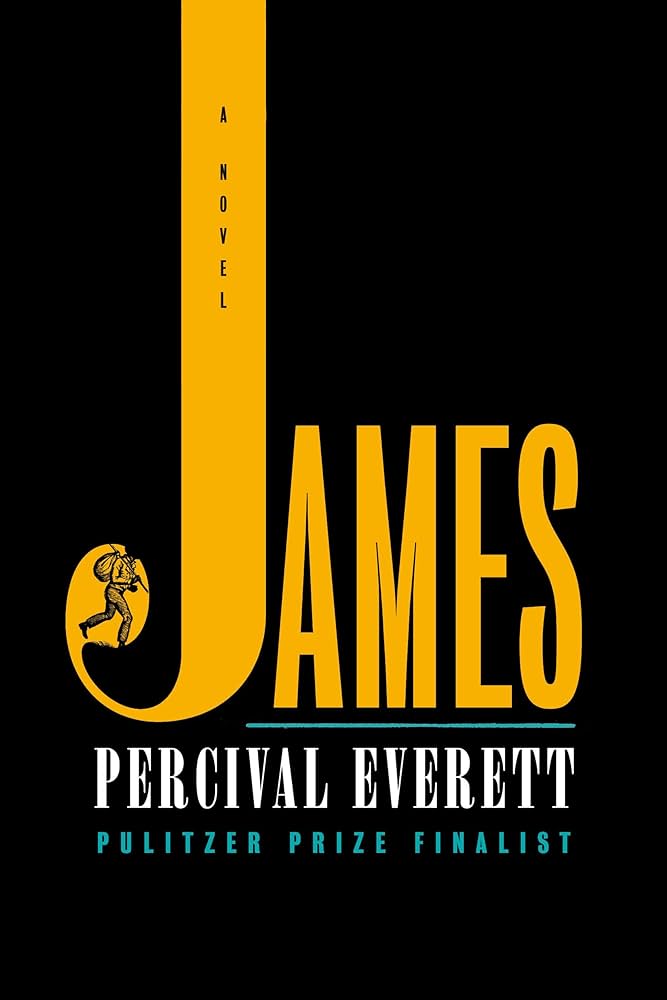
When I first heard about Percival Everett’s James, I thought rewriting Mark Twain’s Huckleberry Finn from the slave’s perspective was an inventive idea. When I finished reading the book, I thought exploring the interior life of and giving voice to the slave, Jim, was genius.
Evidently, I was not alone, as James won the National Book Award for 2024, and was selected by both The Washington Post and The New York Times Book Review as one of the best books of 2024.
It’s not only the idea of “translating” Huckleberry Finn that’s so incredible to me. It’s the rare and raw telling of what life was like for enslaved people just a couple of decades before the 20th century. Like many others, to more fully appreciate James, I felt compelled to reread Huckleberry Finn.
What struck me most intensely in Twain’s telling of the storywere the ordeals Jim had to suffer for the amusement of Huck Finn and Tom Sawyer. The boys were not being purposely malicious toward Jim. They—Tom Sawyer in particular—were having an adventure at Jim’s expense, seemingly ignorant of the physical hardship their plans required and apparently oblivious to Jim’s urgent need to rescue his family.
In contrast to Huckleberry Finn, in James, Huck and Jim were friends helping one another. Their trials were shared. Often it was essential for them to be united in plans and purposes to be safe from discovery.The human connection between Huck and Jim is deeper than their status as slave and White boy. Both were seeking their own respective freedoms and they relied on one another for what each could bring to their endeavor.
In Huckleberry Finn, Jim had no agency. If he wanted help he had to acquiesce to every whim of the boys. However, though he appears an unwitting victim in the games the boys played and served as their human toy, he knew the ways of White folks.
In James, it’s clear that knowing the ways of White folks was the best defense against some of the hard realities of being a slave. The next best defense was knowing White folks better than White folks knew the slaves.
In James, Everett expertly describes code switching as if it were a foreign language spoken by people who understood that to be seen as intelligent or even having the desire to learn—such as opening a book or harboring a pencil—could be the difference between life and death.
James is not only genius in its approach as a novel but does what art does best in challenging those who behold it and allow themselves to consider the important questions raised. In what ways do we continue to code switch and employ survival techniques? How can we be more responsible with our own agency, acknowledge and respect the inherent agency and dignity of others, and find balance in it all? How can understanding the varying perspectives of those with whom we travel different parts of life’s journey help all of the parties involved?
The explosion of Black creativity 100 years ago—known as the “New Negro Movement” or “Harlem Renaissance”—saw Black creatives boldly demonstrating their unique artistic gifts in traditional representations as well as in angry and political forms.
Aspiration, by Aaron Douglas (1936)
Though it may not have been the impetus for this explosion of creativity, it was occurring in the midst of the greatest migration of Black people from the South to other parts of the country. Pushed by poverty, injustices inherent in sharecropping, the prevalence of Jim Crow laws, and the constant threat of inhumane violence, Black people left the only places most of them knew as home and ventured on faith and a prayer into unknown lands that were also suspect.
Having found a refuge from sanctioned violence and a way out of abject poverty, many Black people were able to allow their creativity to flourish. Though many of the most prominent and celebrated creatives had not experienced first-hand the cruelest injustices their Black brothers and sisters from the South were fleeing, proximity and knowledge of suffering and resilience, alike, served as the impetus to create and invested the artists’ creativity with meaning.
Also, in utilizing these realities as subject matter, creatives were able to elevate and reveal to the world the state of most Black Americans fleeing the South. Out of pain came genius and culture in which Black artists seemed unified in purpose, if not style, in showing what the world of Black people was and what it could be.
With the recent release of The Six Triple Eight on Netflix, it seemed appropriate to reshare this guest blog by Carmen Jordan-Cox, PhD, shedding more light on this remarkable group of women too long overlooked…
I just finished listening on Audible to April Ryan’s book, Black Women Will Save The World: An Anthem. This is a powerful and emotional reflection on the toils and unwavering leadership of Black women in a world in which our contributions are not valued and, in fact, our very selves often are devalued.
This book made me think about those women—“hidden figures” —who, over the decades, have provided the very foundation for all the successes of subsequent generations of Black families. One such group of “hidden figures” is the 6888th Central Postal Directory Battalion from World War II.
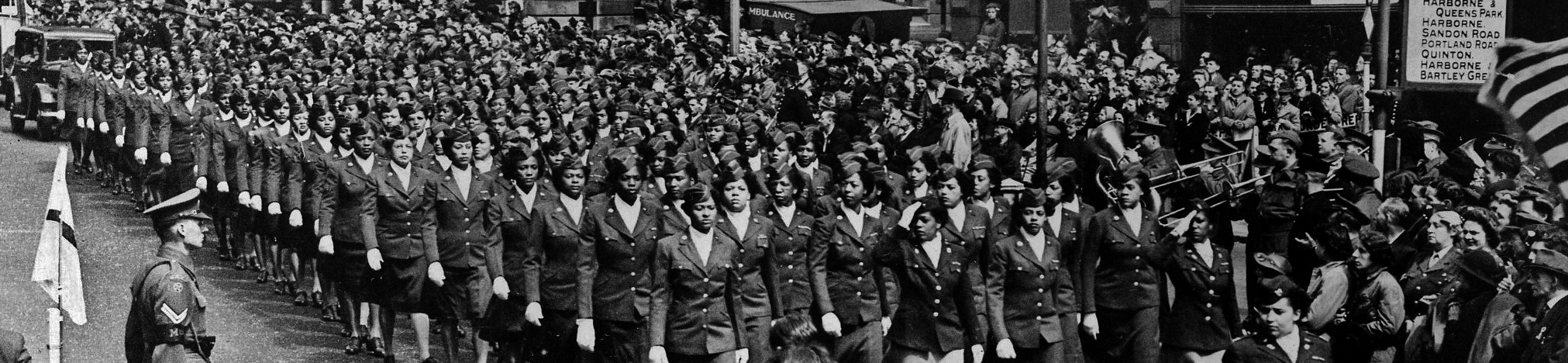
The 6888th was a unique U.S. Army unit that had the distinction of being the only all-female, African American battalion to serve in the European Theater of Operations during World War II. Made up of 855 women—824 enlisted and 31 officers—this Women’s Army Corps Battalion was commissioned in Europe between February 1945 and March 1946, and was led by 26-year-old Major Charity Adams.
The specific mission of the 6888th was to sort and clear a multi-year backlog of mail for the American Army, Navy, Air Force, the Red Cross, and uniformed civilian specialists who were stationed in Europe. This represented seven million people awaiting mail.
In February 1945, the first contingent of the 6888th embarked from Camp Shank, New York, to sail for Britain. They survived close encounters with Nazi U-boats and arrived in Glasgow, Scotland, where a German V-1 rocket exploded near the dock. The second contingent of 6888th soldiers docked in March 1945 in Gourock, Scotland.
Upon arrival by train in Birmingham, England, the Battalion confronted warehouses stacked to the ceiling with letters and packages. They endured inhumane working conditions, including dark, unheated, rat-infested aircraft hangars with broken windows and air raids. Despite these conditions, the Battalion created a new mail tracking system, worked 3 separate 8-hour shifts, 7 days a week to process an average of 65,000 parcels per shift (which is 195,000 daily), and cleared the 6-month backlog of mail in 3 months.
After resolving the immense mail backlog in Birmingham, the 6888th Battalion sailed to France for their next assignment in Rouen. They encountered undelivered mail dating back two to three years, which the Battalion again successfully processed and cleared in just three months.
Upon concluding their final assignment in Paris, the last of the Battalion returned to the United States by ship and was disbanded in March 1946 at Fort Dix, New Jersey. There were no parades, public appreciation, or official recognition of their accomplishments.
Adhering to the motto, “No mail, low morale,” the Battalion provided essential support to the U.S. military in the European Theater of Operations by linking service members to their loved ones back home. The 6888th achieved unprecedented success and efficiency in solving the military’s postal problems. The Battalion was the largest contingent of African American women to ever serve overseas, dispelling stereotypes and representing a change in racial and gender roles in the military.
It was not until nearly 80 years later that the 6888th received the well-deserved recognition for their service to the United States. In March 2022, the Battalion became the only women’s military unit to be awarded the Congressional Gold Medal, which was first awarded to General George Washington in 1776.
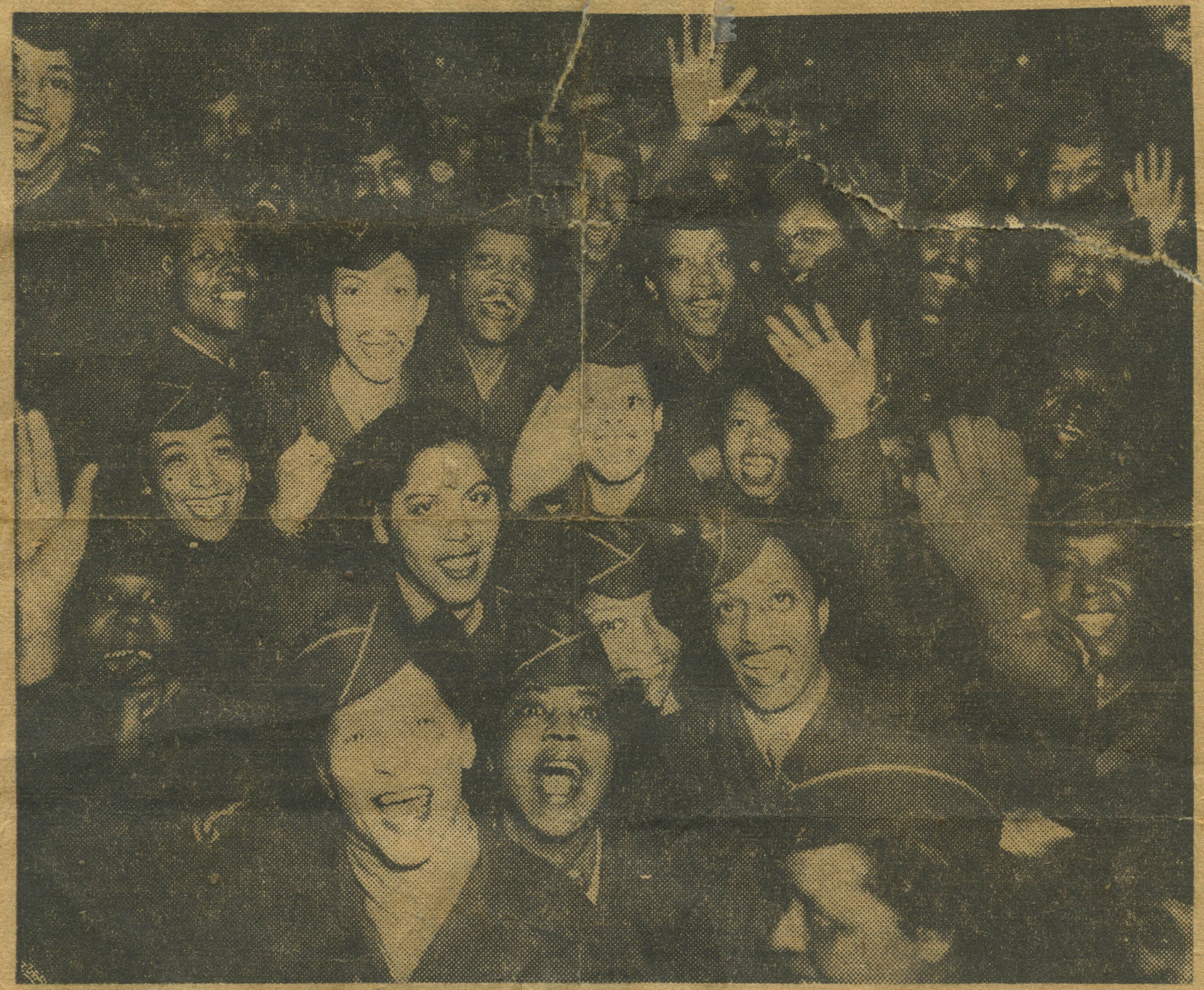
Iconic photo from when the last of the Women’s Army Corps (WAC) returned home from France. Annie Knight (Jordan) is the woman with the big smile in the top left corner.
The 6888th has a very special significance for me. My mother, Private First Class Annie Knight (Jordan), was one of those brave Battalion soldiers. As kids, my siblings and I always knew that she was in the Women’s Army Corps (something about which she was extremely proud). She mentioned to us that she did Morse code. We just thought of that as being like another language of sorts. It was not until Fall 2022 that we understood that her enlistment classification was not military postal worker. In fact, mom was in a special category called “Cryptographic Code Compiler.” Cryptographers, also known as code breakers, were secretly trained to crack code that provided intelligence information for the Army. Very little is known of the Black women who served in this capacity.
As I learned more about the 6888th, I began to think about how many ”hidden figures” there are and wonder how we might ensure that their stories are shared and their legacies known. I asked questions like, “What inspired these 855 African American women to enlist and pursue the 6888th?” “What gave them the internal fortitude to take on unknown ventures in a dangerous foreign land?” “What made them so different?” and “How did that very difference change the course of their lives post-military service and influence their legacies?”
So, in 2022, I became a first-time podcaster: NextUs818 Podcast is a reflective platform for connecting past successes with future progress in the African American community. There are many African American heroes—some known and many unsung men and women—who helped build this country. Some were the first or only in their fields of endeavor, like the 6888th. Yet little is known about how their unique journeys influenced the trajectory of their familial legacies…such as their children, grandchildren, nieces, nephews. The NextUs818 Podcast introduces the multi-generational descendants of these heroes. On the first and third Wednesdays of each month, I interview descendants of an African American hero and explore family lore, traditions, and values, and how the descendant’s journey was directly impacted.
The inaugural season of the NextUS818 Podcast features the descendants of the 6888th Central Postal Directory Battalion. [Four] themes have emerged to help me better understand what inspired the 6888th soldiers and how their service has influenced subsequent generations: patriotism, fearlessness, adventurousness, and unwavering commitment to lifelong learning.
Patriotism: Despite the rampant racial and gender discrimination of early 1940s America, these women were exceptionally patriotic. With the country at war, they felt that it was their DUTY to contribute to the war efforts against the Hitler regime. They eagerly embraced this chance to serve.
Fearlessness: The notion of a young African American woman going into war zones would be darn right scary, even today. Yet these brave women exhibited a remarkable degree of fearlessness.
Adventurousness: Not only did these women demonstrate fearlessness, but they were excited to explore the unknown. As kids, mom always spoke about her adventures, especially once the Battalion moved on to France. In all the stories I heard about the women, they saw serving in the Army as a way of giving them broad exposure and opening post-military opportunities otherwise unavailable to them.
Commitment to lifelong learning: Many of the women went on to attend college after their military service, some using the G.I. Bill when the opportunity was available. (See How the GI Bill’s Promise Was Denied to a Million Black WWII Veterans.) Their unwavering commitment to education deeply influenced their children and grandchildren.
In the NextUs818 Podcast, I enjoy hearing the stories of the soldiers’ civilian lives after World War II. The women of the 6888th were college graduates, teachers, nurses, college deans, and entrepreneurs. As important, they influenced the trajectory of their children and grandchildren who, among other things, are PhDs, physicians, engineers, lawyers, educators, professional musicians, and financial and advertising executives. All of the descendants with whom I have spoken emphasize that their successes are directly attributable to the foundation laid by the women of the 6888th. From them, they learned how to be focused, tenacious, and how to persevere under adverse circumstances. They learned how to survive and thrive. So when we are tempted to live in the moment and think we got here solely on our merit, we must never forget those shoulders on which we stand!
Five final notes:
Fort Lee Redesignation: The U.S. Department of Defense has made a commitment to rename military bases named after individuals associated with the Confederacy and other dark periods in American history. On April 27, 2023, Fort Robert E. Lee [was] renamed “Fort Gregg–Adams” in honor of two trailblazing African American officers: Retired Lt. General Arthur Gregg and the late Lt. Col. Charity Adams (commander of the 6888th Battalion).
6888th Legacy Tour: A group of 6888th descendants and advocates will return to Scotland, England, and France, walking on the grounds where the brave soldiers made history as part of an upcoming 6888th Legacy Tour [in October 2025].
Tyler Perry Studios and Netflix [released their] movie about the 6888th [on December 6, 2024].
Carmen Jordan-Cox, PhD, is a retired university vice president and judge/magistrate. Currently, she is producer and host of NextUs818 Podcast and a freelance curator of stories about descendants of World War II soldiers.
According to TheWashington Post exit polls, 92% of Black women voted for Kamala Harris to be president. Other polls also indicated that more than 90% of Black women voted for Harris. While the number of Black women voting for Harris is overwhelming, it took large numbers of other women and men to generate the number of votes the candidate received. I’m especially grateful that women showed what enthusiasm and sisterhood could accomplish. All who voted for Harris should feel proud of what we accomplished.
Pride aside, no one should be surprised that those men and women who worked to get Harris elected were let down after the election. “Let down” is surely an understatement for those who pushed a boulder up a mountain higher than they thought was possible. When it came crashing back down, many dedicated Black women, in particular, felt crushed.
People react to disappointment in different ways. Some are angry and get some kind of release in blaming those who didn’t help with the nearly impossible task. Some are disillusioned and blame themselves for daring to hope when the system never changes. Some are speaking out about not participating in what they see as futile efforts in a nation that hates them and is rigged against them.
We can’t ignore the overwhelming feelings of anger and frustration after so much effort and hope has been expended toward what was an incredible goal of electing our candidate as president of the United States. Although our feelings and reactions are as varied as we are as individuals, we are similar and consistent in not succumbing to what others might see as defeat.
Like any powerful fighters, taking time to rest and regroup is natural and necessary in order to come back strong to fight another day.
Twenty-three years ago—once again finding myself in a restaurant eating alone, a consequence of traveling around the country to be among members in their regions and to make speeches on various subjects—I often jotted my musings on a napkin.
On one such napkin, I wrote about what I wanted to say at the association’s business meeting as an introduction to reporting on the statistics and successes since the last annual meeting:
“We have to attend to the demographics of the profession to insure that what we as an association offer is relevant not just for today and today’s members, but for the future and tomorrow’s members. Student affairs and other support services are projecting the largest number of retirees within the next 5-10 years that the profession has experienced.
“Our challenge is to meet the needs of professionals up and down the demographic ladder. We can do this by broadening our definition of diversity among our membership to include age, gender, race, socioeconomic factors, and different perspectives.
“We need good people who are eyeing retirement to remain active in the profession as mentors and sages. We must find a way to capitalize on the gifts and legacies of our retiring professionals.
“At the same time, we need to look to mid-level, new and potential professionals to rejuvenate the field and the association. Determining what they need from their professional association is a particular challenge. In addition to meeting their professional needs, we want the talents they bring to move the association forward.
“We need to help the burgeoning number of mid-level professionals to assume leadership roles. What is the best way to show them that we need their participation and leadership to accomplish our vision?
“One of our tasks is to emphasize the power of leading from the middle.”
From what I can glean, as an outsider today, the association has been successful in bringing to fruition what were notes on a napkin a long time ago.
This is my most important vote, ever. During this messy present, it may be the last time I have the right to vote as an African American woman and the fact that my expiration date is nearing based on statistical data.
I took my sweet time completing my ballot. I started at the bottom and worked my way up to the top of the ballot because I know how important our state and local legislators are to the well-being of the communities in which we live.
Prior to receiving my ballot, I took every opportunity to hear and see candidates and to explore their past records.
When I was not sure about propositions, I didn’t just guess. I took time to learn as much as I could, and I relied on those in the know who I trust to tell me what they knew about judges and others on various boards.
I feel good about the seriousness with which I completed my ballot. If it is my last opportunity to vote, I gave it my best.
There was once a woman, in a land far away, who made a New Year’s resolution about how she wanted to best serve the organization for which she was given the privilege of being executive director.
While membership increase and satisfaction were always at the top of her mind, she wanted to move forward with intention on what some called leading-edge innovations. She wanted to play a role in helping the organization realize its potential.
When she was oriented to her position, it was made clear that she was not to think of herself as the leader representing the organization. She was staff in service to the board who represented the membership. Her role was to carry out the wishes of the board.
After being in the executive position for a while, it became clear to her that in addition to carrying out the directives of the board, she—in collaboration with volunteer members and the staff team—had an incredible opportunity to move the organization forward in ways that would meet members’ needs and be good for higher education.
On the occasions when she ventured beyond the boundaries of how the board envisioned her role, she was chastised and directed to pull back and stay within the bailiwick of what one in her position had always done. She was to keep the mechanics of the machine running smoothly.
These cautions and restrictions puzzled her because colleagues in similar roles were not only allowed visibility but encouraged and rewarded for exhibiting leadership. In her heart, she knew that those who hired her did so because they saw that she wanted to fly and had the determination and courage to test the power of the organization.
After moving forward and often standing up without permission, she eventually learned that in her position, if she wanted to survive, she had to shape-shift depending on the characteristics of the board as a whole and the agendas of specific members of the board.
When there were board leaders who had vision beyond merely maintaining the good standing of the organization, she knew that it was possible not only to claim the organization’s tag line, but to realize what it meant to be the leading voice for student affairs in higher education.
With these forward-thinking leaders, there were test flights into the unknown. Invariably, following such visionary leaders, however, there would be new leaders who thought they had a mandate to rein her in and ground her before there were future flights. They feared that there was too much change too fast.
They thought that there were too many innovations, too many new partnerships outside of student affairs, too much attention to seeking grant support, and a need to be careful about positioning the organization in areas that other organizations had traditionally had a role.
Dismayed but not discouraged by these attitudes, she had faith that what, at times, seemed like the curse and most difficult part of her role was also the best and saving grace. Unlike many organizations with board members who had long tenure, members of her board rotated off in two-year cycles—except for the chair who, given their role as part of the executive committee, served for an additional year. She counted on leaders with whom she could work in partnership to help the organization move toward its highest potential.
In the end, it was not about being seen as a leader. It was about keeping those new year’s resolutions. Being the invisible leader worked just fine in this land far away.
Listening to the radio on my way to work, I flinched in annoyance when I heard then-presidential candidate Bill Clinton reference benefits expressly for the “middle class.” Never having the luxury of financial security myself—as I’ve lived from paycheck to paycheck and I’m a Black woman always fearful of losing my job regardless of the merits of my work—the candidate was not speaking to me.
I think most people see themselves as middle class even if they meet the criteria for what is referred to as “working class” or the “working poor.” Therefore, it makes sense that the public relations teams for those making appeals for votes want their candidates to speak to the largest number of voters. These voters want to be called by name when it comes to policies that may have an impact on their financial and social status.
I just wish that good-hearted smart people would not buy in to the cultural and societal habit of categorizing people into a class or caste system based on arbitrary criteria such as income and social status. I feel better when I hear politicians talk about all the people and how what they champion will benefit everyone who needs help.
In addition to calling out the middle class, most candidates say that they represent all the people when they speak in different venues and in many of their campaign ads. It’s the calling out of the middle class that makes me wish that the constituent message would be more like President Lyndon B. Johnson’s reference to the people as the “Great Society.” This positive outlook for everyone feels better to me than identifying and thus ranking people according to class.
As I write this, I ask myself, “Why does this matter to me?” It matters to me because calling out the middle class is just another way of excluding people who don’t have the requisite income and societal status deemed good enough to be middle class.
In the end, I will support candidates who champion inclusion in their policies and who seek solutions that are helpful and not harmful to any people. We owe it to ourselves and to our country to champion leaders who strive to promote a society for all the people even if they must call out the middle class in their efforts to be elected.
I don’t take my civil rights and my right to vote for granted. In this current election cycle, I fear that these precious hard-won rights may be in danger as they teeter precariously on the worst instincts of those who seek power at any cost.
Along with other groups, I have experienced legalized discrimination and I know what it can do to the human spirit.
In the upcoming iteration of democracy in action, it’s not just those of us who are the historic and presumed targets of discrimination who are at risk: It is all of us who are shocked and dismayed by the overt acts of those who want to turn back time in their vision for the nation.
We must not be distracted by the noise created by the theater and drama of the political process. We must keep the goal of an inclusive, multiracial citizenry with hard-won rights in our sights as we vote and encourage others to vote for those with a record of enacting policies that align with our basic human values.
The week before Easter, one of my Millennial friends told me that she would like to find a Black church to go to on Good Friday and Easter Sunday. I was surprised that she expressed this desire because she had never spoken about church before. Up to this point, I had not given much thought to Millennials and their religious habits and affiliations.
Shortly after this revelation that a Millennial was interested in going to a Black church for Easter services, I saw the documentary, gOD-Talk: A Black Millennials and FaithConversation. The film is the product of a collaboration between the National Museum of African American History & Culture and the Pew Research Center.
The narratives given by early and later Black Millennials are enlightening and fascinating. Some of these Millennials grew up in a family of generations of churchgoers and remained with their origins. Others expressed adherence to the beliefs and practices of other religions or philosophies—Atheism, Buddhism, Christianity, Islam, Ifá, and Spiritualism. They talked about their journey to find themselves within the faith that was right for them.
Faith was the bedrock upon which they built. The tools were different according to the life they wanted to live. Regardless of the avenue they took to find themselves in a community of faith, the commonality was their orientation to eschew sexism and racism and to value social justice. In other words, similar to the traditional Black Christian church, they sought community and action in their gOD. What may seem fractured regarding Black Millennials and the church is more like a fusion that includes grace, acceptance, and transformation.




 Gwen Dungy