Category Archives: reflection

Our Story, Our Song, Part 2: The Black Church in Chicago

(read pt. 1: Our Story, Our Song)

After living in Memphis with my Daddy, his wife, and my baby brother for several years, my Daddy sent me back to Chicago at the age of 12 to be with my mother and her family.

In Memphis, the two Black churches I knew were large, elegant, traditional religious structures in which members could feel a sense of pride. The first church I experienced in Chicago was a “storefront church” on the West Side of Chicago. It was on Fulton street surrounded by manufacturing industries and crisscrossed by “L” trains.

On my first visit to this storefront church, I thought it was not a real church because of its name and how it looked. There was a large showcase window to the right of the entrance with the name of the church painted on it. It read “West End Baptist Church.”

I soon came to realize that what West End Baptist Church lacked in traditional religious ambiance, it made up for in the religious fervor and dedication of its small and loyal congregation. Because of the loyalty of members such as my family who scraped together money, the congregation was able to rent a space shortly after my arrival in Chicago in a modest “real church” structure a few blocks away on the same street.

To say that my family was very involved in the church is an understatement.  My grandfather was on the Deacon Board and the Usher Board; my grandmother was in the choir and on the Mother Board; my mother was in the choir and the “poet laureate;” and I was in the choir. On Saturdays, my grandfather and I cleaned the church.

Some of the most exciting times at church were the Sunday afternoons when another church would visit. The choir, minister, and some of the members would represent their church. It was really fun when more than one church visited because it was like the battle of the choirs as each choir would have an opportunity to sing its best songs before the minister began the sermon. While I claim not to have any artistic talent now, I was quite proud of the banners I made to welcome visiting churches. Our dining room and car never seemed to be free of the glitter I used for my creations.  

On one occasion when West End Baptist Church was hosting visiting churches, the person who usually gave the formal welcome to visiting churches was not available. Since my mother was the resident poet who wrote poems for every special occasion, reciting them from memory most of the time, the thinking was that I, her daughter, should be able to give the “Welcome Address,” as it was called on the program. Apparently, the welcome I gave met expectations and, from that day forward, I was the most frequent designee to welcome visiting churches.

This storefront church challenged children in many ways. Church members were the encouraging audience for whatever any child wanted to try. The members praised my tacky welcome banners and responded to my welcome addresses as if they were something special. They gave me the courage to keep doing what I didn’t believe I could do. And, as challenges became successful efforts, my faith in myself and something bigger than myself continued to grow.

Our Story, Our Song

I recently watched “The Black Church: This Is Our Story, This Is Our Song,” a PBS documentary that creator and narrator Professor Henry Louis Gates, Jr., describes as a message of “race and resilience, struggle and redemption, hope and healing.” 

Indeed, my Black churches revealed me to myself. They helped me to see who I was in relation to others. They showed me models of women I could strive to emulate. They challenged me and gave me the opportunity to try. They gave me the concept of faith as an enduring value.

The first church I remember is Mount Gilliam Missionary Baptist Church in the Orange Mound community of Memphis, TN. My mother and her parents loved this church. It was the first church they joined after leaving the Mississippi Delta. To see how they dressed and the sophisticated manner in which they carried themselves when they attended this church, one would not believe that it had been only five or so years since they had been sharecroppers.

In addition to Sunday services and other religious programs and meetings, the church was also the meeting place for charitable fraternities such as the Masons of which my grandfather was a proud member. My grandmother and mother were members of the women’s counterpart to the Masons, The Eastern Star, to which they were dedicated and seemed to be always involved in raising money for one cause or another.

The “Royal Court”

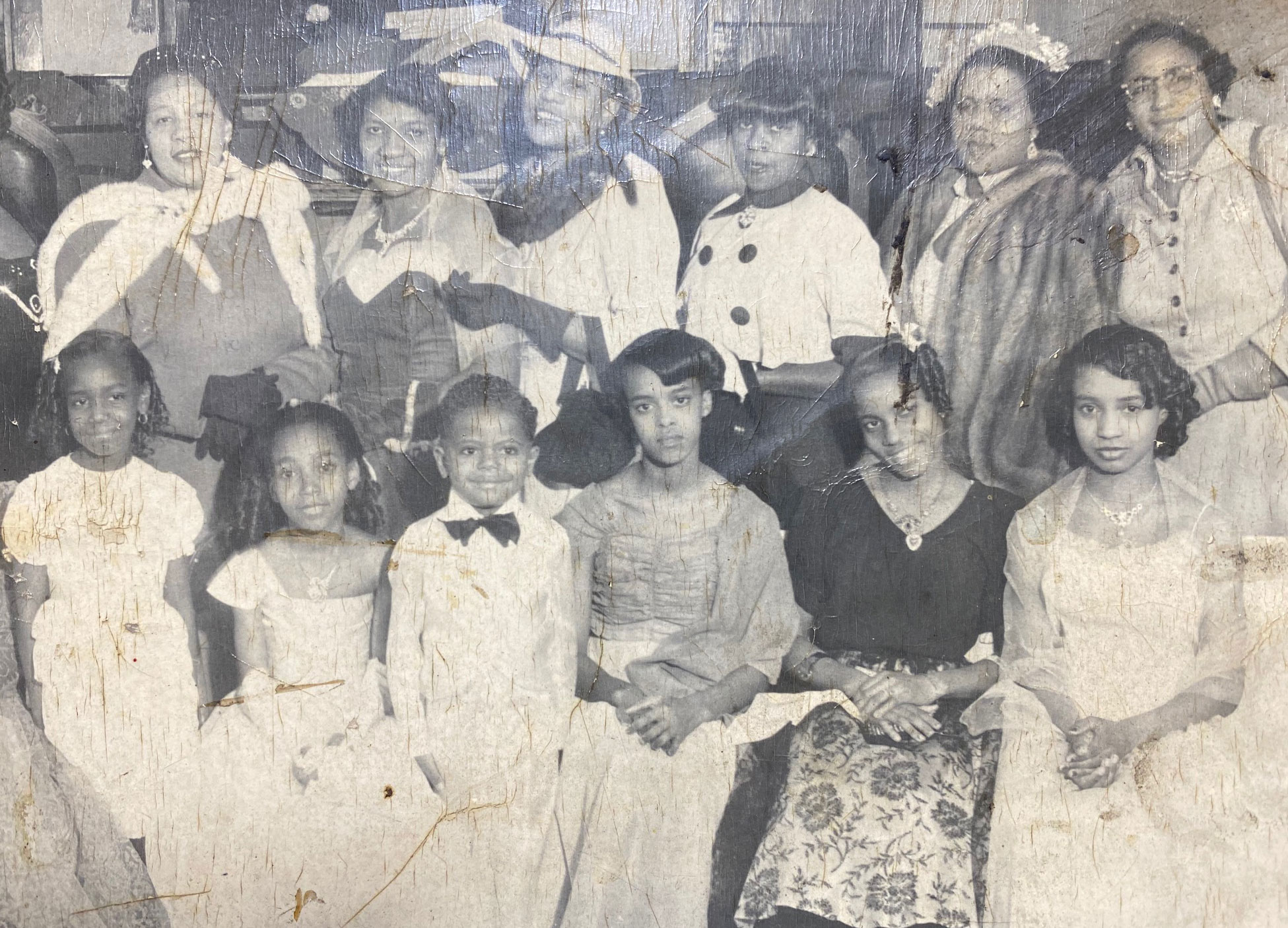
One of these fundraisers was a pageant where a little girl was crowned princess and a little boy prince depending on how much money their sponsors raised. My most vivid memory of Mount Gilliam Missionary Baptist Church is the night of the pageant when I was six years old. I remember being sleepy and my folks kept me awake so I could be in the pictures that would be taken that night. Apparently, my folks had not raised enough money for me to be the princess, but I was part of the royal court standing next to the princess and prince. Being in the royal court and not the princess may have been the first experience that made an imprint about who I was in relation to others.

The other Black church in the Orange Mound community of Memphis I became familiar with was Mount Pisgah Church, where Miss Bailey attended. Miss Bailey had a standing taxi appointment for my Daddy to pick her up early in the morning to take her to work. I think she was a nurse. I could tell that my Daddy respected her a lot, and he asked her if I could go to church with her on some Sundays when he picked her up to take her to church.

Miss Bailey was a kind lady who had manners, dressed nicely, carried herself in what people called a “dignified manner,” and seemed to have the respect of all who knew her. I felt good standing next to her in church with hymn book in hand singing “Have Thine Own Way Lord,” “Blessed Assurance,” “The Old Rugged Cross,” and my favorite song, “I Come to the Garden Alone.” Singing these songs and being in the presence of Miss Bailey, though I was only nine years old, I could feel the love of God, and I knew that Miss Bailey was the type of woman that I wanted to be.

The Black Church is, indeed, “our story, our song.”

(Next Week: The Black Church in Chicago)

Journaling: The Cure for Selective Memory?

Why is it easier to remember the hurt someone caused you than it is to remember something that they did that was generous and kind? Why is it easier to remember the good things you did for others than it is to remember the hurt you might have caused them?

There are some people I have encountered during my lifetime that bring negative feelings along with any memories I have of them. These people are prominent in my memories when I recall the times that I smiled or showed no emotion while gritting my teeth at the same time. It was at these times that I experienced shame and pride all balled up together in my chest. Shame because I didn’t respond in kind, and proud that I remained poised and focused on my purpose.

I recall the tears I shed in private as a result of the cruelty shown by these individuals. Yet, I don’t want to hold grudges. I never want to be the person who says, “I can forgive, but I can’t forget.” I truly want to forgive and forget the ugly situations and intense encounters. I never want to think of them again. Since I’m not able to completely avoid the memories of these people, perhaps I could have at least one good memory that might decrease the intensity of the lingering negative emotions.

What I’m discovering as I read journals I’ve kept over the years is that there is more to the stories of those I only recall in the dark places in my mind and heart. Although these people may be the topic of my journal writing mostly because of the negative things they did, every now and then I have found a lovely flower of kindness that they planted among the weeds that they cultivated in my garden.

The villains in my story were not awful all the time. Similarly, as I read these many journals, I learn that, contrary to what I want to believe about myself, I have sown some weeds in other people’s gardens, as well.

People ask me why I have written and kept journals. In the past, I believed that I wrote them to stand in for a best friend who could be trusted with my innermost feelings and my deepest desires. Today, I think I kept the journals for this time in my life when I can review them and relive all the good times and recall all the kindness that I’ve received from my encounters with both my villains and my heroes. 

I highly recommend keeping a journal during some period of one’s life.  

The Excitement and Curiosity of Having “No Plans”

Retirement is one of those events that some look forward to with eager anticipation while others feel sad about the prospect.  Then there are some—like me—who don’t experience either of these thoughts or emotions.

On February 22, 2012, about a month before I officially retired from NASPA, I wrote the following in my journal:

As I get nearer to the final days at NASPA, I feel no sadness. I feel satisfaction and pray that all continues to prosper with the organization.

On March 1, 2012, I wrote:

I don’t think I’m going to miss my role. I just want to keep doing something that is meaningful to move our world forward. I want to add my part, fulfill my purpose, live up to my potential.

These were goals for my life. I had no plans for what I would do in retirement.  

Being without the responsibility of a job and having no reason to get up, to get dressed, and to leave the house would be a little like a free fall. I had to rely on my faith that without these routines and trappings of identity, I would still be able to maintain confidence in myself and optimism about my future.

As I dropped through the space of what could be a professional void, unexpected safety nets and lifelines afforded me a soft landing in the field of retirement after my last day as NASPA Executive Director on March 30, 2012. At the same time as I was consulting, facilitating workshops, and making speeches (see boxed list), I was working on writing projects with 2012 deadlines and organizing and filing a career’s worth of papers and notes at home.

What gave me the energy to follow through on the activities and experiences I had during the year that I “retired” was my excitement and curiosity about the experiment of having “no plans.”

Since this experiment, I’ve stopped making New Year’s resolutions and I’ve begun each year with optimism and “no plans.”

  • 4/15-16: Indiana State University
  • 4/18: Skype with master’s class, DePaul University
  • 4/25: in person with graduate class, University of Maryland, College Park
  • 5/21-29: China on behalf of NASPA
  • 6/4: Taylor University in Indiana
  • 6/19-23: Portland State University
  • 7/9: conference, Los Angeles
  • 7/28: conference, Manhattan
  • 7/30-8/3: University of Vermont
  • 8/16: University of Southern California
  • 8/30-9/1: Evergreen State University
  • 9/17-19: California State University, Fullerton
  • 9/18: Skype with graduate students, Colorado State University
  • 9/19-21: conference, Washington, DC
  • 9/30: Skype with graduate students, Oregon State University
  • 10/16-17: Berkeley College, New York City
  • 10/19: conference, Baltimore
  • 11/1-2: Wake Forest University
  • 11/18-19: conference, Hawaii

Learning in Community

It didn’t matter how little sleep we had had the night before, we made ourselves get up in order to be on the road by 6:30 a.m. on the two days in the fall when we would attend The Atlantic Festival of Ideas in Washington, D.C. Most of the time, the weather was beautiful, but sometimes there would be rain and flooding. On the occasions when there was heavy rainfall, we had to leave home even earlier in order to get to the parking garage and find a spot near the front of the lines waiting to get into Sidney Harman Hall where the Festival forums would take place.

We liked sitting in rows close enough to the stage so we could see the faces of the guests in real life rather than on a screen. I was always eager to see the journalists from The Atlantic and NPR, as well. After so many years of reading their work or listening to them on radio, I felt as if I knew these journalists and I wanted to see if my preconceived notions of what they looked like panned out. Never did. I was always way off in how I thought they might look.

We saw members of Congress, journalists, artists, entrepreneurs, educators, environmentalists, and many other thinkers who were asked questions about their take on a wide range of current events and the future issues. I was amazed at how all of us were able to just sit for hours and listen to one guest after another chat about the world and our place in it.

Because of the COVID pandemic, the Festival was virtual this year. The guests were just as interesting as when we could be in the same room with them, and we were up close where we could clearly see their faces on the screen, yet the virtual experience was less satisfying for me.

I tried to get at what made the experience less satisfying than being in Harman Hall in person. For example, although I’d be taking notes furiously on the questions interviewers posed and the responses offered by the guests, I could, at times, look down the row from where we were sitting or look at the people in the row in front of us and try to guess how they might be judging what they were hearing. There were people of all ages at the Festival but not much racial diversity. Over the years, I would look in wonder at the many rows of people who shared the same skin color, but not mine.

When there were breaks, we would seek out other people who looked like us to start a conversation, exchange cards, and sometimes promise to follow up. The people who planned the virtual Festival were aware of the need for people to interact, so they set up chat rooms so people could make connections. This didn’t appeal to me. I remained silent.

Treats of the onsite Festival included exhibits of up-and-coming innovations, an opportunity to see documentaries and films that may not be shown in many theaters, and the “Food for Thought Break-Out Lunch.” These lunches were sponsored at different restaurants in D.C.’s Penn Quarter or might be a box lunch at Harman Hall. The lines were too long at all the eating places and there was a scramble to find a place to sit, but it was well worth it because speakers such as the initiators of Black Lives Matter were there to have a conversation with us. The crowds of people—all eager to learn—evoked a vibe that I could not feel during the virtual Festival.

It was during the many hours I spent online getting a lot of information from the speakers that I had the best understanding of what students probably experienced as they took their course work online this past year. For some of us, just because the material presented virtually is the same as that presented in the classroom does not make it comparable. My learning is more than just the transfer of information from someone to me; it’s the feeling of engaging in a common quest with others that stimulates my desire to learn.

Along with students and teachers all over the world, I hope that in the next year and the years to come that learning in “community” will again be the norm for those of us who need it.

While there is something missing when the Festival is virtual. I am grateful for the opportunity to engage with the Festival despite not being able to be there in person. The fact is, without the virtual opportunity, I would have missed the Festival altogether this year because I no longer live in a place where I can just get up and drive to D.C. whenever I like. I hope that when people can congregate in one place to enjoy the Festival, those of us who are not in proximity to the event can still join in virtually. In the meantime, following are some of my notes from the 2020 Festival. The quotes may not be exact, but they are accurate enough for my purpose here:

September 23

  • “1.3 million people would not sign an agreement not to discriminate.” – Brian Chesly, CEO of Airbnb
  • Author James McBride and actor Ethan Hawke talking about the film based on McBride’s book The Good Lord Bird:
    • “The blood has already been shed, the path has already been cut, now we just need to put on our hats and go on down the road.” (McBride)
    • “To do well by people, you have to not do what society wants you to do; you have to break the box.” (Ethan Hawke)

September 24

  • Samantha Bee, host of Full Frontal with Samantha Bee, on “Finding the Funny During a Pandemic”:
    • “You have to prove that you’re vital, so I had to keep doing the show.”
    • “There was a lot of innovating and building new systems and trying to make things more visual rather than a flat experience.”
    • “This form of entertainment is our planting our flag on what’s right and what’s wrong.”
  • Dr. Ibram X. Kendi on “Antiracism in America”
    • “Trump’s denial of racism has become a mirror for other Americans to see themselves as deniers of racism.”
    • “We’re in the midst of a time when writers, organizations, and Black Lives Matter are making people aware of racism.”
    • “Removing Trump from the White House will not be a postracial time.”
    • “The path forward is to replace racist policies, structures, and systems with antiracist policies, structures, and systems.”
    • “On the interpersonal level, make sure we’re seeing racial groups as equal.”
    • “Racist ideas deflect us from what’s preventing us from coming together as a human community.”
    • “The resistance gives me the most hope.”
  • Echelon Insights Research—“Opportunity for Young People to be Successful”
    • Only 13% of those surveyed think the next generation will be worse off than the current generation
    • 43% think higher education is too expensive
    • 40% worry about health care
    • 35% worry about racial inequality
    • The American Dream consists of a husband, wife, white picket fence, opportunity to better lives where people are equal; freedom and financial stability.
    • Key Themes: Importance of the environment 74%; importance of education 72% (want more career and life skills)
  • Journalist and author Bob Woodward
    • “Trump was elected to break norms. His voters loved the lack of decorum.”
    • “We’re in store for a quadruple train wreck after the election.”
    • “Trump has no moral compass.”
    • “Dr. Fauci says that Trump is obsessed with one thing and that’s to be re-elected.”

Gratitude

“You would have more time to get other things done if you didn’t write so many thank you notes and letters,” said Joan, my wise administrative assistant in the 1980s.

While reviewing notebooks and journals I’ve kept over the years, I am amazed at the number of times I noted that I was writing a thank you to someone for something or other. For example, shortly after my retirement as NASPA executive director in 2012, I took a trip as part of the association’s exploration of offering professional development to those who provided student services in some of the universities in China.

I was in Shanghai at the Renaissance Hotel after having travelled to several other cities in China when I reviewed my meeting notes and made a list of the people with whom I had met during this visit. My list included 27 names and pertinent information to help me recall who the people were and the occasion of our coming together. These were the people to whom I would be sending thank you letters upon my return to the United States.

When I wrote the letters, the ones that made me smile the most were the ones I wrote to “unofficial” people, such as the exuberant young women students who met me at some station or harbor in pouring rain carrying a bouquet of flowers that were the worse for wear after being drenched by the rain.

As I look back on what was a time-consuming and, to me, necessary chore of writing so many notes of gratitude over the course of my life, I realize that I likely benefitted more from writing these missives of appreciation than the recipients who might have given my message a cursory review at best.

In order to write the message, I had to recall the location, the interaction, and the result of the meeting. I could relive the pleasantness of the moments. Often, there are so many distractions and emotions present during encounters—whether with people we’ve just met, day-to-day colleagues, or long-time friends and family—that keep us from appreciating what is happening in real time. Recalling the experience in quiet contemplation, we can tease out the wonder of the gift of having made this unique human contact. I’m grateful for these memories and writing to express my gratitude on so many occasions has been well worth the “costs” in time and effort.

The Beauty of Memory

Before Alex Haley’s Roots captured our attention and ushered in family reunions, funerals had been the impetus for our family to come together. Though painful to lose loved ones, the grief was always eased by the abundance of humor. We are a family that can find something to laugh about in just about any situation.

When the family would get together and start “lying” on one another and showing no mercy to the victim of the moment, someone would bring up “the fire.” The aunt, uncle or cousin who told the story would also mimic the action, such as running, and would be laughing so hard that they could hardly finish what they were saying. The funniest part of the story was how fast my mother—“Muhdear,” to me—was running down Hollywood Street away from the burning house. The storyteller would say that she out-ran the fire truck.

After tears from laughter were wiped from cheeks, somebody would recall that my grandmother’s sister had run back into the burning house, found me in the bed in the front room, grabbed me by the ankle, and pulled me to safety.

What really happened?

Me: Muhdear, how old was I when our house at 494 S. Hollywood burned down?

Muhdear: You were four-and-a-half years old. Your birthday was in July, and the fire was in December 1948.

Me: I thought I was about that age. I don’t know what I remember about the fire and what I heard people say about the fire. Muhdear, can I ask you a question? Did you leave me in the burning house and run down the street?

Muhdear (in her own words): I had planned to save my new suits to wear Christmas, but I decided to wear the navy suit and the navy shoes the Sunday before Christmas. When Mama asked me why I was wearing the suit before Christmas, I told her that I had a feeling that if I did not wear the suit on that Sunday, I would never be able to wear it.

I had put two snow suits for you, one blue and one pink, in the lay away, and I had put two suits for myself in the lay away—one navy and one gray. I also bought two pairs of shoes to wear with the suits. The suits were $140 each on sale and the shoes were $32 each on sale. These were good clothes that really looked sharp on me. I had the money because the Christmas savings club had divided up the money that we had all been saving.

This was going to be the happiest Christmas I had ever experienced. I bought the record, “Merry Christmas Baby,” and hummed it all the time. Every inch of the house had some decoration about Christmas and there were new covers on the furniture. The house looked great. We were all in good health, and I was happy that there was no man in my life.

It was December 18, 1948, when one of my Mama’s brothers, his wife, and their children came up from Mississippi where they were sharecropping to spend the Christmas holidays with us and our other relatives in Memphis. The children were excited to be away from home, and they squealed when they saw anything that they had not seen before. Despite their running and screaming, I went to sleep. There were pallets of blankets and sheets all around on the floor for everyone to have a place to sleep.

You were sleeping with me, and you woke me up and said, “Muhdear, I want to go wee wee.” I told you not to be scared of all the people in the house. You should just go through the room where the kids were and wee wee in the slop jar on the other side of Mama and Daddy’s bed and come right back. You came right back and told me that the children were in the other room playing with matches. As it turned out, the children were sticking paper into a space heater and when they heard grown-ups approaching, they threw the lighted paper into the closet and the fire was out of hand immediately.

Somehow, I got you to safety in a fire truck, and I was trying desperately to get my new shoes out of the burning house. My navy shoes were just inside the door where I had slipped them off when I came in earlier that night. Lucy Turner, our next-door neighbor, ran out of her house with her mink coat and her alligator shoes. The neighborhood had just gotten gas, and Lucy Turner was running and yelling for people to get out because the gas was going to explode. When I heard this, I started running too. Folks teased me later saying that I was outrunning the fire truck. I was really scared that there would be an explosion.

When folks calmed me down by assuring me that there was not going to be a gas explosion, I looked for you. During all the confusion, your daddy and his wife had come for you and took you home with them. I was grateful. We all had to find a place to stay. Mama and Daddy stayed two doors down at Miss Nanny’s. She owned the only little eating place and sundry in the neighborhood. I stayed with a co-worker named Augusta from Airways Cleaners, where I was now working.

Me: Wow! I’m sure that was a really scary time. I do remember being cold and I think I was in the fire truck for a while before my Daddy came for me. So how did the story about Aunt Lady grabbing me by the ankle and saving me from the fire at the last minute come about?

Muhdear: That wasn’t you. One of your cousins was still asleep on the couch and he was grabbed from the house just before the roof collapsed.

As Muhdear looks off into the distance taking herself back to that night, in my mind I’m playing the investigator as if a crime has been committed: Got me to safety, trying desperately to get the navy shoes, and out-running the fire truck all at the same time the fire is raging. Huh?

If she says this is what happened, this is what happened. This is the beauty of memory. It’s ours and ours alone.