Category Archives: reflection

Photos and ‘Memory’

I am so glad that I took the time to put most of our photos online. On a melancholy day, revisiting pictures of past experiences and feeling nostalgic is just what I need.

I smile the entire time I’m scrolling because most often the people in the pictures are smiling. The best photos are those where the subjects are not looking at the camera and don’t know that someone is taking their picture. Unsurprisingly, there are fewer of these than those where the subject is camera-ready.

Sometimes when I click on a photo, I think I’m recalling exactly what was happening. Other times, I have no clue about a particular photograph. Scrolling through pictures demands imagination in ways reading my journals—in which I recorded details of what was happening—does not.

Because it’s impossible to remember exactly what was happening when many of the pictures were taken, I find myself creating stories to expand the limits of what a photo can convey. These stories serve as stimuli for reflection with the added advantage of hindsight.

Through such an exercise of imagining and creating stories, it’s clear to me that our photo histories are likely completely disassociated from the reality of the moments when the images were captured. And for my purposes, that’s just fine.

Notes on a Napkin

Twenty-three years ago—once again finding myself in a restaurant eating alone, a consequence of traveling around the country to be among members in their regions and to make speeches on various subjects—I often jotted my musings on a napkin.

On one such napkin, I wrote about what I wanted to say at the association’s business meeting as an introduction to reporting on the statistics and successes since the last annual meeting:

“We have to attend to the demographics of the profession to insure that what we as an association offer is relevant not just for today and today’s members, but for the future and tomorrow’s members. Student affairs and other support services are projecting the largest number of retirees within the next 5-10 years that the profession has experienced.

“Our challenge is to meet the needs of professionals up and down the demographic ladder. We can do this by broadening our definition of diversity among our membership to include age, gender, race, socioeconomic factors, and different perspectives.

“We need good people who are eyeing retirement to remain active in the profession as mentors and sages. We must find a way to capitalize on the gifts and legacies of our retiring professionals.

“At the same time, we need to look to mid-level, new and potential professionals to rejuvenate the field and the association. Determining what they need from their professional association is a particular challenge. In addition to meeting their professional needs, we want the talents they bring to move the association forward.

“We need to help the burgeoning number of mid-level professionals to assume leadership roles. What is the best way to show them that we need their participation and leadership to accomplish our vision?

“One of our tasks is to emphasize the power of leading from the middle.”

From what I can glean, as an outsider today, the association has been successful in bringing to fruition what were notes on a napkin a long time ago.

White empty napkin and pen on gray background

Books in My Coming-of-Age Story

It’s that special period in life when, in retrospect, one realizes that this was the point at which the boundary between childhood and adulthood begins to blur. It’s the time to suffer through regardless of one’s economic circumstances or relative place within culture and society. It’s that bridge that we all cross if we live long enough. That’s why the popularity of coming-of-age films, performances, and books never wane. Coming-of-age stories are relatable because we’ve all been there in one form or another.

I used to feel embarrassed when I didn’t know references to characters in children’s books. I didn’t know these characters because these stories were never read to me, and the books were not available to me when I learned to read for myself. I’m not placing blame or feeling sorry for myself. It’s just a fact.

My various families were doing the best they could to keep me housed, fed, and churched. There was no time nor money for story books. In my formative pre-teen years, I was grateful for Webster’s Dictionary and a few books from school. During my teen years in a different family home, there was a Bible, a dictionary, and just before I finished high school, there were the World Book encyclopedias.

Though I didn’t know it at the time, I needed books and the stories they told to create a virtual world in which I could imagine beyond my circumscribed world. Once I had the freedom to read the books that I wanted to read, I would do anything to keep them in my life.

In fact, the only crimes I’ve committed are related to books. I still feel badly when I think about the incidents. I’m guessing that there was not a public library in my community because I had to take a bus to a library that was a good distance from where I lived in what was considered a White neighborhood. I wasn’t sure I would be able to get a library card, but thankfully I was given one. After a few borrowings and returns, there was one book that I wanted to keep. The return date came and went. I received overdue notices in the mail. Though I was afraid of what might happen, I chose to give up my privilege of borrowing future books in order to keep the book that I felt I had to have. I made the sacrifice because having the book was worth the risk.

After assuming that I had lost my privileges at the library because I had not returned the book, innocently, I committed another book crime. Lured by advertisements about real books for $1.00 sent by mail, I subscribed. When I realized that subsequent books would cost more, I attempted to stop the subscription to no avail. My family did not have money to pay for my foolishness. All I could do was wait to be arrested. Eventually, the books stopped coming and no one came to arrest me. My mother may have found a way to stop the subscription and pay for the books I had received. I only remember how awful I felt about the situation.

Done with book subscriptions and probably banned from the library in the neighboring community, I had to find a way to read. I don’t remember how I was able to convince my family to allow me to stop doing forced labor in order to have a few free Saturdays. I wish I could recall the conversation I had with my mother that afforded me the money and freedom to take the bus downtown to the Chicago Public Library. This privilege was, indeed, a miracle.

I can picture myself being self-consciously aware of my difference sitting at a table at the rear of the reading room. Whether it’s reality or not, the ambience as I recall my time at the library is warm, brown, wood-paneled walls and shelves of books. I liked the smell, the soft lights, the quiet. I was away where I had freedom to read undisturbed.

A book not returned and therefore stolen; books received and likely not paid for; feeling small and insignificant in spaces not welcoming to me—these are some of the significant events in my coming-of-age story.

Sensitivity

The sun is bright in a perfectly blue sky and the water aerobics class is in full swing. There are so many of us in the pool that we must keep checking to make sure we don’t kick someone. We all love this class with the music classics that give us the beat to help us move our bodies as if we’re young again.

Most of us just follow the instructor and try to keep up. I’m sure I’m not the only one who loves to hear the loud whoops and comments from one zany, fun-loving woman who makes an early morning class feel like an afternoon fiesta. She sometimes repeats what the instructor directs us to do as if she’s a microphone and sometimes she makes comments about what we love and what we dread doing as an exercise. She makes it fun and not work.

There must have been something in the air on this particular morning because a woman near me who seemed to enjoy the cheerleader on previous occasions said to me that she wished someone had tape for the mouth of our cheerleader. A short time later, another woman approached our cheerleader and said something to her about keeping it down. Then there was silence and it felt strange to be in the water going through our routines without our cheerleader.

Not long after the forced silence except for the music and instructions for the exercises, our zany cheerleader, apparently feeling admonished, made her way to the back of the pool. As she passed me, she said, “Some people don’t like the noise I make.” I said, “I love the noise you make!”

After she found a spot in the very back of the pool, I beckoned her to come back to her spot. She shook her head, no. The instructor who, like many of us enjoyed her cheerleading, asked her if she was all right. She nodded that she was. When I checked a few minutes later, she had left the pool.

I watched as a few people rallied around the woman who admonished the cheerleader, and I could see that she was explaining how minimal her comment was.

I felt sad for both women. As tough as women may be in making their bodies strong, as aggressive as they might be in their careers, and as in charge as they may be in their own household, there are not many who can allow what is considered a slight or admonishment to roll off like water.

Often onlookers of our shame and our reaction to feeling diminished will say that we’re “too sensitive.” Perhaps those of us deemed “too sensitive” are resigned to care too much about the connections between ourselves and others. For those who navigate the world immune to slights and prejudices, one wonders what the impact of this posture might have on their ability to empathize with those who are not immune to the judgments of others.

Rather than feel embarrassed about being described as too sensitive, one might feel sad for those who are not sensitive enough.

Freedom

There is so much about Beyonce’s rendition of the song Freedom that touches my very core. When my body responds naturally to the music and I experience the timbre of the voice she gives to the lyrics, I’m transported to a singular private experience that resonates as an anthem and a promise taking me to private places that I don’t often visit.

Freedom comes in many guises depending on who one is, what one’s experiences have been, and where one stands in one’s world. For me it’s not so much the words that we use to define freedom, it’s the voices of those who sing, speak, and write about freedom that make this abstract word concrete for me.

I’m sure all of us have had theme songs for the stages and trials of our lives. They give us the courage, strength, and conviction to push forward against all odds to achieve our goals, to reach for the stars, to overcome obstacles, and to do the impossible. Beyonce’s Freedom with Kendrick Lamar is that song for us now.

A Recipe Box Down Memory Lane

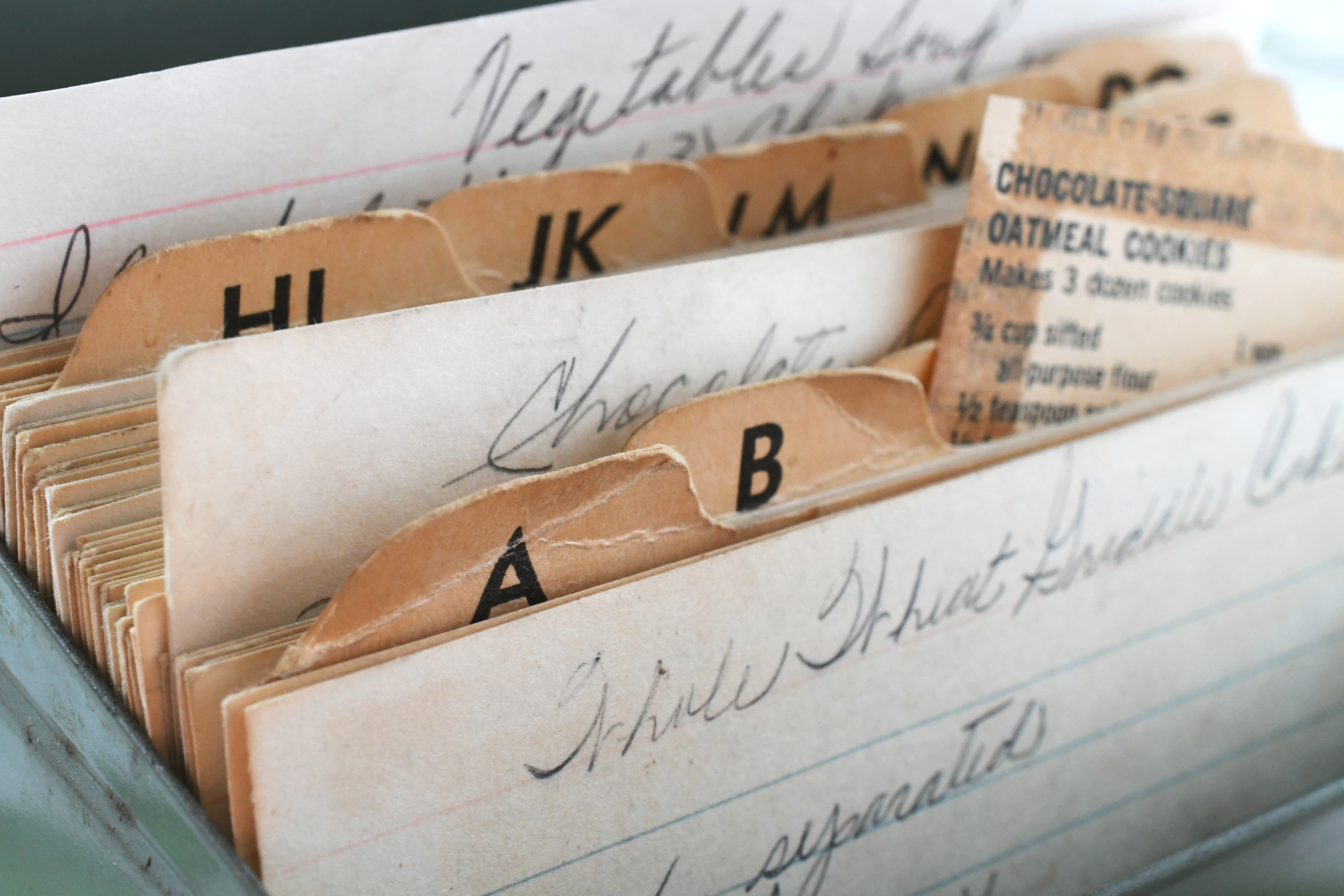
close-up of recipe box with handwritten index cards and alphabet dividers

Every time I open the door to the cabinet, I see—on top of a few Martha Stewart cookbooks that my husband liked—the little gray plastic box with the alphabet tabs for recipe index cards. The box was so stuffed that the lid never closed.  When I hesitate a moment before getting what I opened the cabinet for, I tell myself that I really need to take time to go through those old recipes and get rid of those I know I’ll never use again.

The day finally came for me to weed the box of some tattered and yellowed index cards. What a trip down memory lane of good times and good people.

I was surprised at the number of recipes to which I attributed an “owner’s” name. Weeks after clearing out most of the recipes, I wish I had written down the names of the people I owe for the recipes.

Some that I remember include Grace’s Gooey Butter Cake and Potato Salad, Ginny’s Lettuce Bacon Salad, Bob’s Chicken Curry Casserole, Bettie’s Cornbread Dressing, Maw’s Pecan Crescents, Anne’s Marinara Sauce, Jacki’s Gravy, Jackie’s Mac & Cheese, Mary’s Broccoli Cheese Bake, Larry’s Squash Rolls, and Aunt Evelyn’s Fried Corn. And then there’s “What’s Her Face,” who gave me the recipe for the Texas Chocolate Cake. I didn’t have her name attached but I remember her clearly…except for her name, that is.

Each of these recipes found its way into my box because I had enjoyed the dishes made by the recipe-giver and wanted more. I thought I could replicate the dishes and make them for my family. I can say with all candor that my attempts at the dishes were never as tasty as the originals, but they were good enough for me to keep trying.

The best part of attempting these dishes was that the process always brought back memories of the people who unselfishly shared their recipes with me.