Category Archives: respect

Sensitivity

The sun is bright in a perfectly blue sky and the water aerobics class is in full swing. There are so many of us in the pool that we must keep checking to make sure we don’t kick someone. We all love this class with the music classics that give us the beat to help us move our bodies as if we’re young again.

Most of us just follow the instructor and try to keep up. I’m sure I’m not the only one who loves to hear the loud whoops and comments from one zany, fun-loving woman who makes an early morning class feel like an afternoon fiesta. She sometimes repeats what the instructor directs us to do as if she’s a microphone and sometimes she makes comments about what we love and what we dread doing as an exercise. She makes it fun and not work.

There must have been something in the air on this particular morning because a woman near me who seemed to enjoy the cheerleader on previous occasions said to me that she wished someone had tape for the mouth of our cheerleader. A short time later, another woman approached our cheerleader and said something to her about keeping it down. Then there was silence and it felt strange to be in the water going through our routines without our cheerleader.

Not long after the forced silence except for the music and instructions for the exercises, our zany cheerleader, apparently feeling admonished, made her way to the back of the pool. As she passed me, she said, “Some people don’t like the noise I make.” I said, “I love the noise you make!”

After she found a spot in the very back of the pool, I beckoned her to come back to her spot. She shook her head, no. The instructor who, like many of us enjoyed her cheerleading, asked her if she was all right. She nodded that she was. When I checked a few minutes later, she had left the pool.

I watched as a few people rallied around the woman who admonished the cheerleader, and I could see that she was explaining how minimal her comment was.

I felt sad for both women. As tough as women may be in making their bodies strong, as aggressive as they might be in their careers, and as in charge as they may be in their own household, there are not many who can allow what is considered a slight or admonishment to roll off like water.

Often onlookers of our shame and our reaction to feeling diminished will say that we’re “too sensitive.” Perhaps those of us deemed “too sensitive” are resigned to care too much about the connections between ourselves and others. For those who navigate the world immune to slights and prejudices, one wonders what the impact of this posture might have on their ability to empathize with those who are not immune to the judgments of others.

Rather than feel embarrassed about being described as too sensitive, one might feel sad for those who are not sensitive enough.

Leaving Your Mark

Recently, a friend and I went to see the play Hamilton. Like so many others, we never tire of the experience. For us, the musical does not lose its luster no matter how many times we see it. Whether it’s on Broadway or in the desert, we love it. There are so many songs and so much dialogue that just become a part of us. After this recent show, the song that stuck in my mind was Who Lives, Who Dies, Who Tells Your Story.

Innumerable biographies tell stories of extraordinary people who leave great and lasting legacies as a result of their talents, activism, and contributions to the uplift of humankind and to the sustainability of life as we know it. These legendary people leave their mark through acts that become a part of the history of the world. Their impact is usually broad and powerful.

One does not have to die famous to leave a mark. Not all people who leave their mark are widely known and celebrated. Ordinary people also leave their mark. A brief obituary does not mean that the deceased did not leave their mark.

Leaving your mark is not always about the number and magnitude of notable public contributions. It’s not about the number of people who knew about you. Your circle may be small including a few friends and relatives who will remember you and the influence you had on them. Leaving your mark is the impact you had on others, no matter the number or magnitude.

During an interview for Esquire, renowned author Stephen King, said that he would like to be known “as somebody who died merry—who did his work the best he could and was decent to other people.”

With this statement, the author left his mark on me because he put into words my heart’s final desires.

Lottie’s Kids

Families are complicated.

In a recent rare visit with my siblings, my sister aptly named us “Lottie’s Kids.” When we get together, memories of our Mother dominate our conversation.  

As we talk, there are familiar rhythms and vibrations that create the pattern of our being together. From raucous laughter to wide smiles, from quiet nods to abrupt interruptions to tell what “really” happened. 

Some of our funniest anecdotes are those that describe incidents that were not so laughable at the time they happened. It’s only through the many iterations of the tales that they become comical. What once loomed large are now small and distant memories. Yet, they are powerful enough to create a static hum that connects who we are now to who we were as “Lottie’s Kids.”

Rather than an archeological dispassionate exploration of the truth, we hold on to our own recollections of what really happened. Sometimes what we think are memories are not, in fact, our own recollections. Rather they are what we heard others say happened based on their memories. During our reunions, truth is not what’s important. What is important is the telling of the tales from the recollections of “Lottie’s Kids.”

Notwithstanding the possible therapeutic benefits of reuniting and sharing with family, for a brief moment when we’re together recalling our growing up, I feel as if we’re doing something disrespectful to our Mother’s memory because we describe her behavior without knowing the context or motivations from her point of view. I wonder if my siblings have similar feelings.

By the end of our time together, I know that our Mother would join us in this comic-fest. No one would sit near her, however, because she had this habit of hitting the person near her when she was in the throes of laughter. She took laughing seriously!  

Despite our regrets and wishes that our lives would have been more of what we think is “normal,” we know that our Mother was a singular woman with many more gifts than foibles. Her eccentricities might have been her way of shielding her heart that had been broken too often by too many people.

I’m grateful to be one of “Lottie’s Kids.”

Artist Appreciation

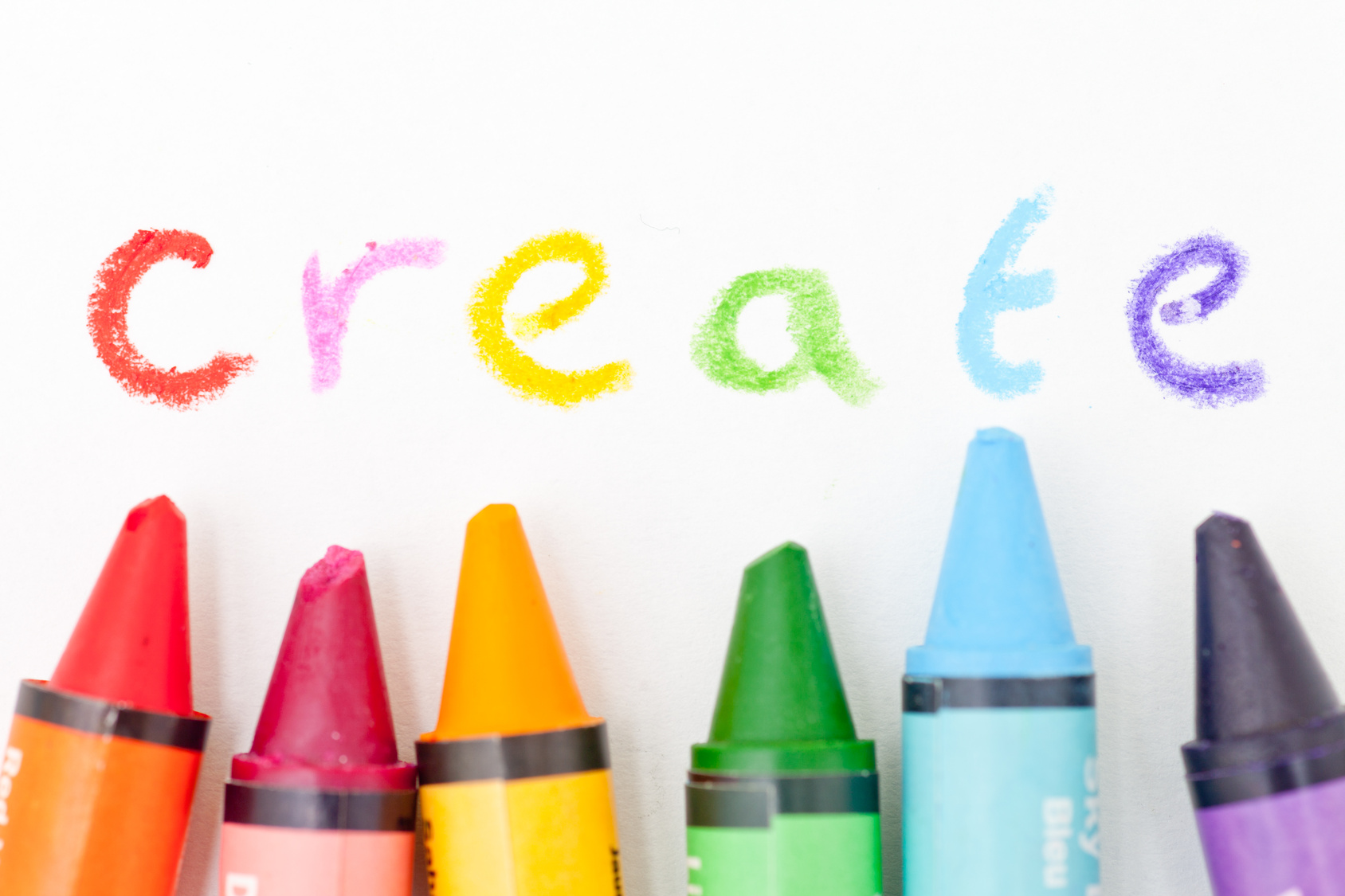
the word create written with multicolored crayons

I have a great appreciation for people who create art. The closest I ever came to creating “art” was as a child carefully coloring within the lines while playing with my coloring books. I loved coloring and eventually began to use my darker colored crayons to outline the images  and a lighter shade of the same colored-crayon for the body of the image. My favorite gifts were larger and larger boxes of crayons. My first box had about eight colored crayons and I think the last box I remember having had sixty-four crayons!

Not having the experience of craft-making—except for a few potholders in a summer Bible study and crocheting Afghan throws when I was pregnant—I don’t recall ever having made something that could be called art or craft. My lack of exposure to ways to be creative and perhaps my real lack of talent may be the reason why I hold those who can create art in such high esteem.

I value artists and what they contribute to a world of beauty often, and to imagination all the time. Using what they have learned and their natural talent, it seems to me that they have an advanced level of human intelligence and more courage than those of us who have been too fearful of failure to dig deep enough within ourselves to find the spirit and essence of what we might be capable of doing. In my case, it’s easier to deny any desire to create art than to devote myself to pursuing something that I might fail to achieve.

I think that artists meld their emotions and imagination into the kind of self-expression that is more than aesthetic fulfillment. It is a dedication to a search for truth born out of a passion to create. Artists’ creations speak to that part of humans that craves a shared experience. Through their work, artists help us to bridge the gap between what is and what could be. Their art helps us to focus on the intangibles as well as aid us in seeing the bigger picture.

Self-expression through creative endeavors is a gift to be treasured. I appreciate the artists who make our world more livable and our lives more fulfilling.

August is American Artist Appreciation Month. Let’s thank and celebrate our artists! 

Still Thinking About Being Authentic

I have decided to stop saying, “Just be yourself and act natural.”

I realize that hearing this does not always motivate. It can even be devastating when one feels that just being one’s self is not enough.

This is where role models come in. If we think that being our natural self is not enough, who are the people we would like to be like in this situation?

Acting as we think the people we admire would act is still being ourselves. We’re just finding a way to bring this part of ourselves into focus for this purpose. It does not change who we are. Acting as we think a role model would act enhances and burnishes the self that we’re always creating.

Being our best selves by not deliberately deceiving for selfish reasons may be the better part of being authentic.

If we’re guided by a basic human value of treating others the way we would like to be treated or the way they prefer to be treated, I think we can simplify the complex issue of being our authentic selves.