Once in a lifetime, if you’re lucky, you will know a Mr. or Ms. FANTASTIC!
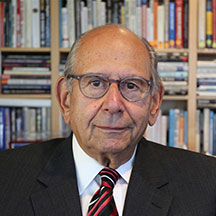
Laurence N. Smith is my Mr. Fantastic! He was the vice president for University Marketing and Student Affairs at Eastern Michigan University from 1975–2000.
I give him this title because he stands out from the rest in every way. He’s always the tallest in the room and the smartest in the room. And when asked how he’s doing, invariably, he responds, “FAANTASTIC!”
Leadership in a volunteer organization based in higher education can be a different experience than what a leader might be able to do in a top-down organization where the people responsible for making the trains run on time are paid and can be released at-will.
When I was in such a leadership position, willing volunteers were the key to success. Many stepped forward to let me know that I could count on them to help me achieve the goals of the organization. They used words like “help you,” “support you,” “here when you need me.”
In my imaginative recall, Larry Smith, towering over the heads of his colleagues, fixed his eyes on me, made a beeline to me, and asked, “What is your vision for this organization?” With confidence, I summarized my mandate from the volunteer board of directors and added my own vision, which could be described as fantastical given the structure and history of the organization. Mr. Fantastic’s eyes communicated, “Are you sure?” The gaze I returned indicated that I was.
Lyrics from songs best describe his response: “Come along with me,” “I’ll take you there,” “I believe I can fly!” My leadership vision was the perfect vehicle for Mr. Fantastic to test drive his ideas about what student affairs administration in higher education could “truly be.”
On the journey with Mr. Fantastic, it was obvious that when we were talking about using listservs to bring our members together in conversation from various locations, he was already thinking about what we now call Zoom meetings. When we were talking about Palm Pilots, he was envisioning what is now Chat GPT. Always looking toward the possibilities for the future, never fearing failure, and always optimistic is my Mr. Fantastic.
And I’m not the only one that found Larry to be fantastic. In 1999, he was named a NASPA Pillar of the Profession, and in 2002, he was the recipient of the Fred Turner Award for Outstanding Service to NASPA. The equivalent of a Lifetime Achievement Award, the Turner Award recognizes NASPA members who have brought honor and dignity to the student affairs profession and to NASPA as an association for a sustained period. Among Larry’s extensive activities, he was founder and chair of the NASPA National Academy for Leadership and Executive Effectiveness and executive editor of NASPA’s online management magazine.
I spoke with Larry recently and told him that to have him as a colleague and friend during my time at NASPA was a blessing of pain and glory. The pain was tempering the projections of where the organization could go and modulating the speed of change in order to be in sync with the volunteer leadership. The glory was the innovations NASPA achieved through its volunteers when we were flying with Mr. FAANTASTIC!
Thank you, Larry. I am truly grateful for your colleagueship and friendship.
Temperatures of 116 degrees Fahrenheit couldn’t scorch the magnificent tapestry of my birthday. Just being alive and in good health was enough, but my cup ran over with well wishes from friends and family near and far. Thank you all.
It’s not the same for everyone, but I appreciate being remembered on my birthday. However, I’m learning that what pleases me may not please someone else.
Like me, you might think that everyone wants to be remembered on their birthday. I have discovered that this is not true. This discovery makes me think that it’s not always best to “do unto others as you would have them do unto you.” Instead, I read somewhere that we should “do unto others as they would have you do unto them.” This is an acquired skill that I’m attempting to master.
This is appreciation day for all of you who read my blog. And for those of you who take the time to comment, a very special, “Thank you!”
I appreciate comments about my blog. Sometimes when there are long stretches without any comment, I want to ask if there is anyone out there. And, for a fleeting moment, I tell myself that I should stop writing.
However, this feeling is fleeting because…
I write to give my opinions on topics of the day. I write to share my thoughts on culture. I write to express my thoughts and feelings similarly to when I kept a journal. I write to fulfill some part of my desire to write a memoir. I write to share personal anecdotes that may resonate with another person. I write to exercise my mind. I write to have the discipline to prepare something each week. I write to feel seen and heard. I write to enshrine my identity. I write to assure myself that I’m still here.
In a recent interview, Harrison Ford summed up my reason for writing when he said, “I’m editor in charge of my life.”
Although I rarely respond to comments online, I am deeply grateful to you who do let me know that you hear me. Please accept my gratitude. Thank you.
My brother-in-law—married to my baby sister, Regina, for 47 years—passed on Monday, June 26. My heart aches for all of us who knew and loved him. My hope is that we will all find comfort in knowing that he was a man who lived a good life as a loving husband, father, grandfather, and friend, to name just a few of his many roles.
I send a special prayer to my sister whose grief is inconsolable. Mack, who she knew from when they were in grade school, was the love of her life. And she was the love of his life, whom he loved steadfastly and with tenderness seldom witnessed.
He was the steady hand as they raised their children. He anchored the family with his calm dignity. He brought joy when he smiled with his eyes as his large, strong body shook with laughter.
Many community college students are true immigrants to higher education. To them, going to college is as foreign as finding themselves put ashore in a strange land.
Once they embark upon a college education at the community college, often their main concerns include how to pay for their course work and how to juggle their myriad responsibilities in order to find time to study.
Often, their plans include getting as many courses done as possible at the community college at lower costs before continuing toward their four-year degree.
They are proud of these hard-earned credits. However, too often they find their safe harbor disrupted when they discover that many of the credits earned at the community college will not transfer or be accepted by their choice of a four-year college.
More than 40 years ago when I worked at a community college, the most time-consuming and frustrating parts of my job as a counselor and academic adviser were to work with students who were being stymied in their progress because the community colleges and four-year colleges could not come to agreement on which courses taken at the community college were “equivalent” to courses at the four-year college. I think now as I did then: If community colleges are “colleges” and faculty who teach the courses are qualified and students meet the requirements, why are there questions about equivalences?
A recent story on Marketplace Morning Reportnoted that when transferring from a community college to a four-year college, about “43% of college credits don’t end up counting toward a new degree.” The reasons for this lack of cooperation and consistency between community and four-year colleges seem to be about money and hierarchy.
With less funding from states and counties and increasing infrastructure costs for colleges and universities, four-year colleges continue to raise tuition as a source of revenue. Done intentionally or not, having students repeat courses already taken at community colleges is another source of revenue.
Then there is the hierarchy. Community colleges that were created to give opportunities to a broader spectrum of students in their own communities are often described in unflattering terms. Rather than being seen as a way to level the playing field, the hierarchy is preserved when the gatekeepers at four-year colleges stand in judgment as to the worth of the credits earned at community colleges.
Students have little say or control about the transfer of credits and suffer the consequences of being stuck in the middle. If faculty from the two types of institutions cannot agree on what is acceptable in courses of the same or similar names and descriptions, then it may be time for outsiders to interfere further in the business of the professionals in higher education.
If outsiders are allowed to make decisions about what is appropriate to be in the curriculum, how teachers teach, and what books are in the library, why not take this interference further and mandate articulation on course transfer between community and four-year colleges? The time is long overdue for leadership to require that the roadblocks to complete articulation between community and four-year colleges be removed.
“’Tis the times’ plague when madmen lead the blind.” —Gloucester in Shakespeare’s King Lear
It has been a couple of weeks, and I still can’t get out of my mind Maureen Dowd’s April 16 column in The New York Times, “When the Mad Lead the Blind.”
In today’s world, who are the mad and who are the blind?
What comes to my mind is that some of the people who hold political positions of power are mad. They are in positions of immense responsibility but lack the wisdom and grace to fulfill the promise of their title. Those who have good intentions—not the mad but those who don’t have the wherewithal to persuade, build coalitions, and execute plans—will hopefully have short terms in office avoiding catastrophic damage. However, it is those who are mad who will hang on to their positions, seeing every position as just another rung on their quest for dominating power. These officials have no regard for the impact of their decisions on citizens and the ideals of the nation.
Why do we elect people who are mad? Is this not a vote against our own wellbeing? Do we elect people who are mad because we are blind to who they really are? Acting as if we are blind to such people’s true nature makes us vulnerable to their maniacal actions. Willful blindness is a transgression paid for by retribution down the line.
We should not be surprised when some officials attempt to enact unconscionable policies that would have been unimaginable just a decade ago. These bold actions are just the tip of the iceberg because these elected and appointed officials believe that the citizenry is blind to who they are and to the purposes of their actions.
Imposters abound, using rhetorical tools that sound as if they are protectors of the electorate all the while spewing words that increase contempt and polarization among groups of people. When a candidate vilifies any group with no regard for the consequences of their message, you will know that this candidate is mad. More than party affiliation, charisma, or credentials, history tells us that it’s the character of the person that will foretell the kind of leader or representative that person will be.
Perhaps more than the sighted, blind people can discern if a person has empathy as well as a moral pale beyond which they will not tread. A yardstick to measure and a thermometer to test the degree of madness of potential leaders and elected officials is to listen to how they imagine the nation can restore a sense of unity; how they imagine creating cooperation among governing bodies; and how they imagine defusing bitter conflicts at home and abroad with compassion, justice, reason, and love.
For our own sake, we must believe that we can overcome the shame that some of our elected officials are creating when they enact punishing and disgraceful policies aimed at stifling freedom and rolling back progress for everyone, not just some. Rather than being discouraged by the actions of those who foment conflict indicating that they have no human compassion or moral compass, we need to do our due diligence in preparation for our next opportunity to choose.
We must not be blind. We must see who among the prospective elected officials are mad.
What I fear about aging is becoming conspicuously and stereotypically old. I’m not talking about the natural physical and mental changes that accompany aging. What I fear is the calcification of my attitude and outlook on life. I want to avoid falling into the trap of thinking according to a generational divide and believing that I must stay on my side of the generation gap.
Each generation has its place in the continuum of time, and unfortunately there are negative comparisons coming from both directions. Past generations create myths that support their belief that they were stronger, smarter, bolder, cooler, braver than succeeding generations.
The younger generations, because they are more technologically advanced than previous generations, see a mirage that indicates to them that they are more savvy and capable than the generations that came before them.
I want to know what I need to do to continue to be relevant and engaged in the continuation of human prosperity for all generations. I want to take a walk in the athletic shoes of younger generations to try to feel what it must be like to be facing an uncertain economic and social future in today’s world. I want to meet younger generations where they are in their interests.
I feel extremely lucky when I have the privilege to have conversations with the newer generations. I’m eager to understand their views on representation and culture; family and values; work and play; politics and human interactions. If they want to hear my perspective, I’m happy to share. However, I do not believe that because I’ve lived longer and have more experience in some things that I, and others like me in older generations, have the insights and knowledge to change the trajectory of the future. As in all things, I believe that shared knowledge among diverse groups is essential for optimal outcomes.
I do now believe–and always have–that our upcoming generations are our hope for the future. My hope for myself is that I can be a help and not a hindrance to the work that they must do. One way that I plan to avoid being conspicuously and stereotypically old is to be transgenerational. I want to cross the generational divide by accommodating to the new order of things. I want to lessen the distance of the generational gap by being in the moment with what’s happening now.
On Palm Sunday, April 2, 2023, I went to the Scottsdale Museum of the West to see a screening of the documentary film, Jews of the Wild West.
As I watched the film, I kept thinking about how the stories of Jewish people who immigrated to the United States and later to the Western United States appear to be missing from American history. The absence continues to be perpetuated in books and films today. A special thanks is owed to the nonprofit production company and to the filmmaker, Amanda Kinsey, for uncovering and sharing such a significant part of American history.
Notable Jewish migrants to the West are Levi Strauss, who we can thank for the jeans we wear; Isaac Shwayder, whose son, Jesse, founded the premier luggage line Samsonite; and Meyer Guggenheim, patriarch of the philanthropic Guggenheim family whose wealth came from the mining and smelting business. Women such as Golda Meir were also prominent in establishing a Jewish presence in the West. To say that these families had humble beginnings is an understatement.
They used their ingenuity, persistence, grit, and desire to make a life without persecution—one in which they not only survived the hardships of the frontier but thrived. They found that the Wild West had less antisemitism than New York City. In general, people who moved West had one thing on their minds: taking advantage of the riches the frontier would eventually offer.
The Jews who migrated West, for the most part, were not panning streams and mining for gold. They understood that people needed practical products and clothes as they pursued their dreams of a better life and their road to riches. The Jewish migrants may have started out as peddlers who made enough money to open a dry goods store as in the case of Shwayder. Eventually, they found markets within their communities and beyond that became their road to success. Because they were usually the only people in the community with a business, they often became the mayors of these frontier towns.
Jews of the Wild West is rich with the personal stories of the Jews who struck out for the Wild West and made good. Check out streaming platforms and American Public Television to see this film.
Everybody has an opinion on the slap heard around the world. The Oscars on March 12 reignited conversations about two of entertainment’s most celebrated men. They were the butt of jokes by the 2023 Oscars host, fodder for every journalist who can write an opinion, and a major topic of discussion among some of us Black people.
I had a double dose of Smith and Rock the night before the Oscars. With some other film lovers, I watched Will Smith in Emancipation. Though not on our agenda, we could not help but talk about the slap. That same evening, I watched the Chris Rock Netflix special, Selective Outrage. Seeing these two men back-to-back exhibit their talents in such stunning ways, I ached for them and for all of us who are witnessing this episode in their lives.
Two rich and famous Black men torn asunder by an ill-conceived act of chivalry. They say that chivalry is dead. On the night of the Oscars in 2022, many of us wish that chivalry would not have been awakened. After a period of absence from the public, Will Smith made what I thought was a contrite and sincere video apology to Chris Rock. He apologized to everyone and took full blame and responsibility for what he did. He also said that, “If you hang on, we can be friends again.” Chris Rock obviously didn’t accept the apology and said so by calling it a “hostage video.”
Chris Rock put his response to the incident in his Netflix special, Selective Outrage, and timed the release to correspond with the anniversary of the slap. Before Selective Outrage, there may have been hope that, in time, the two men would get beyond the unfortunate and unforgettable incident. Now, I fear that there may never be a proper reckoning or any kind of sorrow and forgiveness.
Rock waited until the final minutes of his hour-long routine to clean his spleen about Smith. The unvarnished feelings that he conveyed were more than anger. There was fury. I felt that the anger he showed was not just for theater. His feelings of outrage seemed to be a fresh wound and not a bruise left over from a year ago. The bitterness of his retaliation was stunning.
Though the audience laughed at the revenge monologue, I want to believe that, upon reflection, many of them felt sympathy for both men who at the pinnacle of their careers are the butt of jokes and ridicule. Sadly, these two great talents have become a cliché.
I just finished listening on Audible to April Ryan’s book, Black Women Will Save The World: An Anthem. #BlackWomenWillSaveTheWorld. This is a powerful and emotional reflection on the toils and unwavering leadership of Black women in a world in which our contributions are not valued and, in fact, our very selves often are devalued.
This book made me think about those women—“hidden figures” —who, over the decades, have provided the very foundation for all the successes of subsequent generations of Black families. One such group of “hidden figures” is the 6888th Central Postal Directory Battalion from World War II.
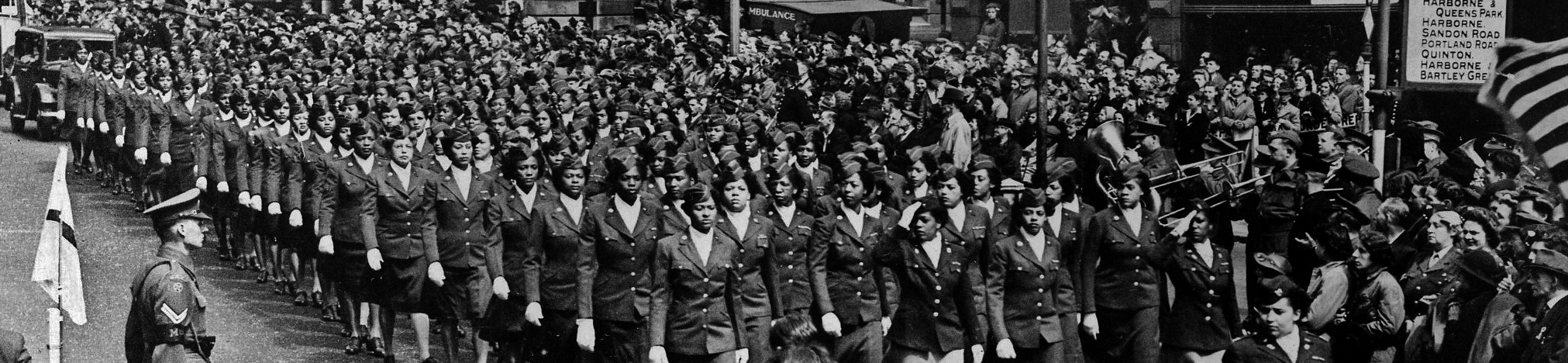
The 6888th was a unique U.S. Army unit that had the distinction of being the only all-female, African American battalion to serve in the European Theater of Operations during World War II. Made up of 855 women—824 enlisted and 31 officers—this Women’s Army Corps Battalion was commissioned in Europe between February 1945 and March 1946, and was led by 26-year-old Major Charity Adams.
The specific mission of the 6888th was to sort and clear a multi-year backlog of mail for the American Army, Navy, Air Force, the Red Cross, and uniformed civilian specialists who were stationed in Europe. This represented seven million people awaiting mail.
In February 1945, the first contingent of the 6888th embarked from Camp Shank, New York, to sail for Britain. They survived close encounters with Nazi U-boats and arrived in Glasgow, Scotland, where a German V-1 rocket exploded near the dock. The second contingent of 6888th soldiers docked in March 1945 in Gourock, Scotland.
Upon arrival by train in Birmingham, England, the Battalion confronted warehouses stacked to the ceiling with letters and packages. They endured inhumane working conditions, including dark, unheated, rat-infested aircraft hangars with broken windows and air raids. Despite these conditions, the Battalion created a new mail tracking system, worked three separate 8-hour shifts, 7 days a week to process an average of 65,000 parcels per shift (which is 195,000 daily), and cleared the 6-month backlog of mail in 3 months.
After resolving the immense mail backlog in Birmingham, the 6888th Battalion sailed to France for their next assignment in Rouen. They encountered undelivered mail dating back two to three years, which the Battalion again successfully processed and cleared in just three months.
Upon concluding their final assignment in Paris, the last of the Battalion returned to the United States by ship and was disbanded in March 1946 at Fort Dix, New Jersey. There were no parades, public appreciation, or official recognition of their accomplishments.
Adhering to the motto, “No mail, low morale,” the Battalion provided essential support to the U.S. military in the European Theater of Operations by linking service members to their loved ones back home. The 6888th achieved unprecedented success and efficiency in solving the military’s postal problems. The Battalion was the largest contingent of African American women to ever serve overseas, dispelling stereotypes and representing a change in racial and gender roles in the military.
It was not until nearly 80 years later that the 6888th received the well-deserved recognition for their service to the United States. In March 2022, the Battalion became the only women’s military unit to be awarded the Congressional Gold Medal, which was first awarded to General George Washington in 1776.
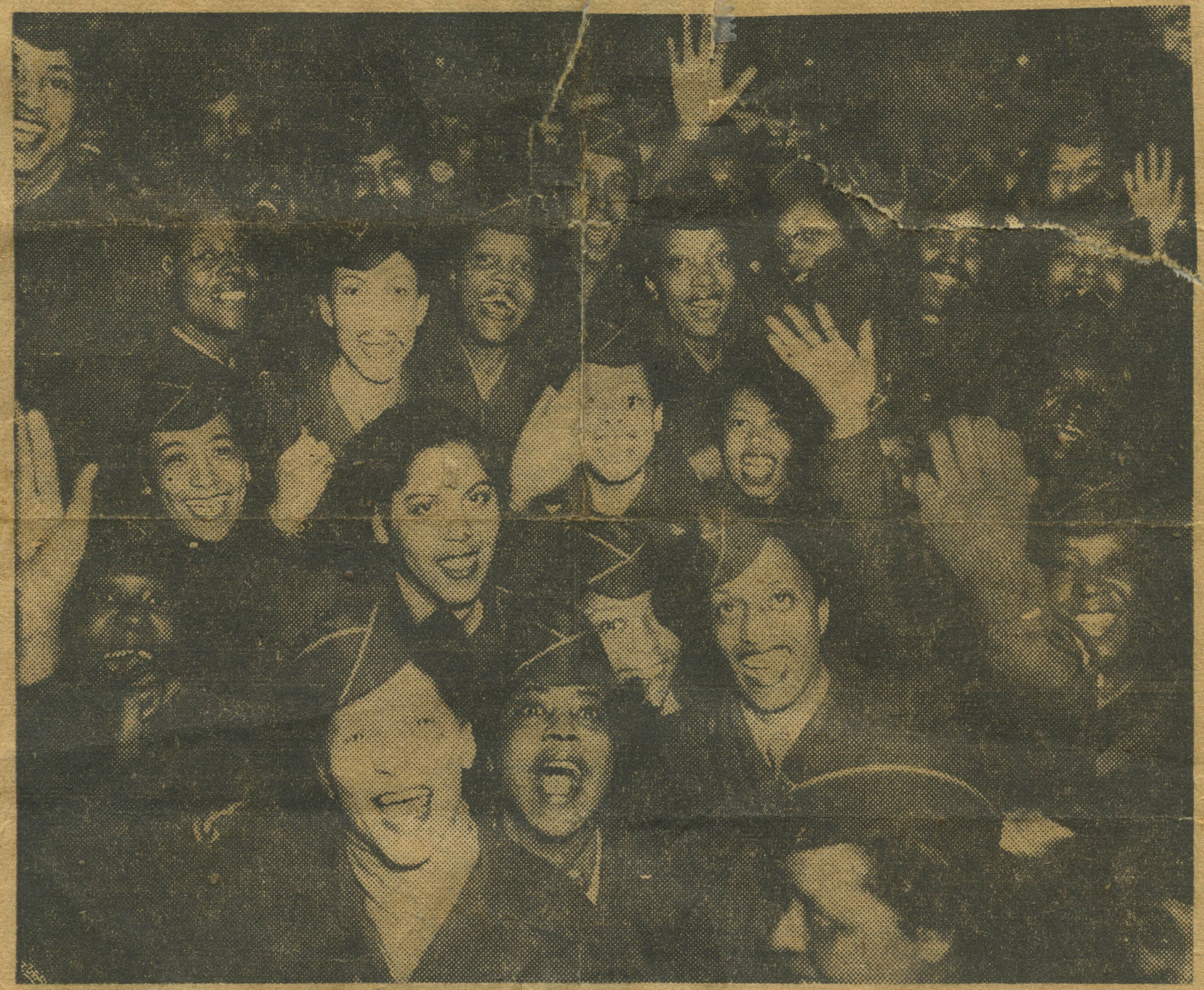
Iconic photo from when the last of the Women’s Army Corps (WAC) returned home from France. Annie Knight (Jordan) is the woman with the big smile in the top left corner.
The 6888th has a very special significance for me. My mother, Private First Class Annie Knight (Jordan), was one of those brave Battalion soldiers. As kids, my siblings and I always knew that she was in the Women’s Army Corps (something about which she was extremely proud). She mentioned to us that she did Morse code. We just thought of that as being like another language of sorts. It was not until Fall 2022 that we understood that her enlistment classification was not military postal worker. In fact, mom was in a special category called “Cryptographic Code Compiler.” Cryptographers, also known as code breakers, were secretly trained to crack code that provided intelligence information for the Army. Very little is known of the Black women who served in this capacity.
As I learned more about the 6888th, I began to think about how many ”hidden figures” there are and wonder how we might ensure that their stories are shared and their legacies known. I asked questions like, “What inspired these 855 African American women to enlist and pursue the 6888th?” “What gave them the internal fortitude to take on unknown ventures in a dangerous foreign land?” “What made them so different?” and “How did that very difference change the course of their lives post-military service and influence their legacies?”
So, in 2022, I became a first-time podcaster: NextUs818 Podcast is a reflective platform for connecting past successes with future progress in the African American community. There are many African American heroes—some known and many unsung men and women—who helped build this country. Some were the first or only in their fields of endeavor, like the 6888th. Yet little is known about how their unique journeys influenced the trajectory of their familial legacies…such as their children, grandchildren, nieces, nephews. The NextUs818 Podcast introduces the multi-generational descendants of these heroes. On the first and third Wednesdays of each month, I interview descendants of an African American hero and explore family lore, traditions, and values, and how the descendant’s journey was directly impacted.
The inaugural season of the NextUS818 Podcast features the descendants of the 6888th Central Postal Directory Battalion. Now 14 episodes in, 4 themes have emerged to help me better understand what inspired the 6888th soldiers and how their service has influenced subsequent generations: patriotism, fearlessness, adventurousness, and unwavering commitment to lifelong learning.
Patriotism: Despite the rampant racial and gender discrimination of early 1940s America, these women were exceptionally patriotic. With the country at war, they felt that it was their DUTY to contribute to the war efforts against the Hitler regime. They eagerly embraced this chance to serve.
Fearlessness: The notion of a young African American woman going into war zones would be darn right scary, even today. Yet these brave women exhibited a remarkable degree of fearlessness.
Adventurousness: Not only did these women demonstrate fearlessness, but they were excited to explore the unknown. As kids, mom always spoke about her adventures, especially once the Battalion moved on to France. In all the stories I heard about the women, they saw serving in the Army as a way of giving them broad exposure and opening post-military opportunities otherwise unavailable to them.
Commitment to lifelong learning: Many of the women went on to attend college after their military service, some using the G.I. Bill when the opportunity was available. (See How the GI Bill’s Promise Was Denied to a Million Black WWII Veterans) Their unwavering commitment to education deeply influenced their children and grandchildren.
In the NextUs818 Podcast, I enjoy hearing the stories of the soldiers’ civilian lives after World War II. The women of the 6888th were college graduates, teachers, nurses, college deans, and entrepreneurs. As important, they influenced the trajectory of their children and grandchildren who, among other things, are PhDs, physicians, engineers, lawyers, educators, professional musicians, and financial and advertising executives. All of the descendants with whom I have spoken emphasize that their successes are directly attributable to the foundation laid by the women of the 6888th. From them, they learned how to be focused, tenacious, and how to persevere under adverse circumstances. They learned how to survive and thrive. So when we are tempted to live in the moment and think we got here solely on our merit, we must never forget those shoulders on which we stand!
Five final notes:
Fort Lee Redesignation: The U.S. Department of Defense has made a commitment to rename military bases named after individuals associated with the Confederacy and other dark periods in American history. On April 27, 2023, Fort Robert E. Lee will be renamed “Fort Gregg–Adams” in honor of two trailblazing African American officers: Retired Lt. General Arthur Gregg and the late Lt. Col. Charity Adams (commander of the 6888th Battalion).
6888th Legacy Tour: A group of 6888th descendants and advocates will return to Scotland, England, and France, walking on the grounds where the brave soldiers made history as part of an upcoming 6888th Legacy Tour.
Carmen Jordan-Cox, PhD, is a retired university vice president and judge/magistrate. Currently, she is producer and host of NextUs818 Podcast and a freelance curator of stories about descendants of World War II soldiers.

 Gwen Dungy