Always in shades, we didn’t know what her face looked like. Behind the shades, she seemed aloof, almost hostile.
Without the dark glasses, my friend and I were surprised at what we saw. To me, the look on her face was like that of a small child—innocent and open. I had the urge to protect and comfort her. My friend said that the woman seemed somewhat agitated.
While I searched for a word to describe what we saw and felt, my friend said, “She looked vulnerable.”
Yes, vulnerable.
The rest of the week, I continued to think about the word “vulnerable.” What does it mean to feel and be vulnerable?
When I was with other friends, I would bring up the topic of vulnerability and ask them to tell me what being vulnerable meant to them and under what circumstances they recalled or would imagine that they would be vulnerable.
My question elicited thoughtful responses. Most common among the ways of defining being vulnerable was feeling open, exposed, defenseless, transparent. When my friends described the circumstances when they thought they would feel or have felt vulnerable, they realized that what they were feeling was fear rather than what they thought of as vulnerability. The situations they described always involved fear of bodily harm by someone else.
Musing about fear and vulnerability, I realized that I would much rather experience fear than vulnerability. I could use the adrenalin generated by fear to fight or flee. In such a scenario, fear comes from outside one’s self, stimulated by the threat of the other.
Experimenting with what I thought feeling vulnerable would be like, what came to mind were those instances in which close friends or family had hurt or disappointed me. Only people for whom I cared deeply could elicit a feeling of vulnerability. There is no rush of adrenalin. In fact, the heart is depressed. There is no fight or resistance. Only sadness, humility, and helplessness because in truth, being vulnerable requires cooperation of the self.
These thoughts bring me back to the mysterious woman who had a face of openness and innocence all the while showing a layer of pain. Based on this fleeting moment of visibility, I think that she had the courage to offer herself up to being vulnerable.
Anna Julia Cooper (1858–1964) put no limits on the intellectual potential of Black people, Black women in particular. Her own intellectual and educational achievements are a testament to her firm belief that women’s opportunities for learning and education should not be less than or different than men based on assumptions about women’s capabilities.
I’m particularly drawn to the life of Anna Julia Cooper because she did it all: was a leading Black spokeswoman; held leadership in women’s organizations; founded the first chapter of the YWCA Camp Fire Girls for Black girls; served as principal and teacher in the “renowned Dunbar High School in Washington, DC;” started a night school for working people to attend college; and authored a seminal book on Black feminism, A Voice from the South.
Even as she focused her energy and attention on cultivating the potential of marginalized people, she also continued to work on her own education. In 1924, Cooper received her Ph.D. from the University of Paris, becoming only the fourth Black woman in the United States to earn a doctorate degree.
Despite these extraordinary accomplishments of a Black woman born in the South and formerly a slave, what captivates me most about Dr. Cooper is that she didn’t seek attention. Dr. Paul Cooke, one of her biographers, wrote that she chose the “lesser light.”
She was dedicated to a larger cause than herself and refrained from crediting her own achievements. An example of Dr. Cooper’s humility is what Dr. Mary Helen Washington shared in her Introduction to Cooper’s Book in the Shomburg Library Collection of Nineteenth-Century Black Women Writers.
“In 1982, when Louise Hutchinson, staff historian at the Smithsonian Institution, completed her biography of Cooper, she called for an official Smithsonian car and hand-delivered the copy of the biography to Mrs. Regia Haywood Bronson, the eldest of the five children Anna Cooper had adopted in 1915.
“Then in her late seventies, Mrs. Bronson took the book from Hutchinson, and holding it to her breast, she rocked back and forth with tears streaming down her face, but not saying a word. When Hutchinson asked her why she was crying, Bronson said, ‘Nobody ever told me Sis Annie was important.’”
Yes, Anna Julia Cooper was important, indeed, in advocating for social justice and equality of rights for all people and the education of Black women, in particular.
Living to be 105 years old, she lived to see a celebration of Black History Month and Women’s History Month. She would have been pleased to see the theme of the 2024 Women’s History Month—Women Who Advocate for Equity, Diversity, and Inclusion.
Introduction in the Schomburg Library Collection of Nineteenth-Century Black Women Writers: Cooper, Anna Julia. A Voice From the South. (United Kingdom: Oxford University Press, 1988).
Since she was always in charge, I’m sure she told Gabriel it was time to blow his horn for her arrival because she had squeezed every ounce of living out of this life and then some at age 96.
Elizabeth B. Rawlins
Dean Emerita Elizabeth B. Rawlins of Simmons College mentored countless young people who thanked her by becoming leaders in their fields and role models for those who followed them.
Beyond Simmons College, Dean Rawlins was the sage who guided Black professionals in the National Association for Women in Education (NAWE) as they sought recognition through leadership to have their voices heard and their talents recognized.
To me, she was “Betty”—friend and role model. While I generally respect the day for family privacy, I called Betty at her home in Oak Bluffs on Martha’s Vineyard on Christmas Day 2023. I could hear the familiar sounds of the family gathering. I could tell by the joy and cheerfulness in her voice that she was elated and ecstatically happy as she told me who was at the house and what they were doing. I could picture the scene, and a feeling of rightness and peace overwhelmed me. I was so glad that I had been led to speak with Betty for what I felt might be the last time.
After we ended our call, I sat for a while and with a smile I recalled good times Charles and I had with Betty and Keith, her late husband, and mutual friends over the years:
African Meeting House in Boston
Betty’s rolls and Keith’s stuffed mushrooms
Inkwell Beach
The ferry crossings
Gingerbread houses
Great seafood
Annual Valentine’s Day in Florida all wearing red
Fireworks on the grounds of the Episcopal Church
Chilmark Chocolates
Literary readings on summer nights
Trips to Edgartown
Oak Bluffs famous-people spotting
Art and bookstore browsing
She had it all. She lived her life with confidence. She loved Simmons College and Simmons College loved her back. She loved and was proud of her family. They were proud of her and loved her. She left this life fulfilled.
Servant of God Sister Thea Bowman (1937–1990) was born in Yazoo City, Mississippi, and reared in nearby Canton. A Catholic convert and the only child of an African American physician and educator, Sister Thea was destined to inspire the Catholic world as a singer and spiritual reconciler.
A young Sister Thea Bowman (Franciscan Sisters of Perpetual Adoration | fspa.org/theabowman)
At age 15, Sister Thea became the first and only African American to join the Franciscan Sisters of Perpetual Adoration, a religious order in LaCrosse, Wisconsin. Their missionary work at Holy Child Jesus School and Church in her hometown of Canton, Mississippi, had inspired Sister Thea’s Catholic faith. Her love of African American culture and music guided how she expressed that faith.
In her essay, The Gift of African American Sacred Song, Sister Thea wrote, “From the African Mother continent, African men and women…carried the African gift and treasure of Sacred Song, Black sacred song is soulful… Black sacred song has been at once a source and an expression of Black faith, spirituality and devotion. By song, our people have called the Spirit into our hearts, homes, churches and communities.”
As an educator, writer, singer, evangelist, and cultural bridge-builder, Sister Thea used music to cross religious and social borders at places in the North and Jim Crow South that were not always welcoming to Black Catholics. Succumbing to her pleas to become a nun, her father had warned, “They’re not going to like you up there” at that White religious order in an all-White midwestern city. She replied, “I’ll make them like me.” She took that mission to the world.
After earning a B.A. in English from Viterbo College in LaCrosse, and masters and doctorate degrees in English from the Catholic University of America, Sister Thea taught at both universities, as well as at Holy Child Jesus School in Canton. Teaching at Xavier University in New Orleans, the nation’s only historically black Catholic university, she inspired Black students and seminarians to share their love and rich cultural heritage with the church and helped found the Institute for Black Catholic Studies. She coaxed White Catholics to accept the gifts God offered through their Black brothers and sisters, and to those who viewed Afrocentric liturgy and styles of worship as “not Catholic,” to open their hearts and minds.
At the height of the civil rights movement in the 70s, the growing diversity in Catholic liturgy and spiritual justice movements emboldened Sister Thea’s tireless efforts to advance cultural diversity and inclusion in the Church. She traveled and spoke in Africa, gaining new insights, friends, and mentors. Sister Thea began wearing African clothing and became an intercultural leader for religious and laity. She helped found the National Black Sisters’ Conference to support African American women in religious life and, in 1978, she accepted an appointment by then-Bishop Bernard Brunini to direct the Office of Intercultural Affairs for the Diocese of Jackson (Mississippi).
Sister Thea Bowman later in her ministry (Franciscan Sisters of Perpetual Adoration | fspa.org/theabowman)
A 60 Minutes interview with Mike Wallace in 1987 introduced Sister Thea’s social justice Gospel to millions and, in June 1989, she became the first African American woman to address the U.S. Conference of Catholic Bishops. She awakened the bishops to the need for inclusion and unity, asking, “What does it mean to be Black and Catholic?” Her initial response to the question was to sing the Negro spiritual, “Sometimes I Feel Like a Motherless Child.”
She went on to explain that being Black and Catholic “means I come to my church fully functioning…I bring myself, my Black self, all that I am, all that I have, all that I hope to become; I bring my whole history, my traditions, my experience, my culture, my African American song and dance, gesture and movement and teaching and preaching and healing and responsibility as a gift to the church.”
But, she told the bishops, the faith witness of Black Catholics is too often denied and devalued, creating feelings of alienation and anxiety in Black Catholics. She closed her address by having the bishops, priests, and all present link arms and sing, “We Shall Overcome,” explaining the history of the song and physical manifestation, and the importance of spiritual leadership and solidarity.
Even today, the Catholic University of America’s recent “Sister Thea Bowman Committee Report” is being used to advance racial equity and, in 2022, the university named a campus street for her. That same year, Georgetown University renamed a chapel in her honor. Similarly, as part of its recognition of the 60th Anniversary of the March on Washington, Howard University dedicated the Thea Bowman Student Center on its campus in a celebration with Cardinal Wilton Gregory, the first African American cardinal in the history of the American Catholic Church.
Before succumbing to breast cancer at age 52, Sister Thea annually fulfilled some 100 speaking and preaching engagements, produced the recordings, “Sister Thea: Songs of My People” and “Round the Glory Manger, Christmas Spirituals,” and helped develop the “Lead Me, Guide Me” Black Catholic hymnal.
“She had her spirituals, the music that was so beautiful,” recalled a classmate Sister Maria Lang in an interview with the Catholic News Herald. “Most of us had been living with little or no contact with anyone of African descent. But her voice was so beautiful, it was just a very rich experience.”
Sister Mary Ann Gschwind, Sister Thea’s roommate at the Catholic University of America during the summer of 1966, added, “It took a lot of nerve for her to join our community. I don’t think I could have done it if the situation was reversed.”
Joann Stevens is a freelance writer and program specialist promoting unsung and unknown African American jazz, faith, and cultural innovators who have influenced democracy and racial justice for the Common Good.
Henriette DeLille (Image credit: National Black Catholic Congress)
Venerable Henriette DeLille (1812–1862) was portrayed by actress Vanessa Williams in The Courage to Love, a romanticized, historical drama that highlighted the Quadroon Balls and system of plaçage that DeLille and generations of her ancestors were born into and practiced. Accepted in North American French and Spanish slave colonies, plaçage allowed wealthy White men to live double lives—one as a committed family man with a White wife and children on a plantation, the other in a household with a mixed-race concubine and children. These unions could last for a year, decades, or until death.
DeLille was a fourth-generation free woman, born and raised under plaçage. Despite a complexion so light that she could have easily passed for White, she never opted for this as the rest of her family did. She entered into plaçage for a short time and bore two children who both died in infancy. By her early 20s, DeLille’s deepening faith and encounters with God compelled her to reject plaçage and encourage other mixed-race women to do likewise.
DeLille wrote in French on the flyleaf of a book centered on the Eucharist, “I believe in God. I hope in God. I love. I want to live and die for God.” Her work on behalf of God is evident in the religious order she founded, Sisters of the Holy Family, and the historical New Orleans Tour the order created to educate people about the life and works of their foundress and order. (The Sisters of the Holy Family are the second-oldest surviving congregation of African American religious, with the oldest being the Oblate Sisters of Providence founded by the Venerable Mary Lange.)
Using funds from the sale of property, her inheritance, and loans, DeLille created programs to teach Black children the Bible and academics, founded the first Catholic home for the elderly in the United States, and fed and cared for the poor.
In 1881, the order purchased the Orleans Theater property that includes the former Orleans Ballroom, the site of the Quadroon Balls, converting it into a school and convent, with the ballroom itself serving as the chapel for the sisters.
Julia Greeley (Image credit: National Black Catholic Congress)
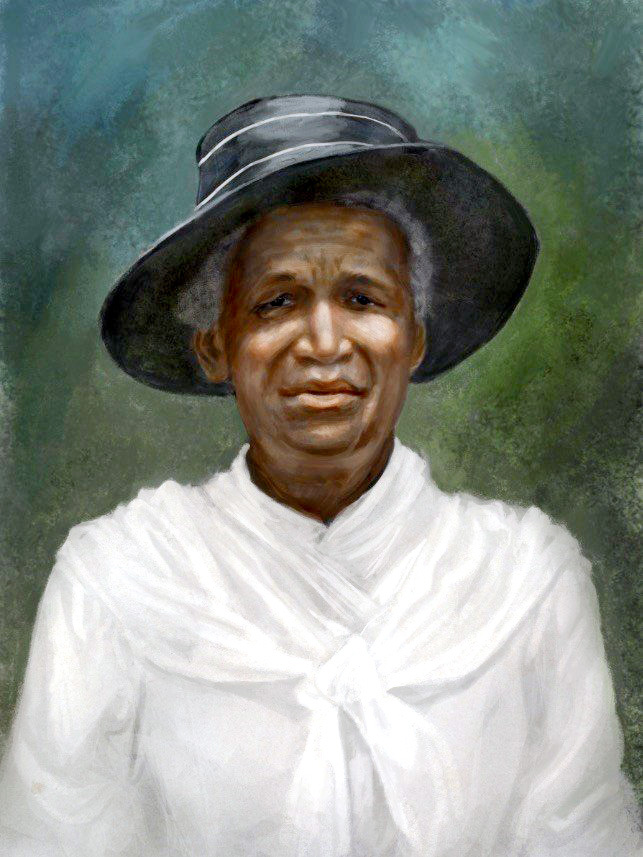
Julia Greeley(c. 1840–1918) was born into slavery in Hannibal, Missouri, sometime between 1833 and 1848. She came to Colorado to care for the family of first territorial governor, William Gilpin, and it was here that she became known as Denver’s Angel of Mercy and Missionary of the Sacred Heart. Greeley’s life and legacy align with that of the unnamed woman that Jesus recognized and honored in the story of the widow’s mite (Luke 21:1-4) for anonymously giving all she had to serve God and others.
A formerly enslaved person blinded in one eye by an enslaver, Greeley arrived in Denver around 1879 or 1880 and was noted for freely giving of her faith, resources, prayer, and strength to all—regardless of race, ethnicity, or faith—until her death in 1918. When her meager resources as a domestic worker failed to provide, she begged for the needy, pulling a little red wagon containing food, toys, clothes, or even a mattress for someone in need. She never sought recognition for her acts of mercy and, sensitive to the possible negative consequences that might come to needy White people receiving assistance from a poor Black woman, she gave anonymously, leaving gifts at night.
A convert to Catholicism, Greeley was baptized at Sacred Heart Church on June 26, 1880. Neither poverty nor past trauma deterred her from evangelizing. Her devotion to the Sacred Heart (e.g., a Catholic devotion to Jesus’s love and compassion for all humanity) led her to attend daily mass at her parish Sacred Heart Church, pray for the Denver community, give alms to the poor, care for scores of children, sing in a small choir at Fort Logan, and specially minister to Denver’s fire fighters.
The Capuchin Franciscans of Denver recognized Greeley’s good works by accepting her into their fraternity as a secular Franciscan in 1901. She died in 1918 on the day of the Feast of the Sacred Heart (June 7) and was buried in the habit of the Third Order of Franciscans as Sr. Elizabeth of the Secular Franciscans. A Third Order is a group of unordained people who live by the ideals of a religious order. Jesuit Fr. Eugene Murphy said of Greeley, “Here was the secret of her influence. She had taken Christ literally, as had the Poverello of Assisi. Like him, she had given away all to the poor and had gone about making melody in her heart unto the Lord.”
At her funeral service, it took five hours for people from all walks of life to view her body and pay their respects. Denver organizations like The Julia Greeley Home for needy women continue to carry her name and mission.
Sources:
Colorado Encyclopedia, Julia Greeley (History Colorado)
Joann Stevens is a freelance writer and program specialist promoting unsung and unknown African American jazz, faith, and cultural innovators who have influenced democracy and racial justice for the Common Good.
What is it about the lives of overcomers that inspire awe, even action?
Learning about the four African American women among the six on the road to sainthood in the Catholic Church, I was in awe of their resistance to personal trials or societal turmoil dampening their faith, or defeating or defining their work to build a multicultural society and Church of love and hope. The women will be presented in chronological order over the coming weeks, concluding with Sr. Thea Bowman, whose evangelism I was privileged to witness at a revival service in Washington, D.C.
Four Women, composed by jazz pianist and singer Nina Simone, narrates trials of colorism and enslavement faced by women. The stories of the four women on the road to sainthood show us the power of love and hope as we strive to live and serve Christ in what the U.S. Conference of Catholic Bishops called “…a genuine conversion of heart, a conversion that will compel change and the reform of our institutions and society,” in its 2018 pastoral letter, “Open Wide Our Hearts.”
Venerable Mary Lange
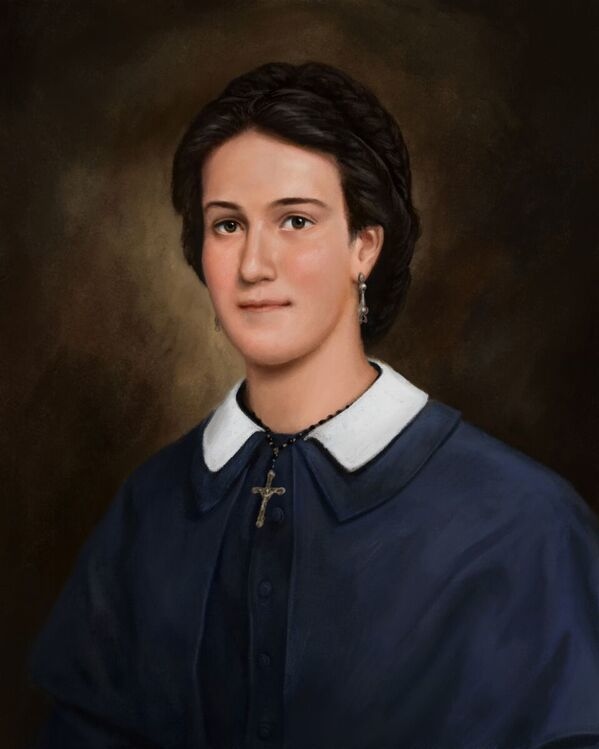
Venerable Mary Lange (1784–1882) immigrated to the United States in the midst of American slavery to achieve the seemingly impossible. In 1818, she and a friend opened a home school to teach Black children in Baltimore. At the time, the city was home to some 1,500 French-speaking Haitian refugees—500 of them Black—fleeing social conflicts in Haiti and France. As a border state, Maryland neither prohibited nor encouraged educating Black children.
The women suffered many indignities, ranging from public insult to Catholic parishes refusing to let them receive communion as they pursued their mission. Lange took in washing to support Saint Frances Academy, which officially became the first Catholic school for Black children in the United States in 1828. The following year, the Oblate Sisters of Providence, the religious order Lange founded, became “the first successful Roman Catholic sisterhood in the world established by women of African descent,” according to Oblate history. Nearly 200 years later, Mother Lange’s educational and spiritual legacy continues in Baltimore.
Born Elizabeth C. Lange in either Santiago de Cuba or Saint-Domingue, Lange was a French-speaking Creole woman whose plantation owner grandfather, Mardoche Lange, sent his family to Cuba to escape the Haitian Revolution. She once described herself as “French to my soul,” and allegedly immigrated to the United States in resistance to an 1808 law requiring non-Spanish residents of Cuba to make a loyalty oath to the Spanish king.
Most importantly, Lange rejected justifications for slavery made by some Catholic priests and church leaders who sought to appease wealthy White donors. She knew slavery was wrong and believed keys to Black liberation included spiritual and academic education. Seeking a White man in America who shared her beliefs, Lange found Father James Hector Nicholas Joubert, a Sulpician order priest and former French soldier and expat from Haiti who became an advocate and spiritual advisor until his death.
Mother Lange taught at Saint Frances Academy, served as housekeeper to the Sulpician Seminary, extended education to Black adults before and after the Civil War, and managed to overcome social violence and poverty right up until her death. Help always seemed to arrive providentially in the nick of time.
Joann Stevens is a freelance writer and program specialist promoting unsung and unknown African American jazz, faith, and cultural innovators who have influenced democracy and racial justice for the Common Good.
I watched the first Republican presidential primary debate a couple of weeks ago. I was fascinated by the efforts the debaters made to distinguish themselves from one another while being careful not to stray away from the party line of the Republican base.
As the candidates responded to the questions, or not, the audience showed its political leanings in a big way. I wonder how those who were in the audience were chosen because they booed anything that sounded almost reasonable and cheered comments that were apocalyptic in their impact if ever implemented.
Following the debate, I purposely avoided listening to commentators’ opinions about who did what and how well they showed themselves. I wanted to sleep on my first impression. The next day I continued to be impressed by the emergence of Nikki Haley.
Comparatively speaking, Haley was the standout in a positive way among the eight candidates. Either she had a lot of courage and conviction, or she gambled that she had nothing to lose because it is highly unlikely that she will be selected by her party as its presidential candidate. Not only did she position herself—purposefully or not—in a way that the Republican Party would never support, but also that Independents would not trust.
Regardless of where she goes from here, I give her points for demonstrating that being a woman and a woman of color does not mean that you can’t play the game. While some of the candidates attempted to obfuscate the issues, Nikki Haley appeared to be crystal clear, all the while masterfully wielding her ideological sleight of hand.
We’ve heard the expression that actions speak louder than words, but what of the sounds we produce with our breath and closed mouth that can also speak?
Sometimes there are no words to describe our jumble of thoughts and feelings, so we just express our sentiment with what sounds like hmmmm.
When I smell brownies baking, catch the scent of fresh flowers, see something pleasing, I say hmmmm with a smile. 😁
When I hear something that I can’t immediately nod in agreement with and yet don’t want to disagree just yet, I say hmmmm with a question mark. 🤔
When I witness something or hear about something that is achingly sad, I moan my hmmmm like the Mothers and Deacons of the church, and like Al Green moans at the end of his song, Love and Happiness. 😩
Here are just a few of my recent hmmmms and what elicited them.
The movie, “Barbie” made over a billion dollars in 17 days. Hmmmm 🤔
On the parking lot, sitting next to my little car, was a stunningly beautiful Bentley in Barbie hot pink. Hmmmm 😁
My water softener box developed a hole and the salt ran out. I contacted the company. They told me that it was still under warranty. Then they said that I would have to bring it to the manufacturer 20 miles away. The box is really large and there is no way I can maneuver it out of its place and put it in my car to take it to the manufacturer. They told me that they can come to my place and replace it for $90. Hmmmm 🤔🤨
A long-time family friend turned 100 last month. He got his driver’s license renewed recently. There are stipulations and he really doesn’t need to drive, but having the license is great for self-esteem. Hmmmm 😁
When I was executive director of NASPA, it was common for administrators in student affairs to call me to discuss issues on their campuses or within higher education in general. During this time, there was quite a lot of focus on campus crime and new regulations regarding how colleges were reporting them to the U.S. Department of Education.
One such call was not so much concern about the requirement to report campus crimes, but concern about how to address an increase in conflicts around social and cultural issues that might be interpreted and recorded as campus crimes.
The administrator wanted to find a way to get more students engaged in activities related to diversity without, in the words of the administrator, “it being reduced to conversations focused only on Black people, feminist women, and gay people.” The conundrum for this administrator was how to make discussions about diversity palatable. The administrator posited that diversity meant something different in 1999 than how it had been characterized in previous years. For example, there could be a focus on internationalism and the diversity of cultures.
I understood the desire to address hard issues by substituting something innocuous that would make it easier to swallow the real medicine. While this administrator genuinely cared about having students interrogate their values, suspend their judgments, and work to enlarge the intellectual community, using language like “difficult dialogues” was not going to engender participation among students at this university. It was a bridge too far.
That was 1999. Today, being against diversity, equity, and inclusion has become an audacious rallying point for cultural politics. Colleges and universities are targets for punishment if any acts or decisions appear to be addressing diversity, equity, and inclusion.
This is a sad and stunning moment in our history because of the echoes of the discriminatory past. Lessons learned seem to be about how to roll back the rights gained and how to foment social conflicts.
I doubt that the administrator I spoke with in 1999 would have ever thought that the subtle and incremental way of approaching diversity would be one of the challenges of our time in 2023.
Many thanks and praise to Chris Hanlon, former professor at Eastern Illinois University (EIU) and then at Arizona State University. In 2010, he brought the idea of a name change for Douglas Hall to EIU President David Glassman, who in turn asked the Board of Trustees to consider the idea of changing the name.
Located in proximity to one another, Douglas Hall for men and Lincoln Hall for women were so named to memorialize the fact that Abraham Lincoln and Stephen Douglas held one of their debates in Charleston, Illinois, where Eastern Illinois University is located. The famous Lincoln-Douglas Debates were part of the campaign when both men were running for the Illinois State Senate. A point of contention regarding honoring Douglas is the fact that he was a strong advocate for slavery.
When the reconsideration of a name change became known, some African American alumni gratefully reached out to some of us to write letters of recommendation to support a proposal for having the residence hall named Norton in honor of Ona and Kenneth Norton. When the 10-year campaign and deliberations ended and a vote was before the Board of Trustees, the Nortons received more letters of recommendation than the other worthy candidates.
The competition to be so honored was stiff with the 205 names submitted including notables such as a former Governor of Illinois, a student-athlete and Tuskegee Airman, a former student and later President of EIU, a Black professor who became the first director of the Afro-Studies Program, and Zella Powell, who is believed to be the first Black graduate of EIU. Ultimately, the Board of Trustees voted unanimously to rename the residence hall Powell-Norton Hall.
Powell graduated from EIU in 1910. Her family lived in Mattoon not far from Charleston. One of only two Black families in Mattoon, her family had means to afford them middle-class status. Nevertheless, the family suffered the indignities common then in small rural towns of the United States. Enduring the stress of being the only Black student on campus and then graduating is a victory not many can boast. Powell taught in Mattoon before moving to Chicago, where she continued her career as a teacher and raised a family with her husband.
By appearance, Ona Norton and her husband Kenneth were not apparently Black, but they apparently were considered to be Black in their community. Their involvement with EIU began in the 1950s when they were asked to “open their home to Black athletes who could not find housing on campus” (The Daily Eastern News, November 24, 2021).
Providing housing for athletes who were Black led to Mrs. Norton becoming the go-to person for other Black students who found their way to EIU. The Nortons rented two modest houses to accommodate Black students—one for women and one for men. I was in the group of Black women who lived in a Norton House on Second Avenue. If it were not for the agency of the Nortons, I would not have been able to attend the university. I didn’t have money to live in the residence halls and even the $28 a month that the Nortons charged was often hard to come by. Some of the other women were in similar circumstances, but I never knew of anyone who was asked to leave the Norton house for lack of funds for rent.
Although Mrs. Norton has been honored for other acts of charity, and EIU has a scholarship in her name for Black students, the honor that she shares with Powell is the most fitting because of its connection to housing students who, without her help, would never have had the opportunity to attend EIU.





 Gwen Dungy