Category Archives: first-generation college students

First-Generation High School Graduates

Maybe you attended a high school reunion recently or talked with someone who attended one. Most likely these reunions are commemorating graduations that occurred 20-50 years ago. It’s likely that the majority of those classmates attending these reunions were the first in their families to receive a high school diploma. Graduating from high school was quite an accomplishment and source of pride for these graduates’ families.

What is stunning and puzzling to me is the number of young people born in the United States who—in 2023—are the first in their family to graduate from high school.

These thoughts led me to these notes from my mother:

What Gwen’s Graduation from High School Meant to Me

Yes, her graduation meant much to me in terms of my life and the chance to make up for disappointments and lost opportunities. It meant that the naysayers and name-callers were wrong about me and my child. It meant that despite the circumstances of her conception and the mess her father and I made of our lives together after her birth, through faith, I knew that God was watching over her. His eyes were on her as he watched over the sparrows.

What Gwen did not know was on the occasion of her high school graduation, I remembered my Grandpapa Agnew, my daddy’s father, who was a slave. With joy in my heart, I thought about how far we had come to finally have someone in our family graduate from high school.

Grandpapa Agnew in a suit and hat with a building in the background
Grandpapa Agnew

I recalled the times when I was a little girl and Grandpapa Agnew stayed with us. I would sit on his lap and he would tell me stories about when he was growing up. The message I got from his stories was about how much better things were for us Negroes now than when he was born and how it was so important that we worked hard to find opportunities to better ourselves and our race.

When Mama and Daddy moved to Memphis, Grandpapa Agnew stayed in Mississippi with his daughter. He visited us when we lived in Memphis and Gwen was a little girl. He had the most beautiful silver, not gray, hair; walked with a cane, and wore a suit and a dress hat. It was such a blessing that he could see his great grandchild, one who would accomplish what he could not have had the imagination to realize.

Removing Roadblocks

Many community college students are true immigrants to higher education. To them, going to college is as foreign as finding themselves put ashore in a strange land.

Once they embark upon a college education at the community college, often their main concerns include how to pay for their course work and how to juggle their myriad responsibilities in order to find time to study.

Often, their plans include getting as many courses done as possible at the community college at lower costs before continuing toward their four-year degree.  

They are proud of these hard-earned credits. However, too often they find their safe harbor disrupted when they discover that many of the credits earned at the community college will not transfer or be accepted by their choice of a four-year college.

More than 40 years ago when I worked at a community college, the most time-consuming and frustrating parts of my job as a counselor and academic adviser were to work with students who were being stymied in their progress because the community colleges and four-year colleges could not come to agreement on which courses taken at the community college were “equivalent” to courses at the four-year college. I think now as I did then: If community colleges are “colleges” and faculty who teach the courses are qualified and students meet the requirements, why are there questions about equivalences?

A recent story on Marketplace Morning Report noted that when transferring from a community college to a four-year college, about “43% of college credits don’t end up counting toward a new degree.” The reasons for this lack of cooperation and consistency between community and four-year colleges seem to be about money and hierarchy.

With less funding from states and counties and increasing infrastructure costs for colleges and universities, four-year colleges continue to raise tuition as a source of revenue. Done intentionally or not, having students repeat courses already taken at community colleges is another source of revenue.

Then there is the hierarchy. Community colleges that were created to give opportunities to a broader spectrum of students in their own communities are often described in unflattering terms. Rather than being seen as a way to level the playing field, the hierarchy is preserved when the gatekeepers at four-year colleges stand in judgment as to the worth of the credits earned at community colleges.

Students have little say or control about the transfer of credits and suffer the consequences of being stuck in the middle. If faculty from the two types of institutions cannot agree on what is acceptable in courses of the same or similar names and descriptions, then it may be time for outsiders to interfere further in the business of the professionals in higher education.

If outsiders are allowed to make decisions about what is appropriate to be in the curriculum, how teachers teach, and what books are in the library, why not take this interference further and mandate articulation on course transfer between community and four-year colleges? The time is long overdue for leadership to require that the roadblocks to complete articulation between community and four-year colleges be removed.

Powell-Norton Hall

Many thanks and praise to Chris Hanlon, former professor at Eastern Illinois University (EIU) and then at Arizona State University. In 2010, he brought the idea of a name change for Douglas Hall to EIU President David Glassman, who in turn asked the Board of Trustees to consider the idea of changing the name.

Located in proximity to one another, Douglas Hall for men and Lincoln Hall for women were so named to memorialize the fact that Abraham Lincoln and Stephen Douglas held one of their debates in Charleston, Illinois, where Eastern Illinois University is located. The famous Lincoln-Douglas Debates were part of the campaign when both men were running for the Illinois State Senate. A point of contention regarding honoring Douglas is the fact that he was a strong advocate for slavery.

When the reconsideration of a name change became known, some African American alumni gratefully reached out to some of us to write letters of recommendation to support a proposal for having the residence hall named Norton in honor of Ona and Kenneth Norton. When the 10-year campaign and deliberations ended and a vote was before the Board of Trustees, the Nortons received more letters of recommendation than the other worthy candidates.

The competition to be so honored was stiff with the 205 names submitted including notables such as a former Governor of Illinois, a student-athlete and Tuskegee Airman, a former student and later President of EIU, a Black professor who became the first director of the Afro-Studies Program, and Zella Powell, who is believed to be the first Black graduate of EIU. Ultimately, the Board of Trustees voted unanimously to rename the residence hall Powell-Norton Hall.

Powell-Norton Hall

Powell graduated from EIU in 1910.  Her family lived in Mattoon not far from Charleston. One of only two Black families in Mattoon, her family had means to afford them middle-class status. Nevertheless, the family suffered the indignities common then in small rural towns of the United States. Enduring the stress of being the only Black student on campus and then graduating is a victory not many can boast. Powell taught in Mattoon before moving to Chicago, where she continued her career as a teacher and raised a family with her husband.

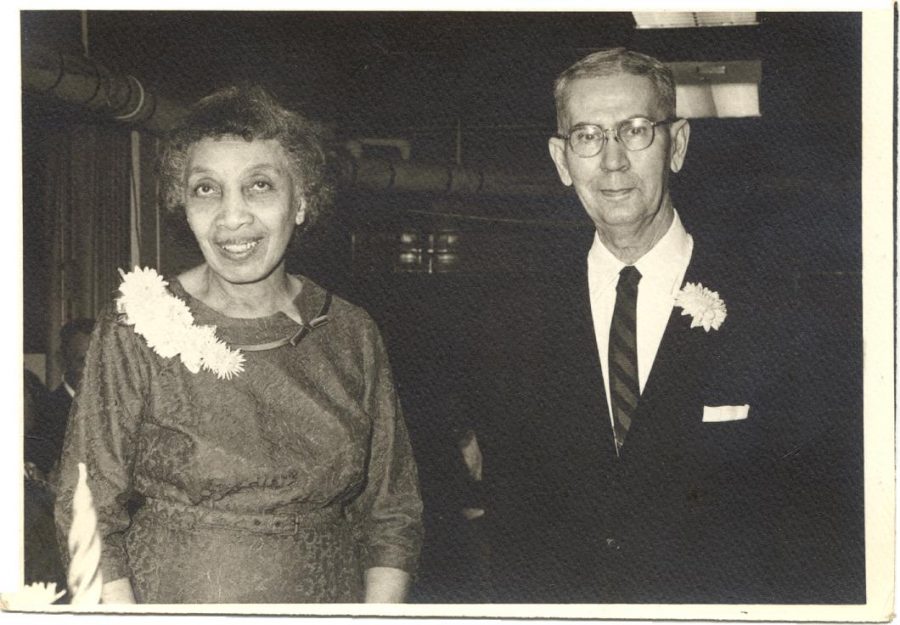
By appearance, Ona Norton and her husband Kenneth were not apparently Black, but they apparently were considered to be Black in their community. Their involvement with EIU began in the 1950s when they were asked to “open their home to Black athletes who could not find housing on campus” (The Daily Eastern News, November 24, 2021).

Providing housing for athletes who were Black led to Mrs. Norton becoming the go-to person for other Black students who found their way to EIU. The Nortons rented two modest houses to accommodate Black students—one for women and one for men. I was in the group of Black women who lived in a Norton House on Second Avenue. If it were not for the agency of the Nortons, I would not have been able to attend the university. I didn’t have money to live in the residence halls and even the $28 a month that the Nortons charged was often hard to come by. Some of the other women were in similar circumstances, but I never knew of anyone who was asked to leave the Norton house for lack of funds for rent.

Although Mrs. Norton has been honored for other acts of charity, and EIU has a scholarship in her name for Black students, the honor that she shares with Powell is the most fitting because of its connection to housing students who, without her help, would never have had the opportunity to attend EIU.  

Ona and Kenneth Norton

Affirming Educational Opportunity

In 1965, I—a descendant of enslaved persons—was the first in my family to graduate from college with a four-year degree. One can see this as a significant advancement over the course of several generations and/or see with the Rev. Dr. Martin Luther King, Jr., “Why [after 100 years] We Can’t Wait” to be able to exercise our full rights and take advantage of the opportunities afforded in this “land of plenty.”

It was around the time that I graduated from a state university that the policy of Affirmative Action began to gain traction in regard to hiring in federal jobs and awarding federal contracts to minority-owned businesses. Following the federal government’s lead in mandating hiring without regard to race, colleges and universities began the practice of acting affirmatively to increase the number of Black students admitted. This proactive behavior on the part of higher education, particularly among elite colleges and universities, began trending in the late 1960s.

The backlash against Affirmative Action in college admissions was swift and endures today. After 30 years of a national controversy, the California Board of Regents voted in 1995 to no longer consider race and gender in hiring and admissions decisions. This decision was the impetus for opponents of Affirmative Action in college admissions to increase the pressure to abolish the practice across the country.

In the meantime, Black students and professors were singled out as part of the problem and became victims of White backlash. For those who have not walked in these shoes down this same path, Ron Susskind gives a stunning biographical portrait of what student life was like for some “Affirmative Action” students. He records the following conversation overheard by Cedric, a Black student on one of his first days at an Ivy League university:

Cedric, settling at a table inside [the café], orders a ginger ale and trains his ears to a table immediately to his right. Two professors, both white, are leaning in…. ‘Are we doing a service to young people to boost them above their academic level and then not offer the services they need? Asks the squat one with flying gray hair. ‘Because who really can? Who can offer that sort of enrichment? You can hardly blame the university. It would take years, and money, and a whole different educational track to bring some affirmative action students to a level where they could compete. There’s no choice but laissez-faire, sink or swim. They should be going to middle-rung universities. There’s no right, as far as I can see, to go to an Ivy League institution. If they work hard, their kids can come here. Hell, it’s what everyone else had to do.’…

It’s all Cedric can do not to respond…. He imagines telling them about his long journey, that his struggle has built in him a kind of strength—a conviction about his ability to overcome obstacles—that other kids don’t have.  But of course, that strength is hard to measure, and lately he’s become uncertain if it will be enough to get him where he needs to be….

The professors, meanwhile, have moved on to the companion controversy about hiring minority faculty members. ‘It’s a mockery,’ said the other professor, a tall distinguished-looking guy, spits, ticking off the names of a few minority professors around campus. ‘A lot of them are good teachers, sure.  But they’re unpublished, not respected, not scholars. What do they bring? Their passion, oh-so personal ‘perspective.’ Nothing special about that. Jesus, everyone’s got one of those.’…

Throughout the day, the overheard conversations at lunch echo in Cedric’s head. More than specifics, he recalls the intensity of the dialogues. At this point, affirmative action is the last thing he wants to hear or think about…. So, he got in. If he fails, he fails; if he makes it, he makes it. Why does everyone have to draw conclusions about an entire race from that, or take sides. He wanted a chance, he got one (A Hope in the Unseen: An American Odyssey from the Inner City to the Ivy League, 191-193).

Unlike our ancestors who were given a hoe and forced to chop cotton, Cedric, myself, and many other Black students and Black professors were given a ladder of opportunity through higher education. The ladder, however, was covered with grease. It was slippery, and we were on the bottom rung.

Affirmative Action, to some extent and in some places, replaced the slippery ladder with real steps upon which new-to-college Black students could begin, but there were no handrails, and the steps were narrow and winding. There was no recognition and subsequent adjustment for the fact that preparation for college was often inadequate and the psychological toll of being “the only one” was more than just distracting. This combination of obstacles knocked many aspiring Black students off the steps.

Now, after 50 years of Affirmative Action being a “thing,” it is still being challenged with the subtext that indigenous and other disenfranchised students are not deserving, don’t belong, and are receiving an unfair advantage. The upside is that during these many years, some colleges and universities have realized that students who are the first in their family to attend college need not only steps but steps with handrails for support.

Progress is slow. One step forward and two steps backward is the norm. Hopefully, it will not take another 100 years for descendants of Black enslaved persons to realize true equal opportunity, full civil rights, and nondiscrimination in admissions to colleges and universities.

The Prime Need of the Hour

Mary McLeod Bethune

In promoting the importance of education, Mary McLeod Bethune (1875-1955)—educator, activist, African American hero, and founder of Bethune-Cookman University, among many other notable accomplishments—said, “Knowledge is the prime need of the hour.”

Whether in the 19th, 20th, or 21st century, knowledge continues to be the prime need of the hour. Considering the dark hours we have seen recently, it is particularly alarming to read that “Degree-seeking enrollments in U.S. higher education have been down for 10 consecutive years” (Brandon Busteed, “21 stats for 2021 That All Higher Ed Leaders Should Know,” Forbes, Jan 4, 2021).

Notwithstanding this ominous trend, and despite the criticism about how both K-12 and higher education are failing Black students, “almost half of Black high school students reported that they were ‘very sure’ they’d go to college to pursue a bachelor’s degree. Among students in the lowest income quintile, Black high school students were the most likely to express that certainty” (Sara Weissman, “ACE Supplementary Report Paints a “Stark Picture” of Higher Education’s Racial Inequities,” Diverse Issues in Higher Education, Nov 19, 2020).

Reading about Black students who, against all odds, have a desire for pursuing higher education should be the impetus for a shift in the dominant way of thinking about low-income Black students. If a student wants to learn and makes it to a campus, it must be the duty of higher education to create the conditions for the student to achieve. Of course, we must not ignore the barriers students encounter along the way, but we can, perhaps, take a moment to be encouraged and take a break from obsessing about statistics that focus only on achievement gaps and noncompletion rates of low-income Black students.  

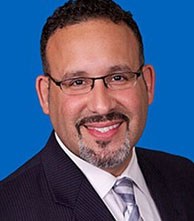
U.S. Education Secretary nominee Miguel Cardona

U.S. Education Secretary Nominee Miguel Cardona echoed these thoughts in his nomination acceptance speech, saying, “For far too long, we’ve let college become inaccessible to too many Americans for reasons that have nothing to do with their aptitude or their aspirations and everything to do with cost burdens, and, unfortunately, an internalized culture of low expectations.”

Abandoning perpetual psychological pessimism and encouraging hope at this hour are dimensions of a new reality for Black students and higher education.

Enrollment Management: Integrated from Beginning to End

waiting graduates in cap and gowns - African American student facing camera

Source: Flickr/ via U.S. Department of Education (CC BY 2.0)

Enrollment managers hold an important and key role to helping colleges and universities enhance the student experience. Every institution has them. They are key players not only in helping the institution meet enrollment goals, but graduation goals as well. These professionals share values and accountabilities with faculty and student affairs, as well as every functional area of the college or university. They are, therefore, favorably positioned to help faculty, staff, and administrators provide the return on investment that today’s students expect.

Several years ago, I was to be the commencement speaker at a college. It was a bright sunny day, and there were rows and rows of people as far as I could see. The stage was full of robed dignitaries and student speakers. I was one of the two African Americans on stage – both getting honorary degrees. In addition to my being unnerved by my own audacity in accepting the role of commencement speaker, the other African American who was receiving an honorary degree was none other than the excellent speaker and brilliant astrophysicist Neil DeGrasse Tyson! To say that I was anxious is an understatement.

Once the preliminary remarks and introductions were over, students’ names began to be called. As they walked across the stage, I forgot about my own stage fright and began to enjoy the celebration. As each student’s name was called and the happy student walked across the stage to receive the diploma and shake hands with administrators, some were beaming with grins and others were crying tears of joy.  I was so happy for them that my face began to hurt from smiling so broadly for so long.

I noticed that the line that had been going rather swiftly up to the point of shaking hands with the administrators was backed up where students were exiting the stage on my far right. I peered around to see what was happening and saw that, as the students were exiting the stage, an admissions professional was standing where the students descended, smiling, shaking hands, fist bumping, high fiving, and being enthusiastically hugged by many of the graduates. I smiled and thought to myself how right and fitting that the first person students encountered during the critical time of choosing this college was there to congratulate them as they graduated.

The idea of being there at the beginning and at the end makes me recall a conversation I had with a student at this same college who had been told that he should take this college off his list of possibilities for all the usual reasons first-generation students might not attend highly selective colleges. The student, however, left the college on his list and his high school counselor scheduled an appointment at the high school with someone from the Office of Admissions. He was late for the appointment and the admissions director asked him why. Usually reticent to talk about himself, especially with strangers, this simple inquiry from the admissions director opened the door for him to share more about himself than he ever would have expected. He thought his chances were not great for being accepted and, if he were accepted, he knew he could not afford to attend. He couldn’t even afford a trip for a campus visit. To make a long story short, he was accepted, received a scholarship, and received funds to visit the campus. Seeing the campus was love at first sight for this student. But something was bothering him.

He said he hated systems and didn’t want to be just another number in an affirmative action system where he wasn’t really seen for who he was. He said that this feeling was a like a cloud overshadowing all the good that was coming his way.

He told me that, early during his first semester, he had an occasion to see the admissions director who interviewed him at his high school. She remembered him and everything they had talked about. He was amazed that she remembered him, and this made him feel good. Shortly after the conversation with this admissions director, he had an encounter with another director from the admissions office. When the director learned the student’s name, he said with a friendly smile, “Oh, yes, I remember reading your essay.” The student said that he thought, “Wow! Maybe I’m not just a number in a system after all.” The student said that these same admissions directors reached out to him to see how he was doing throughout the semester. He said that their genuine attention was a strong motivator for him to do well because his family was in another country and had no idea what life was like for him as a college student in the United States. I can imagine the long hug at the end of the line during commencement when this student crosses the stage and sees his admissions directors.

So, if you find yourself confounded by how different your incoming class is than previous classes of students, don’t wait for the next popular publication: talk with your colleagues in enrollment management. They can give you information about students who are attending your college or university rather than a generic broad-brush description of a new generation of students.

Enrollment managers, more than anyone else on campus, know why students choose to come to a given college or university. It would serve institutions well, then, if enrollment management staff were significantly integrated within the academic community. We all know that a major reason why students do not persist in college is because their expectations are not met. Congruence between expectations and what students find is what is ultimately called “fit.” We speak of “fit” during the recruitment process, but “fit” is really not determined until the retention process is in play.

Professionals in enrollment management do much more than recruit students and provide a pathway to aid. They share the responsibility for students’ success with every other part of the academic enterprise.

Low-income High School Graduates

once upon a time, printed on white paper

Eric Hoover’s article, “Where the Journey to College is No Fairy Tale(Chronicle of Higher Education, June 19, 2017), provides a glimpse into the harsh reality of students who don’t even make it to the starting line to become first-generation college students. Students with tremendous potential – who could begin the pattern and set the standard for siblings and generations to come of family members attending college – are often left on the sidelines at the time of high school graduation because, even with financial aid, they are unable to attend the college to which they have been accepted.

And it’s not just finances. I’ve spoken with students whose families were  unable to give them any kind of support because they did not understand the requirements of the college admissions process, nor did they have any idea about what their student would experience once in college. I’ve spoken with students who navigated the entire application and FAFSA process without any assistance from a family member or counselor. Students who have a tireless and dedicated counselor are indeed fortunate. But, as Hoover’s article points out, there are limits to what a counselor can do. In the end, it comes down to how much financial assistance students are able to garner.

In addition to financial aid and other college support, there are charitable organizations that raise funds to help local low-income students begin college. With financial assistance from multiple sources, some students are able to cobble together enough for tuition, fees, and books for the first semester or year. During this first year, they often work while taking a full load of classes to have enough money for living expenses. If these students are unable to continue college to graduation, they feel as if they have failed; the college questions whether or not the support services provided were adequate; and the charitable organization that raised funds to help the student becomes discouraged, thinking that students they help might not be giving their all to succeeding in college.

In figuring out what else students need to continue on to degree attainment, the tendency is to look for the no-cost answers, such as the need to assign role models, coaches, and mentors to low-income students. Although I am a strong proponent of all types of support and encouragement for students, without realistic and adequate financial support, students from low-income families are not going to get to the starting line. And without realistic and adequate financial support beyond the first year, those who are able to reach the starting line may not be able to cross the finish. If you talk with low-income students like those Hoover found in his visit to Seagoville High School, you will find that financial insecurity is a major barrier to a college education.

It’s daunting to think about how much is required to fully support a college student today. But, if the longer term entire expense is not factored into the plan for the student to attain the degree, there is a high probability of loss regarding goal achievement. Of course, there are the lucky students who find a way to hang on despite the financial hardship. However, luck is a risky gamble – one that many low-income students understandably don’t think they can afford to take.