Category Archives: initiative

Where Do We Go From Here?

Guest post by Kaaryn McCall

As we start a new year, particularly this new year, it is perhaps good to ask, “Where do we go from here?” The Rev. Dr. Martin Luther King, Jr., began bringing his 1967 Southern Christian Leadership Conference address by that title to a close with the following words we would do well to heed today:

“The road ahead will not always be smooth. There will still be rocky places of frustration and meandering points of bewilderment. There will be inevitable setbacks here and there. And there will be those moments when the buoyancy of hope will be transformed into the fatigue of despair…. But difficult and painful as it is, we must walk on in the days ahead with an audacious faith in the future.”

King’s book of that same title that year was aptly subtitled with the question “Chaos or Community?” This is a choice with which we are always faced and, as we enter 2024 that is, among other things, a presidential election year, and as we near the nation’s 250th anniversary even as some talk of the possibility of a second civil war, I, for one, choose community.

Too often, this can seem like an amorphous concept, so it’s helpful to understand the Beloved Community that was King’s ultimate aim, as reflected in remarks as early as 1956, following the Montgomery Bus Boycott: “The end is reconciliation; the end is redemption; the end is the creation of the Beloved Community.”*

From the religious perspective, King saw Beloved Community as the wholly achievable goal of realizing the kingdom of God on earth, “in which all human beings ha[ve] value in and of themselves, and [a]re subjects worthy of love.” This restored community is the ideal of creation—God’s intention for all of humanity living together in an “inescapable network of mutuality.”

Perhaps more concretely, and from a more universal perspective, this Beloved Community is one in which:

“poverty, hunger and homelessness will not be tolerated because international standards of human decency will not allow it. Racism and all forms of discrimination, bigotry and prejudice will be replaced by an all-inclusive spirit of sisterhood and brotherhood…. Love and trust will triumph over fear and hatred. Peace with justice will prevail over war and military conflict.”*

Achieving such community requires transformation on many levels. In his further remarks following the bus boycott, King noted, “It is this type of spirit and this type of love that can transform opponents into friends. It is this type of understanding goodwill that will transform the deep gloom of the old age into the exuberant gladness of the new age.*

It is important to note that King did not believe Beloved Community would be devoid of conflicts, but that these could always be resolved peacefully,* noting that “true peace is not merely the absence of tension [but] the presence of justice.”

silhouette of the Rev Dr Martin Luther King Jr with the words "BUILDING THE BELOVED COMMUNITY" and a colorful illustration with many components, including a river, trees, hearts, stars, hands, people, rainbow, and various decorative elements

So, “Where do we go from here?”

In a world increasingly divided, let us seek to build increasing levels of trust across difference.

In a world increasingly concerned with domestic and international terrorism, let us embrace the fact that “love [is the] most potent instrument available in humanity’s quest for peace and security.”

In a world increasingly complex and intertwined, let us seek to understand the “enemy-neighbor” as more than a given action on their part.

In a world where prejudices continue to manifest themselves, let us seek a true conception of self instead of “self-deception and … neurosis stemming from repressed truth.”

In a world of zero-sum games, let us demonstrate that there is no need to fear one’s own loss when advocating for justice. (As a popular meme puts it, “Equal rights for others does not mean fewer rights for you. It’s not pie.”)

In a world still plagued with brokenness, separation, suspicion, and deadly conflicts, let us find our points of commonality and shared humanity.

The choice between chaos and community remains for each of us individually and collectively. May this new year and MLK Day be about more than just platitudes. Let us answer the call to action and walk on together not in blind optimism, but an intentional hope and “audacious faith in the future.” Let us not fall into despair as a few loud voices are amplified across various media but recall how far we have come and set forth with renewed purpose to building Beloved Community.


SOURCES

† Hunt, C. Anthony. The Beloved Community Toolkit.

‡ Hunt, C. Anthony. Blessed are the Peacemakers: A Theological Analysis of the Thought of Howard Thurman and Martin Luther King, Jr. Lima, OH: Wyndham Hall Press, 2005.

* The King Center. “The King Philosophy.” thekingcenter.org/king-philosophy


Kaaryn McCall is a communications consultant who, in addition to supporting Dr. Dungy, works with nonprofit organizations across the social justice spectrum to most effectively leverage strategic communications to support their missions. Connect on LinkedIn

The Inspirational Six, Part 1: Venerable Pierre Toussaint

Guest post by Joann Stevens

In a series of posts, I’d like you to meet six Black Catholics from the 19th and 20th centuries on the road to sainthood in the global Catholic Church: Venerable Pierre Toussaint; Venerable Henriette DeLille; Venerable Augustus Tolton; Servant of God Mary Lange; Servant of God Julia Greeley; and Servant of God Thea Bowman. Ordinary people inspired by faith to serve the Common Good, they helped build and transform American Catholicism, advanced a democracy they couldn’t enjoy, and upheld Jesus’ commandment to “Love each other as I have loved you” (John 15:12).

Inspiration can be hard to find when celebrity and socioeconomic status define influence more often than character. But sainthood is an equalizer. Saints inspire people of all faiths or no faith. Saints are rarely sexy, beautiful, rich, or celebrated. They endure hardship, poverty, and social rejection. They sacrifice their bodies— sometimes literally, more often figuratively—to serve as agents of God’s righteousness and unconditional love. Saints don’t wear Chanel or Brioni but lift the spirit higher than a well-cut garment as they model essential elements of humanity: Love and Hope.

Pierre, Juliette, and Euphemia Toussaint as painted by Anthony Meucci, 1825

Venerable Pierre Toussaint (1766–1853) took his surname from the Haitian general Francois-Dominique Toussaint Louverture, a Black enslaved person turned enslaver turned slave liberator. Venerable Pierre Toussaint was trained as a house servant in his native Saint Domingue (Haiti). He was taught to read and write in French and English and had free reign of his enslavers’ library. Along with his sister Rosalie, his aunt, and two others, Toussaint arrived in New York in 1787, the property of Jacque Berard who had fled the Haitian rebellion with his family. Berard returned to Haiti to secure his property but died there of pleurisy in 1791, nearly destitute.

At the time, the United States was facing its first financial crisis. Although enslaved, hardship seemed to sharpen Toussaint’s resolve and entrepreneurialism. Apprenticed as a hairdresser, his success enabled him to support the Berard family and household, caring for Berard’s widow, Marie, until her death in 1807, after which he gained his freedom. Toussaint’s success also enabled him to purchase the freedom of his sister—whose daughter he would adopt upon Rosalie’s death—as well as the freedom of others who were enslaved. Among those was Juliette Noel, a Haitian woman Toussaint married in 1811. That same year he bought a house in Manhattan to shelter Black orphans and teach them trades.

Hairdressing was Toussaint’s profession, but his intellect, faith, and love for humanity established his character.  In addition to working more than 12 hours a day dressing hair, followed by household chores and community service to feed the hungry and nurse the sick, Toussaint was a daily communicant of St. Peter’s Church on Barclay Street, attending Mass at 6:00 a.m. He served the public another 36 years after gaining his freedom and was known to quote from the Sermon on the Mount in French. “The Beatitudes seemed to have found a way into his heart,” wrote his first biographer.

Toussaint inspired all who knew or heard of him. His clients were elite society women. Among them the wife and daughter of Alexander Hamilton. They welcomed him into their estates, sought his counsel and admired his kindness, piety, and charitable works. Many were Protestant socialites like Mary Anna Sawyer Schuyler, a close friend who called him “my Saint Pierre.” Under their patronage, Toussaint earned as much as $1,000 a client annually at a time when the average annual salary was $65.

Pierre and Juliette Toussaint spread their philanthropy widely and diversely, creating a credit bureau and employment agency to help Black people and support the resettlement of Haitian immigrants to New York; founding the First New York City Catholic School for Black children; helping raise funds for Elizabeth Seton’s Sisters of Charity to open an orphanage in New York City even though it only served White children; funding the nation’s first religious order of Black nuns, the Oblate Sisters of Providence; providing aid for retired priests and destitute travelers; and contributing to the founding and building of St. Patrick’s Church that became St. Patrick’s Cathedral.

As his health failed with age, friends pressed the elderly Toussaint to retire and enjoy his success. He responded, “I have enough for myself, but if I stop working, I have not enough for others.” His last recorded words, two days before his death, were, “God is with me.” Asked if he wanted anything, he replied, “Not on this earth.”

Pierre Toussaint died at age 87, two years after his beloved Juliette. Friends and media praised this man defined by his faith, heart, and character and not external circumstances.

An act of racism once barred Toussaint from attending the St. Patrick’s Church he helped found. In a testament to God’s grace and remembrance of Toussaint’s servanthood, Cardinal John O’Connor arranged for Toussaint’s reinterment in 1959 to a vault under the altar of St. Patrick’s Cathedral on Fifth Avenue. He is the only layperson buried among bishops and cardinals.


Sources: George Washington’s Mount Vernon, Ten Facts About the American Economy in the 18th Century; Archdiocese of New York; Archways, the online Magazine of the Archdiocese of New York; Cathecist Cafe


Joann Stevens is a freelance writer and program specialist promoting unsung and unknown African American jazz, faith, and cultural innovators who have influenced democracy and racial justice for the Common Good.

Dousing the Fires of Inhumanity

I woke up and looked at the clock. It really was 3:00 in the morning. “Oh no,” I thought. “I hope I can get back to sleep.” Because I usually sleep well, I tried to recall my activities from the day and evening to try to figure out what could be causing me to wake up and not get back to sleep.

After about an hour of tossing and turning, searching for the best position to invoke sleep and playing mind games equivalent to counting sheep, my mind was pulled toward the ubiquitous, never-ending negative news stories of the day.

Wars and their devastating physical and psychological human toll and our inhumanity to one another as exhibited through political maneuverings, the cutting cruelty of social media, and random killings, some out of a belief that some people are worthy to live and others are not. As I ruminated about these things, I was overwhelmed by a deep sadness and tears slowly leaked out of the corners of my eyes.

My sadness caused me to think about the title of my website: The F.I.R.E. This Time. Inspired by Baldwin’s The Fire Next Time, the title I chose in some ways reflects my pessimism about us humans.

Though there are ebbs and flows, there is always Fire. Sometimes there are Fires all over the world and little fires everywhere all the time. What are these Fires?

What I call Fires is what David Brooks describes as “the rising culture of dehumanization . . . tribalism, racism, ideological dogmatism, and social media.”  (“A Humanist Manifesto: The world feels like an awful place right now. Here’s how to make it better.” The Atlantic, October 24, 2023.)

Brooks describes dehumanization as “any way of seeing and acting that covers the human face, that refuses to recognize and respect the full dignity of each person.”

Described as such, dehumanization is the root cause of all the Fires. What ignites these Fires is humans thinking that there is only one right way, one right answer, one point of view and other ways of thinking or viewing are wrong or bad and must be vanquished, destroyed, and annihilated.

Some ideas Brooks suggest for conserving humanity that resonate with me are what he calls humanistic wisdom and empathy.*

Brooks shares that it takes humanistic wisdom “to be able to understand one another to some degree, to see one another’s viewpoints, to project respect across difference and disagreements.” If this is all we must do, why do we feel helpless to confront the problems we see and hear about? What can we do as individuals? How can we exhibit humanistic wisdom and empathy?

It’s obvious that we can’t contain world Fires, but we can contribute to dousing the flames of little fires. While even controlling little fires is no easy task, it is something that each of us can do in our everyday interactions, even our casual encounters. Instead of accusing as a first instinct, we can practice the habit of first accepting and hearing.  

An attitude of acceptance and hearing sets the tone for humanistic wisdom and is a meaningful step toward empathy. Brooks’ understanding of empathy is “first mirroring—accurately reflecting the emotions of the person in front of you. Second, mentalizing using your own similar experiences to project a theory about what the other person is going through. Third, caring…. To care, you not only have to understand another person: you also have to perform an action that will make them know that you understand how they feel.”

We should be grateful for the many good people who try to be empathetic by mirroring and mentalizing in their encounters with others. It’s the third part of Brooks’ description of empathy—caring—that is often missing from our relationships with “the other.” If more people could care about “the other” because it’s the humane thing to do, we could chip away at the kindling that keeps these Fires of hate and aggression smoldering and eventually bursting into flames.

Our history demonstrates that there was fire last time, and sleepless nights cause us to ruminate on the fire this time. Sadly, if there are not more demonstrations of humanistic wisdom and empathy, there will undoubtedly be Fire the Next Time.

word cloud in shape of two hands reaching toward each other with primary words in one being "I HEAR YOU" and "CONNECT" and the primary word in the other hand being "EMPATHY"

*In fact, the FIRE in the title of my blog is an acronym that’s long been a touchstone for me, of which ‘empathy’ is a component, so I guess I’m not entirely pessimistic. Following are the components of the acronym:

  • Fate/Faith
  • Integrity/Initiative
  • Reflection/Respect
  • Energy/Empathy

First-Generation High School Graduates

Maybe you attended a high school reunion recently or talked with someone who attended one. Most likely these reunions are commemorating graduations that occurred 20-50 years ago. It’s likely that the majority of those classmates attending these reunions were the first in their families to receive a high school diploma. Graduating from high school was quite an accomplishment and source of pride for these graduates’ families.

What is stunning and puzzling to me is the number of young people born in the United States who—in 2023—are the first in their family to graduate from high school.

These thoughts led me to these notes from my mother:

What Gwen’s Graduation from High School Meant to Me

Yes, her graduation meant much to me in terms of my life and the chance to make up for disappointments and lost opportunities. It meant that the naysayers and name-callers were wrong about me and my child. It meant that despite the circumstances of her conception and the mess her father and I made of our lives together after her birth, through faith, I knew that God was watching over her. His eyes were on her as he watched over the sparrows.

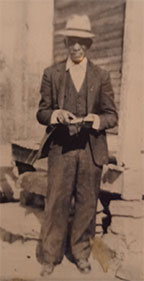
What Gwen did not know was on the occasion of her high school graduation, I remembered my Grandpapa Agnew, my daddy’s father, who was a slave. With joy in my heart, I thought about how far we had come to finally have someone in our family graduate from high school.

Grandpapa Agnew in a suit and hat with a building in the background
Grandpapa Agnew

I recalled the times when I was a little girl and Grandpapa Agnew stayed with us. I would sit on his lap and he would tell me stories about when he was growing up. The message I got from his stories was about how much better things were for us Negroes now than when he was born and how it was so important that we worked hard to find opportunities to better ourselves and our race.

When Mama and Daddy moved to Memphis, Grandpapa Agnew stayed in Mississippi with his daughter. He visited us when we lived in Memphis and Gwen was a little girl. He had the most beautiful silver, not gray, hair; walked with a cane, and wore a suit and a dress hat. It was such a blessing that he could see his great grandchild, one who would accomplish what he could not have had the imagination to realize.

7 Interview Recommendations to Land a Top Leadership Position 

Guest blog by Laurence N. Smith

What does it take to land that coveted leadership position in a high-stakes job interview?

Over the years, I have been in the position to advise many ambitious professionals on how they should perform in interviews for top-level executive positions. 

My immediate response when asked for advice was to tell them to go online to see what others recommended. In some ways this was a mistake because they often came back to me questioning the validity of what they read.

So, serving on several boards and being connected to many successful corporate, university, and community service top executives, I took these recommendations to a great panel of experts for their review. Interestingly, their real-world advice differed from many of the online recommendations.

Their top recommendations follow:

  1. Know the difference between being a leader and a manager. This has been an almost universal reply. Being promoted from a successful management position to a top leadership role is not necessarily a good decision because the roles and skills required for each are not the same. Check the current professional literature on leadership to be well informed for questions about your leadership style.
  2. Have a clear understanding of how internal and external dynamics affect the position for which you are interviewing. Apparently, some executives were unaware when they signed on about shifting reporting decisions; and conflicts arose among and between investors, board members, and the organization’s executives.
  3. Know and appreciate the entire organizational ecosystem. Successful leaders recognize that the brains of an organization do not reside only in board members and executives, but also in employees throughout organization, as well as in clients, customers, students, and even vendors. Successful executives will need to know how to navigate and integrate this process into practice.
  4. Be aware that interviewers know all about interviewees. Many executives have been surprised by this. Professional consulting firms have thorough researchers on their team. Make sure you research the internet to see what they might have learned about you. Know that others in the organization may have friends who worked for or with you. Their opinions also influence interview questions.
  5. Create a conversational interview environment. Many search committees have not been coached on how to create a productive interview process. This also applies to others participating in the interview process.  Avoid becoming a consultant in the interview process or being trapped in an interview that takes the format of an interrogation.  An interview should be a two-way street: “Do you want me?” and “Do I want you?”  Prepare questions that require interviewers to share their insights about the organization’s current situation and future alignments. 
  6. Have a consistent message in your interviews with all groups and individuals. Avoid the trap of making statements to win over a particular group or individual that conflict with statements made to others.
  7. When asked what your leadership style is, make sure to include the following to the extent they are true for you. Based on post-interview comments, this recommendation has always been central to what helped make a major difference in the interview outcomes.
    • “People support what they help to create.”
    • “The ultimate test of our effectiveness will be the positive difference we make in the lives of the people our organization includes and touches.”

Laurence N. Smith is a founder and Senior Partner of New Campus Dynamics with 40 years of experience as a senior university administrator and as a national leader in higher education. He can be reached at smith@dixboroventures.com

What the “Fantastic” Thing Is All About

Guest blog by Laurence N. Smith

Since Gwen Dungy’s fantastic blog about me, I have heard from several former colleagues who just wanted to say hello and catch up, and some who wanted to know what the fantastic thing was all about. Among the callers were some who asked what I thought would be the best advice to a new or aspiring student affairs vice president. And since my daughter, a prominent business consultant, unknowingly to me shared Gwen’s blog with some individuals in her network, it opened the door for a few who asked for advice for their own future success.

My first vice presidency was at Chicago State University in 1969. At 29 years of age, I was the youngest administrator by many years. Times were difficult, and especially difficult for students of color who comprised 80 percent of the student body!

Among students, faculty, and administrators there existed a downbeat atmosphere concerning just about everything. The president was focused on bringing in new young talent to change that condition. The litany of what was wrong with the University was a long series of frustrations. I learned very fast never to ask my colleagues, “How are you?”  

It was then that I decided that when anyone asked \how I was that my reply would be “fantastic.” I realized that in the culture of the University it was an unusual reply. I decided to make it even more energized to have greater impact. The simple “fantastic” was replaced by a vigorous “FAANTASTIC!”     

In the early years the reply shocked people and opened the door to exploring change when they asked me why I felt fantastic. It didn’t affect everyone, but even those who thought it was an over-the-top reply were curious why I felt that way or wanted to test if I was in touch with reality.  It enlarged the view and discussion about the University.

Where it had the most significant impact was on students.  For student leadersthe student newspaper reporters and editors, the captains of athletic teams, and others—my feeling fantastic helped them feel fantastic. It fostered a new level of enthusiasm and discussion about the opportunities that were ahead if they embraced the efforts necessary for getting a college degree.   What they experienced, they shared.  It caught on.

And when I became vice president for university marketing and student affairs at Eastern Michigan University, it had the same impact. 

It still sparks curiosity and engagement. Try it out for yourself. When you are asked, “How are you?” respond “fantastic” or “FAANTASTIC.” No matter who you are and what you do, it still works.


Laurence N. Smith is a founder and Senior Partner of New Campus Dynamics with 40 years of experience as a senior university administrator and as a national leader in higher education. He is emeritus Vice President for University Marketing and Student Affairs at Eastern Michigan University. Among his extensive activities, he was founder and chair of the NASPA National Academy for Leadership and Executive Effectiveness and executive editor of NASPA’s online management magazine. In 1999, he was named a NASPA Pillar of the Profession, and in 2002, he was the recipient of the Fred Turner Award for Outstanding Service to NASPA, the equivalent of a Lifetime Achievement Award in the student affairs profession.

Mr. Fantastic

Laurence N Smith

Once in a lifetime, if you’re lucky, you will know a Mr. or Ms. FANTASTIC!

Laurence N. Smith is my Mr. Fantastic! He was the vice president for University Marketing and Student Affairs at Eastern Michigan University from 1975–2000.

I give him this title because he stands out from the rest in every way. He’s always the tallest in the room and the smartest in the room. And when asked how he’s doing, invariably, he responds, “FAANTASTIC!”

Leadership in a volunteer organization based in higher education can be a different experience than what a leader might be able to do in a top-down organization where the people responsible for making the trains run on time are paid and can be released at-will.

When I was in such a leadership position, willing volunteers were the key to success. Many stepped forward to let me know that I could count on them to help me achieve the goals of the organization. They used words like “help you,” “support you,” “here when you need me.”

In my imaginative recall, Larry Smith, towering over the heads of his colleagues, fixed his eyes on me, made a beeline to me, and asked, “What is your vision for this organization?” With confidence, I summarized my mandate from the volunteer board of directors and added my own vision, which could be described as fantastical given the structure and history of the organization. Mr. Fantastic’s eyes communicated, “Are you sure?” The gaze I returned indicated that I was.

Lyrics from songs best describe his response: “Come along with me,” “I’ll take you there,” “I believe I can fly!” My leadership vision was the perfect vehicle for Mr. Fantastic to test drive his ideas about what student affairs administration in higher education could “truly be.”

On the journey with Mr. Fantastic, it was obvious that when we were talking about using listservs to bring our members together in conversation from various locations, he was already thinking about what we now call Zoom meetings. When we were talking about Palm Pilots, he was envisioning what is now Chat GPT. Always looking toward the possibilities for the future, never fearing failure, and always optimistic is my Mr. Fantastic.

And I’m not the only one that found Larry to be fantastic. In 1999, he was named a NASPA Pillar of the Profession, and in 2002, he was the recipient of the Fred Turner Award for Outstanding Service to NASPA. The equivalent of a Lifetime Achievement Award, the Turner Award recognizes NASPA members who have brought honor and dignity to the student affairs profession and to NASPA as an association for a sustained period. Among Larry’s extensive activities, he was founder and chair of the NASPA National Academy for Leadership and Executive Effectiveness and executive editor of NASPA’s online management magazine.

I spoke with Larry recently and told him that to have him as a colleague and friend during my time at NASPA was a blessing of pain and glory. The pain was tempering the projections of where the organization could go and modulating the speed of change in order to be in sync with the volunteer leadership. The glory was the innovations NASPA achieved through its volunteers when we were flying with Mr. FAANTASTIC!

Thank you, Larry. I am truly grateful for your colleagueship and friendship.

A Philosophy of Sorts

Guest blog by David Keymer

Over time I arrived at something like a philosophy to govern my work in student affairs and higher education. Ultimately, all of our expertise points back to a vision of what college and university life should be like, what it should do. Universities and colleges are a special kind of community—a community of learners. The emphasis should be on both words: “community” and “learners.”

The ideas, then, are simple…nothing complicated:

First and foremost, I was there for the students, and the students were there to get an education. In this exchange, then, it was the students who were paramount. If it was about empowering students, it was simply a matter of service for me. That meant that…

  • students should always be able to reach me;
  • it was important that I give good value in whatever I did; and
  • ego was less important than results.

Using power gratuitously is not only wrong, it’s counterproductive. The power I held was the position’s and there for a purpose. It was not mine and, just because I had it by way of the position did not mean I had to use it.

This was especially true as I realized that everyone on campus needed to be in the same business of helping students succeed, academically as well as socially. Parents or prospective students didn’t come on campus and ask where the Vice President for Student Affairs’ office was. They talked to whomever they met. It might be a worker planting flowers in the flower beds outside a classroom building, or a campus police officer passing by, or a stray faculty member or student on the way to class. As a result, I did a lot of walking around talking to colleagues and students to ensure we got our message out that we had the same ends and were serious and proud of our commitment to student success.

Everything I managed to do required other people. It was important, then, that I listen to EVERYone, not take others for granted, and recognize others’ contributions and let them know I appreciated them. That being said, an important piece of effectively working with people is to cooperate, but “never give up your teeth.” The work is too important, and every so often, you may have to take a bite out of someone to convince the other person you’re not kidding.

Relatedly, developing people is as important as spurring them on to work well. It takes time, money, and effort to find and hire someone new for a position. If there were difficulties initially, it wasn’t a matter of giving up, but needing to find out what people did well and what inspired them, then leveraging those strengths and interests.

After all, work should be fun as well as work.


David Keymer served as a chief student affairs officer at SUNY Utica Rome; California State University, Stanislaus; and Zayed University (Dubai and Abu Dhabi) from 1983-2004. For more wisdom gleaned from Keymer’s experience in student affairs across these varied institutions, check out the seven-part series published in 2021 from a set of interviews.

Illusion of the “perfect, fulfilling” career

I don’t watch much television news these days because I’m just too busy. However, I do continue my habit of catching Fareed Zacaria on CNN’s Global Public Square (GPS) on Sunday mornings. I take time to listen to the five-or-so minutes of “Here’s My Take,” Fareed’s commentary at the beginning of the show. After Fareed’s comments, I begin preparing my Sunday morning breakfast with one ear to the conversation that he has with his guests.

On last week’s show, one of Fareed’s guests was the author of a new book about careers. I only heard the author’s last name and some of what he said in the interview. Some of the comments he made piqued my interest because I’m a certified career counselor, and I’m always interested in hearing different perspectives on this complex topic.

After breakfast, I went to Google to try to find the author’s name and the title of the book but initially had no luck.* What I did find was a whole patch of books on careers and even a blog titled 16 Best Career Books to Read in 2023.  The statement introducing the list of books noted that they were about “finding the perfect job and cultivating a fulfilling career in the modern workplace.” I shudder at the use of words like “perfect” and “fulfilling” when it comes to choosing a career.

Ideas about career choice and career change are often generated by people who have a bright idea and a catchy title for a book. In my graduate research on career choice, however, I found nothing to support the idea of being able to methodically find a perfect job and fulfilling career.

I didn’t need research to know that people’s desires and life circumstances are not static and what seems perfect and fulfilling at one time in life is not necessarily going to be what is fulfilling at another time. In other words, career satisfaction and fulfillment have a “shelf life” and “sell-by” date for most people.

Those who can accept the fact that the job or career path chosen at the age of 19 or 20 will, in all likelihood, not be what brings satisfaction at 35 and beyond are realistic. Lucky and rare are those who know in their hearts and minds what they want to do from an early age, follow that path, and receive the proverbial gold watch and plaque at the end of a fulfilling career. This may have been the Hollywood ending generations ago, but it’s not the likely ending for those who are entering or are now in the early stages of their careers.

The world of work is changing so rapidly that it’s almost impossible to plan for a career. What seems satisfying and passion-fulfilling this year may not even be an option by the time you finish preparing for it. It can be a frustrating journey searching for one’s passion. In my experience, the most successful and satisfied workers have been those who became passionate about their work. Passion was not the draw. Passion was the reward.

I hope that those who are feeling pressure to decide on a career will just think about preparing themselves for a job that they can do well and to plan on using the experience to test the waters to see what makes them feel good and satisfied with how they are situated in their world. I hope that they will go into these different jobs looking for gold, and if the gold is not there, the experience is one more clue to where they can discover the gold. 


*Later searches found the GPS guest to be Bruce Feiler, whose latest book is “The Search: Finding Meaningful Work in a Post- Career World.”