He’s kind and thoughtful. Like the time his kindergarten teacher wrote, “He has a good attitude toward others; wants to please and do the right thing and is bothered if others do not.”
He’s compassionate. Like the time when he took blankets off his own bed and gave them to people in the neighborhood who had been negatively impacted by a snowstorm.
He’s generous. Like the time when, at seven years old, he took money from his bank, went to a neighbor’s garage sale, and bought his mother a letter opener and a cookbook.
He’s patient. Like when he slowly, without apparent annoyance, repeats what he has already explained. His kindergarten teacher described this as “good self-control.”
He’s positive. When people around him find fault with something or someone, he finds something to say that expands the perspective so others can see the person or situation in another light.
He’s disciplined. He decides on a goal and, without falter, takes the steps to achieve it. His kindergarten teacher wrote, “He is very conscientious about his work—tries hard to do well, and completes what is expected, and enjoys doing it! He’s very well-disciplined—but also enjoys just being a boy sometimes.”
He’s optimistic. Like when his best efforts in pursuing a goal appear to fail, he perseveres, looking for the rainbow.
He’s responsible. Like when he got his first job at age 12 and has not been without a job from that point on.
He’s confident. Like how he never seems to doubt his abilities. His kindergarten teacher wrote, “He seems pleased and happy about himself, school, and others.”
He’s courageous. Like the times when he has been selected as the spokesperson for a group and takes the role regardless of the possible consequences.
He’s fair. Like the times when during a discussion he often asks, “Is that fair?”
He’s funny. Like the many times he makes those around him laugh out loud even when the situation is what might be described as “dark” and “not funny.”
He’s curious. Like when he finds just about everything interesting and, judging from his behavior, in need of further study and work.
He’s self-possessed. Like when he seems to be walking too leisurely and never wears a watch, yet always gets to where he intends and on time.
I like being in his presence because there is a lightness of being around him.
I like seeing him live his life unstintingly, stretching it out to experience and enjoy every inch of it.
I’ve talked with people who after many years in a particular kind of work feel unsettled as if they are not doing the kind of work that fulfills their passion. Others I’ve had conversations with have changed the kind of work they do many times. They say that they get restless after the bloom of doing something different begins to fade.
Like those I’ve spoken with who wonder if there is something that they should be doing rather than what they are doing with their lives, I’ve had these thoughts. But for me, these thoughts have been fleeting. During my career journey, I took many of the assessments that purport to help career searchers begin to narrow their focus. Interpretations of my various assessment results showed a consistency in that whatever I chose for a career, I would be a “helper.”
I defined being a helper as someone who would provide support to others in reaching their goals and human potential. The question for me was how this might be realized in a specific career. Coming of age in the 1960s, I didn’t believe that the universe of options was open to me. Going into the medical field was my teenage dream. However, the reality of my financial situation made that dream unrealistic as a goal.
Being a teacher was one way that I could become a helper. However, it was a choice for which I settled rather than one for which I had a strong inclination. I didn’t know it at the time, but it was during these years that I thought I was settling that I found my passion. Teaching helped me realize that young people found it easy to relate to me and sought my counsel beyond the classroom. During these one-to-one sessions with students, I learned that many of them worked to the level that was expected of them rather than to the level of what they were capable of doing. They had more potential than they realized. Helping these students see beyond their current circumscribed existence brought me joy.
My sense of satisfaction in these relationships with students and their positive response to me confirmed for me that I was in the right place. Attaining a degree in counseling, I was prepared to be a helper. I found real congruence between who I imagined myself to be and who I could be in my career as a mental health and career counselor.
Even at this early stage of my journey, my touchstones of FIRE were part of my inner process:
I accepted the situation that I was in (fate).
I believed that I would be led to the right outcome (faith).
I focused on living a life infused with integrity.
I took initiative to get the required credentials to do what I wanted to do.
I was constantly reflecting on circumstances in a manner that I could glean lessons from my experiences.
I always tried to respect those with whom I interacted regardless of age and position.
I applied energy to achieve career goals and to carry out my responsibilities as a spouse and parent.
I freely expressed empathy for others, and I allowed myself empathy when it seemed that I had lost my way.
My hopeful wish for young professionals is that you will find the path that will lead you to your place of passion and fulfillment in your professional and personal life.
I think the first time I felt a sense of communal pride was in Miss Johnson’s first-grade classroom. The first thing students did to start the day was to recite the Pledge of Allegiance. Surrounded by pale green walls, we stood beside our desks and faced the right corner of the classroom where the U.S. flag was extended from a brown bracket just above the blackboard. With our right hands over our hearts, in unison, we recited the Pledge.
We didn’t know why we recited the Pledge, and we didn’t know what all the words meant. We understood that it was important to speak loudly and enunciate every word clearly. When we recited the final words “with liberty and justice for all,” there was an exclamation mark in our voices, and I felt particularly strong and proud to be a part of something special.
Because we were too young to understand the effects of stratifications, there was no reason for us not to believe that we were just like everyone else. We were not aware that our race and our location in segregated spaces all over the South, in particular, meant that the promises of liberty and justice for all did not apply to us and people who looked like us.
I’m glad we didn’t know our places in the social and justice hierarchies. If we had known, I believe that it would have broken our spirit and dampened our desire to aspire to something that might seem out of reach.
Because we didn’t know the reality of the lie about liberty and justice for all, we believed our family and teachers when they told us that if we studied and worked hard, we could be anything that we wanted to be.
Depressed because my best friend was not returning to college with me. Broken-hearted after finally realizing that my boyfriend was the worst thing that ever happened to me. Being alone on a train was the best place for me to be after being devastated by these changes in my life that were beyond my control.
The only thing left for me to do was to feel sorry for myself and pray. I prayed for a true friend and companion who would be someone I would love and someone who would love me.
As the train slowed, I saw a guy in faded jeans and gym shoes. When the train stopped, I was looking straight at Charles William Dungy, Jr. When he took the seat next to me, we had our first real conversation.
Arriving a few days before classes started, there was only one place to get something to eat near campus. We were both famished. Looking at the menu, we saw that the prices for just about everything exceeded what money we had. We both worked on campus and wouldn’t have any money until that first check of the quarter arrived. We decided to pool our money and get what we really wanted. We shared a bacon, lettuce, and tomato sandwich and swore it was the best sandwich we’d ever had.
That was the beginning. Fifty-five years later I can say without reservation that Charles William Dungy, Jr. is the best thing that ever happened to me. Fate looked upon me with favor when he came into my life.
He has been gone three years this past February and this is the first time I’ve been able to allow myself to recall and write about the person he was. Until now, I only allowed sneak peeks of who he was, and I fed on comments others made about him. A couple of weeks ago, a colleague from many years ago and I reconnected. In expressing her condolences to me she said that she remembered Charles as distinguished, charming, and a wonderful host. She said that she would always remember a comment that a mutual acquaintance made about him—that he was easy on the eyes.
I used the condolence comments of my dear friend, Caryn, for his Obituary. In remembering him, she referenced the emptiness formerly filled by his warmth, gentleness, keen intellect, wide-ranging interests and deep devotion to his family.
There is no doubt that he was blessed with good looks, charm, impeccable taste, enormous intelligence, and boundless curiosity and interests. I used to call him Mr. Smithson because his interests were as many and as varied as those housed in the Smithsonian.
His varied interests may make some think that he was a dilettante. He was not. He just didn’t have the time to go as deeply as he would like to go in his many areas of interests. He needed many more lifetimes to satisfy his need to know and desire for experiences.
When he would get frustrated about time pressures, we’d often say, “There is no time!” We picked this expression up after watching the film Killer Angels regarding the Civil War. This was supposedly said by General Robert E. Lee when talking strategy for attacks at Gettysburg just before the war ended.
Charles was the most intelligent person I had ever met. When the rest of us were just learning what a computer was, his job at the university was running data for professors’ research projects. He was indispensable to them at that time as he later was indispensable to our family. He majored in math, physics, and engineering. He also attained an MBA. These degrees were just stops along the way for his prodigious mind.
We will always love him and feel indebted to him for putting his interests in a small pouch that he would only dip into every now and then because he wanted to support me in my career, and he wanted to hoist our son up so he could strive to reach his unlimited potential. This beautiful and talented man drew his ambition small and bent his will to support us.
It grieves me when I think that he didn’t have as much time as he needed to explore the wonder of everything that interested him. I will always love him, miss him, and respect him for the man he was.
The third place I recall living while in second and third grades wasCarnes Avenue…
Miss Loraine’s Sundry was the place where my Daddy took my baby brother and me when he brought us back from Chicago.
Images
In back of the Sundry up a few steps was a small bedroom. Outside the bedroom in a short hallway was a cot.
There was a large window next to the front door of the Sundry where I would search for signs of Muhdear.
Miss Loraine while talking baby-talk, holding and kissing my baby brother.
Miss Loraine while talking baby-talk, holding and kissing Queenie, her small dog.
My Daddy trying to comb and braid my hair.
Miss Loraine up late at night adding numbers and ordering stuff for the Sundry.
Events
It was cold in that short hallway where I slept on the cot. I coughed so much that Miss Loraine, put a glob of Vicks Vapor Rub on her finger, made me open my mouth, and pushed it down my throat.
I had pneumonia and was in the hospital.
Mama Rosie brought my Daddy’s father by the Sundry to see my baby brother and me. I had never seen or heard of him before. She took me outside to the curb where he was waiting. She said he could look at me, but he’d better not touch me. Miss Loraine would not allow Mama Rosie to take my baby brother outside to see my Daddy’s father.
Emotions
I longed for connection with Muhdear, Mama Bennie, and Daddy Gilbert.
I was confused about everything.
I would stand outside the Sundry and look down the road toward the cabstand where my Daddy worked and if a woman was walking towards the Sundry, I hoped it would be Muhdear coming for us.
Miss Loraine helped customers in the Sundry; I took care of my baby brother in the back of the Sundry. There was nothing to do and no one to talk with. I was lonely.
I choose not to remember
I was trying to become lovable like Queenie, Miss Loraine’s dog.
The second place I recall living while in second and third grades was 1630 W. Fulton:
Images
It was a tall skinny white building. When you opened the door, there were a lot of steps to climb to reach the attic apartment where Daddy Gilbert’s brother and sister-in-law lived. Daddy Gilbert’s brother was very pale with straight black hair. He was sick and always in bed.
Events
Daddy Gilbert’s brother died.
Muhdear and I began to sleep at the apartments of other relatives.
Muhdear and I stayed in one place long enough for me to go to school for a few months. For Halloween, Muhdear bought me a yellow plastic costume to wear to school. The kids at school tore it off me.
Emotions
I was miserable.
I was confused.
I wished I was back in Memphis.
I loved that I could put Ovaltine chocolate in my milk.
I imagined that I was the girl in the after-school television show when she said at the end of the show, “Take me away Mr. Pegasus, take me away!”
I recall living in four different places while in second and third grades. The first was Castalia Heights:
Images
Muhdear, Daddy, Mama Rosie (Daddy’s mother), and baby brother all living together. Mama Rosie and I slept in the same bed in one bedroom and baby brother slept in a crib in the room with Muhdear and Daddy.
Events
Uncle Richard (Daddy’s brother) came to the apartment one night and Daddy told him he had to leave. Mama Rosie was angry with Daddy for making him leave. Daddy said Uncle Richard was a thief, a liar, and no good. For most of the next day, Mama Rosie cried and prayed really loud. She scared me. When Daddy came home from work, he found Muhdear, my baby brother, and me sort of hiding out in their bedroom. This made Daddy really mad at Mama Rosie.
Then something happened where Daddy and Muhdear were angry with one another. Muhdear took my baby brother and me back to 494 S. Hollywood, where her parents, Mama Bennie, and Daddy Gilbert lived.
Emotions
Before Uncle Richard came by, I was happy because we were all together. After, I was scared and confused because everybody was mad.
I choose not to remember
Muhdear told me that she became ill shortly after leaving my Daddy in Castalia Heights. She said that she lost so much weight that she was only about 89 pounds. One day she passed her own father on the street and, because she looked so drastically different, he didn’t even recognize her. She told me that her skin had darkened to black; her eyes were open wide and protruded out from her face; and her once long hair was so short it stood up like a crew cut. She had a lump under her neck, and she shook like someone with palsy.
I am fascinated by what my memories reveal when I just stick a pin into something as unremarkable as my previous addresses.
Who was I trying to become when I lived at my various addresses?
What images do I remember? What events stand out? What emotions do I recall?
What do I choose NOT to remember?
Images
Next door on the right, Miss Alice’s yard was just brown dirt with no grass or flowers, and her boys, Jesse and Curtis, always had dirty faces, hands, and clothes. Jesse’s skin was almost as white as Miss Alice’s, and his hair was brown and not too curly. Curtis had brown skin, but not as brown as mine. I liked his curly black hair.
Mama Bennie had very dark brown skin and she was kind of fat. Daddy Gilbert had very light skin and his eyes were scary because they looked green. He was very skinny.
Events
I think I was four when the cousins from Mississippi came for a visit and burned the house down.
When I was five years old, my birthday party was in the back yard and all the children in the neighborhood were there. I wanted all the flowers on the birthday cake for myself. To my surprise, they tasted very bitter.
Daddy Gilbert made a wooden stool for me to stand on to reach the sink, and Mama Bennie taught me how to wash dishes.
The little brother that I prayed for was born when I was seven, and Muhdear said that since I prayed to have him, I had to take care of him. I washed his diapers and only let one of them go down the toilet.
I was able to go to the store by myself to get the “strik-a-lean strik-a-fat” salt pork for Mama Bennie to put in the greens she cooked.
I got my first two-wheeled bike. It ran away with me downhill and I crashed.
Emotions
Since everybody in the house was tired most of the time, I was proud that I could do things to help.
I was always happy when my Daddy came by to drive me to school. Sometimes he came by when there was no school and he let me stand on the running board of his Dodge.
Mama Rosie, my Daddy’s mother, made me feel pretty and precious. When she visited, she kissed and kissed and kissed me. She always brought me something. She brought dolls for my birthday and for Christmas. I felt sad when Mama Bennie scolded her for bringing me candy.
I choose not to remember
that Muhdear often had migraines when she was at home, so I had to tiptoe and be very quiet.
I was trying to become
a good girl who was not lazy like some of the people Mama Bennie talked about.
Breaking news about gun-related devastation, proliferation of hate crimes, waves of roll backs on previously sanctioned rights, revelations from the January 6 Select Committee hearings, television ads of extreme political candidates, and on and on.
We’re constantly accosted by the sound and fury of idiots. We want the sound and fury to signify nothing, but as we can see from recent Supreme Court opinions and laws being enacted in states, it’s clear that the sound and fury have power.
One way to wake up from this shared nightmare is for everyone to vote for those political candidates who seem to be the most sane from your point of view. This, then is a different kind of power—not the “reckless and abusive” kind wielded by the sound and fury. Instead, as the Rev. Dr. Martin Luther King, Jr., put it, “Power at its best is love implementing the demands of justice, and justice at its best is power correcting everything that stands against love.”
Political engagement is necessary to continue progressing toward the realization of our shared national ideals—the dream, as it were.
I was very pleased when Gwen asked me to write a piece on any subject that I wanted for her blog….
When I was younger, I thought life was basically random. I grew up in southern Illinois in Carmi, located on the Little Wabash River. The population was around 5,000 people.
Carmi was my dad’s hometown. He was born in 1914 and grew up attending a segregated school and the segregated Mitchell Chapel African Methodist Episcopal (AME) Church. My mom met my dad when she came to Carmi to visit her uncle who lived in nearby Maunie. My parents married in 1943.
My mother had been born in 1919 and raised in Whiteville, in western Tennessee. She also attended segregated schools and was raised in the Bartlett Colored Methodist Episcopal (CME) Church. The name was changed to Christian Methodist Episcopal Church in 1954.
My brother Charles and I were both born in St. Louis, Missouri—he in 1944 and I in 1947. Our family moved back to Carmi in December 1947.
There were very few Black people in Carmi. Charles would integrate Washington School by going to the first grade at age 6. My mom took Charles to school on the first day. When she went back to pick him up, she said she met him already on the way home, happy and skipping down the street. After Charles passed away, several of his classmates wrote me that they remembered meeting him in the first grade.
Growing up, Charles was much more self-assured than I was. He excelled in math and science and played basketball. He was outgoing and everybody liked him. I was concerned with being nice and polite and modest. I liked reading and writing and English.
Our lives in Carmi were integrated in every way except for church. This was a time when most people went to church, which at that time was largely identified as mainline Protestant denominations. I do remember going to Vacation Bible School, concerts, and programs at the White churches, but on Sunday we went to Mitchell Chapel AME Church.
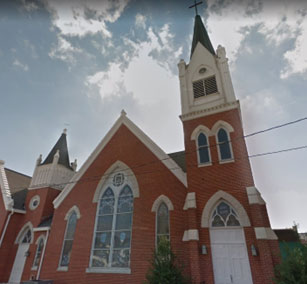
Mitchell Chapel was located a block off Main Street across the river in East Carmi. The church must have had a guardian angel, for in today’s world it would certainly be condemned as a fire and safety hazard. The church leaned to one side, there was only one entrance, and there was neither running water nor a bathroom. We had an old-fashioned coal stove and one of the men who lived across from the church would go early and make a fire when it was cold.
Not all of the Black people in Carmi attended the church, but they would come to funerals and also to fundraisers. There were probably 15 to 20 of us attending Sunday services, for which I remember getting dressed up and having new outfits for Christmas and Easter programs. We became part of a circuit with two other AME churches in Harrisburg and Carrier Mills, Illinois.
We were pioneers. My mother was the church recording secretary, and my dad was the lay reader and taught Sunday School. On Communion Sunday, we put up the white cloth around the altar and served communion with a chalice, using the silver communion set for the grape juice and wafers.
I remember the Sunday the minister “opened the doors of the church” and Charles walked forward to the altar to join. I followed him, joining the church because he did. Charles was in high school, and I was in junior high. Everybody cried.
We never invited any classmates to the church, and I am sure most people did not know the church existed because of the isolated location. When classmates asked where I went to church, I remember answering in a low voice and not with any pride. I do not remember any of the ministers as being special or giving outstanding sermons. We did not have a choir, but I do remember students from Southern Illinois University in Carbondale coming to sing.
In the late 1960s, Mitchell Chapel was allowed “to die” with the changing times. My family would be joyfully welcomed into the Carmi First United Methodist Church (FUMC). We had many friends at FUMC and would make new ones. My mom was especially happy and would become very involved in church activities.
When I graduated from Carmi Township High School in 1965, I did not have a plan beyond knowing that I would leave Carmi. I was encouraged and expected to leave by everybody including my parents and teachers. I moved to Champaign, Illinois, to stay with my aunt and attended Illinois Commercial College.
In Champaign, I attended Bethel AME Church. The church had a choir and a good minister, and I could get involved in activities of my own choosing. I knew a few people and made more friends. Most of all I knew the AME liturgy and songs having learned them at Mitchell Chapel AME. I became an usher and taught Sunday School briefly.
Charles was at Eastern Illinois University in nearby Charleston. He would come to Champaign on weekends and practiced teaching math at Champaign Central High School.
There were just a few Black students at the Commercial College. Just before graduation the man who was in charge at the school sent me to talk with the State Director at the U.S. Department of Agriculture (USDA), Farmers Home Administration State Office in downtown Champaign. He offered me a job and I accepted. I had just turned 19 years old. The office was small and convenient to where I lived, was with the federal government, and the employees were friendly and welcoming.
I would at times have challenges working with USDA but it was very beneficial to me overall. I worked with many smart and helpful supervisors and co-workers and made life-long friends. I felt rewarded and USDA enabled me to transfer from Champaign to St. Louis and Washington, DC. I received training, took business trips, and was able to retire after 41 years of service with a pension and health insurance.
When I moved to St. Louis, I joined Centenary United Methodist Church, which was part of the Plaza Square apartment complex where I lived downtown. Centenary was an elegant and historic church. I became a greeter and served on the church board for a year and participated with other programs and activities.
Charles and Gwen had met in college at Eastern, and married in 1967, when I was 20. They now lived not too far from me in suburban St. Louis with their young son Dan, but would later move to the Washington, DC, area. When an opportunity and encouragement came for me to also move to DC three years after they did, I wanted to move but also felt uncertain about doing so.
It would have been easy to stay in St. Louis. The move would take me away from the Midwest and my family, but I also knew I could easily fly home for vacations. DC was expensive and I wondered if I would be able to find an apartment and live in a safe and nice part of the city. I prayed and knew I wanted the transfer. I found a nice and very small apartment in a pleasant part of the city with the help of a friend. Being on the bus route and convenient to the Metro, it was a short commute downtown to work.
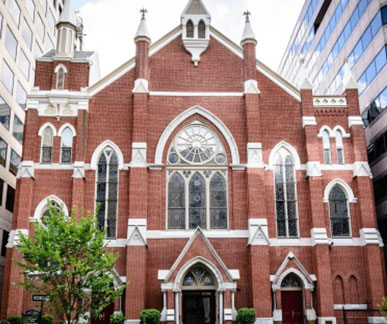
I had read about Metropolitan AME Church before I moved to Washington. The church was convenient to where I lived. It was a beautiful and historic church with a storied history and prominent members. Walking in the church, you feel the ancestors. I would come to understand that the AME Church, which was founded in Philadelphia in 1816 by Richard Allen, was about so much more than just segregation. I joined the church and became involved in many activities including ushering, the Love and Peace Missionary Society, the food bank, and serving as a chaplain for a seniors’ club. I took my co-workers to the church on weekdays when the seniors prepared a soul-food lunch.
I came to feel I was following God’s plan for me, which had always been there from the beginning. I would never have joined Metropolitan AME if I had not been raised in Mitchell Chapel AME Church in Carmi.
Watching the Communion Sunday church service online during Covid, I would use the Mitchell Chapel chalice my mom had given me before she passed and really feel the connection between the two churches.
I had been in Washington for 12 years and Metropolitan AME was going through changes. I was ready for a change also. The Washington National Cathedral was close to where I lived in northwest Washington. I had visited and toured the Cathedral and was awed by the beauty and peacefulness of the church and the grounds.
I liked the idea of the Nation’s Church which welcomed everybody. I did not expect to become a Cathedral volunteer or think it was even possible for me. I was not an Episcopalian. I made friends and met with the volunteer coordinator to find my place. I could volunteer at the Cathedral and still keep my membership and participation at Metropolitan AME. I would start as a greeter and become an usher, a lay reader, and volunteer in the gift shop.
My last time with Charles a week before he passed away would be attending a Sunday morning service in the Cathedral. Most people did not know Charles was seriously ill. When he passed away from a rare disease, I wondered why it had been him instead of me. At the end of the play Hamilton, there is a song “Who Lives, Who Dies, Who Tells Your Story.” I felt I survived to tell Charles’ story. I was the only connection to Carmi and our classmates.
I belong to a grief support group and recently we discussed how we would like to be remembered. I would like to be remembered as a Christian hopefully for kindness and outreach and inclusiveness and for understanding and forgiveness for myself and others. I feel blessed for the ways in which God has led, and I pray he will continue to guide me along my journey.


 Gwen Dungy