
Category Archives: reflection

Vulnerable

Always in shades, we didn’t know what her face looked like. Behind the shades, she seemed aloof, almost hostile.

Without the dark glasses, my friend and I were surprised at what we saw. To me, the look on her face was like that of a small child—innocent and open. I had the urge to protect and comfort her. My friend said that the woman seemed somewhat agitated. 

While I searched for a word to describe what we saw and felt, my friend said, “She looked vulnerable.”

Yes, vulnerable.

The rest of the week, I continued to think about the word “vulnerable.” What does it mean to feel and be vulnerable?

When I was with other friends, I would bring up the topic of vulnerability and ask them to tell me what being vulnerable meant to them and under what circumstances they recalled or would imagine that they would be vulnerable. 

My question elicited thoughtful responses. Most common among the ways of defining being vulnerable was feeling open, exposed, defenseless, transparent. When my friends described the circumstances when they thought they would feel or have felt vulnerable, they realized that what they were feeling was fear rather than what they thought of as vulnerability. The situations they described always involved fear of bodily harm by someone else.

Musing about fear and vulnerability, I realized that I would much rather experience fear than vulnerability.  I could use the adrenalin generated by fear to fight or flee. In such a scenario, fear comes from outside one’s self, stimulated by the threat of the other.

Experimenting with what I thought feeling vulnerable would be like, what came to mind were those instances in which close friends or family had hurt or disappointed me. Only people for whom I cared deeply could elicit a feeling of vulnerability. There is no rush of adrenalin. In fact, the heart is depressed. There is no fight or resistance. Only sadness, humility, and helplessness because in truth, being vulnerable requires cooperation of the self.

These thoughts bring me back to the mysterious woman who had a face of openness and innocence all the while showing a layer of pain. Based on this fleeting moment of visibility, I think that she had the courage to offer herself up to being vulnerable.

Images in My Mind’s Eye

Retired friends were talking about things they left at their previous homes and wished they had kept. After the conversation, I began to take a mental tour of the house I left in Maryland when I moved to Arizona. As my imagination took me from room to room, I recalled the fun adventures Charles and I had as we shopped for and selected everything.

Reminiscing as I visualized each room and space, I have no regrets about leaving almost everything we owned behind. We enjoyed them for years and I am grateful for that. There are, however, two exceptions to my laissez-faire attitude about what I left behind.   

While I could not have kept these two items because of my current space, I would like to be able to look at them every now and then.

Both of these prized items were in a room seldom entered unless there was a special occasion. We made what had been a game room into our living room, despite its being in the very back of the house. 

In place of the game room’s pool table, our living room featured a large, square, black lacquer coffee table with fat rounded legs making it appear as if crouching low to the floor. That table owned the space it covered. It could not be dismissed.

A particular photo comes to mind of a friend sitting on the floor next to the table while celebrating Christmas with us. Despite a riot of wrapping paper strewn across the table and the loveliness of the smiling friend, that table still took center stage, quiet and magisterial.  

In that same room was what I considered the most beautiful object in the house. I don’t recall how our search started, but we were on the hunt for Quezal iridescent glass in the art nouveau style for our central light fixture to replace the previous track lighting.

We searched antique shops and contemporary shops for just the right lighting for this special room. We recognized it instantly. it was like looking at our newborn among a nursery of beautiful babies. Everything else paled in comparison.

As it turned out, it was not what we thought we were searching for. I’m unable to give a fair description of this chandelier that looked like nothing we had ever seen. There was no sparkling glass. There was no lightness about it. It was as heavy as it looked. We feared that the beautiful antique brass base needed to attach it to the sloping ceiling would not be able to support it.

Not to everyone’s taste, it had a huge bowl shape with golden brass fittings. The color of the bowl was the peach of an early Arizona evening sunset with subtle granite-like veins sparsely trailing throughout.  It was gorgeous without the light being on and awestriking when lit. When we first got it, we would walk into the room together, look up at it, and then look at each other and smile with great satisfaction.

Image

The Way We Were: Stone Harbor 50th Anniversary

Gwen and Charles Dungy on beach at Stone Harbor

So poor that…

When we talk about just about anything today, the root seems to be either money scams or the bitterness of partisan politics. It makes for a lot of ugliness. It’s hard to write a weekly blog and not get mired in the depressive stuff of the day. For this week, with Spring in its full glory, I didn’t want to write about negative and depressing things.

Searching through some papers I saved, I found something that made me laugh and I hope you’ll laugh too. These quips are from Colbert I. King’s piece titled, “At Darrell’s Barbershop” (The Washington Post, February 16, 2002):

Can you top this?

“We were so poor, burglars used to break in our house and LEAVE money.”

“We were so poor that our front door and back door were on the same HINGE!”

“We were so poor that when I was growing up, my pants had so many holes in them that when I ran they hummed.”

“That’s not poor, in my neighborhood the rainbow was black and white.”

“Wait a minute. I was so poor, when I was born, Mom and Dad bought me a stroller. I made the last three payments MYSELF!”

“I was so poor, my family received CARE packages from the Third World.”

“I was so poor growing up, my favorite food was ice.”

“I was so poor that once my arithmetic teacher in elementary school asked me, ‘If you had $2 in one pocket and $3 in another, what would you have?’ I told her someone else’s pants.”

These people were so poor that:

  • on Christmas Day they got a battery with a note saying, “Toy not included.”
  • they went to McDonald’s and put a milkshake on lay-away.
  • they used to wave around a popsicle stick and call it air-conditioning.
  • they had to join the Army to get a haircut.
  • when somebody came to their house and lit a cigarette, their father would shout, “Clap your hands, stomp your feet, praise the Lord, we have heat.”

I need silly and corny sometimes. Do you?

Clothes

Is it just me or are designers and manufactures of women’s clothing playing a joke on us and laughing all the way to the bank?

On a recent shopping trip, I browsed in stores for women’s clothing from economy to high-end and everything in between and had a difficult time liking the choices available. From the quality of fabrics to colors and designs, there were disappointments. 

In addition to being disappointed in the choices, I was keenly aware that none of the clothes were labeled as being made in the USA. I considered the implications of this for the manufacturing workforce in the United States. It used to be that the prices were more affordable when the garments were not made in the United States. I don’t think this is the case now. Very casual wear such as t-shirts made overseas seemed unreasonably expensive for the quality. So why all the imports?

As I looked through racks of clothing at various stores, I thought about what my mother’s reaction might be upon seeing the choices today. She was a woman of impeccable style and discernment. She knew quality fabrics and was a real stickler about the precision of the tailoring. She would rub the fabric between her thumb and middle finger and determine whether the garment was worth the price. Even though money was short, if she had to buy clothing, it would be of the highest quality. She took very good care of her clothes. As a result, she kept her clothes for a long time, but they never seemed to go out of style. They were classics.

I haven’t seen what I would call a classic in some time now. Instead of styles today, there are trends because what’s up-to-date, or what everyone is wearing, changes so frequently. Designers and manufacturers of almost every consumer product create them for obsolescence. Otherwise, there would be no profit. I think most of us buy clothes that make us feel good about ourselves. Clothes we choose represent the image we have of our best selves. That’s why most of us have at least one garment that is, in our opinion, a classic. We keep it even if we don’t wear it because it’s who we are.

Except for that classic piece, I suspect that we don’t wear our clothes season after season because we don’t want to be out of sync with what others are wearing. To keep up with the trends of the day, we hold our breath and pay the prices offered.

It’s not that we are complacent and don’t care about quality or have discerning taste. We have no choice but to settle for the last resort and buy what is offered. It is our vanity and unwillingness to be out of sync with the latest trends that allow designers and manufacturers of clothing to get away with offering us shoddily made unattractive clothing.

It’s a bittersweet memory to recall the days when I couldn’t afford most of the clothes that appealed to me, and window shopping was good enough because the beauty of the clothes brought joy whether I could own them or not.

A possible upside to my dim view about today’s clothes is that we’re not alone.  Everybody looks very strange in the trends of the day.

Keys

I don’t subscribe to the adage that “nothing is ever lost.” I used to lose things all the time. While in college, I lost two coats! Like a lot of people, I’ve lost more umbrellas than I can count and don’t get me started on misplacing things. When I used to misplace things at home, my calm and logical husband was always there to find them for me.

I don’t usually lose things now because I try to be mindful of what I’m doing. Also, I like to establish the kind of habits that relieve me of having to be consciously thinking about where I put the items I use every day. Most things have their place. Now that I’ve downsized, there are a lot of open spaces and flat surfaces where I can easily see things if I’m looking for them. I’ve been feeling pretty content and maybe a little smug about not having the frustration of always looking for something that has been misplaced.

That was until recently…

I have now become preoccupied with retracing my steps and actions to see if I did anything differently on the day that I lost my keys.

For a solid week, I was unable to walk through the house without scanning for the keys. The only thing that was different the day the keys disappeared is that I did have folks in the house doing some work. Coming from a background in which people felt that it was okay to take something that didn’t belong to them, I struggle to keep from thinking that someone deliberately took my keys. I’m going with the notion that the keys are lost or misplaced.

Resolved to think that the keys are lost or misplaced and not stolen did not take away the feeling of anxiousness. I would tell myself to just let it go and feel lucky that I was able to replace the keys. However, I was unable to take my own advice in letting it go. In my desperation, I became irrational in my search. I was looking in places knowingfull well before I searched that the keys would not be there—in boxes and drawers and under everything.

My preoccupation with the lost or misplaced keys became pervasive and a nuisance taking up brain space that I’d rather use otherwise. At the point of exhaustion, I called on my value of reflection. I asked myself what my deeper feelings were—those feelings beyond frustration.

Upon reflection, I was surprised to discover that my deeper feeling was one of distrust. Distrust in myself. How could I trust myself if I couldn’t  keep up with something as simple as my own keys? Acknowledging this feeling gave me permission to allow my feelings of humility to surface.

In this posture of humility, I was able to reflect on what I had done in the past when I lost confidence in the one person that I should be able to trust.

During these times of a crisis of confidence in myself, I slow down. I soften my facial features. I show myself the same empathy and gentleness that I would show someone else who temporarily lost confidence in self. And lastly, I forgive myself for the all-to-human trait of being fallible.

Still Thinking About Being Authentic

I have decided to stop saying, “Just be yourself and act natural.”

I realize that hearing this does not always motivate. It can even be devastating when one feels that just being one’s self is not enough.

This is where role models come in. If we think that being our natural self is not enough, who are the people we would like to be like in this situation?

Acting as we think the people we admire would act is still being ourselves. We’re just finding a way to bring this part of ourselves into focus for this purpose. It does not change who we are. Acting as we think a role model would act enhances and burnishes the self that we’re always creating.

Being our best selves by not deliberately deceiving for selfish reasons may be the better part of being authentic.

If we’re guided by a basic human value of treating others the way we would like to be treated or the way they prefer to be treated, I think we can simplify the complex issue of being our authentic selves.

Being One’s Authentic Self

For me, thinking about what it means to be authentic started when I read that one of RuPaul’s foundational beliefs is that “everybody is playing a role.”

In talking about dressing in drag, Jinkx Monsoon similarly says, “It’s armor because you’re putting on a persona.”

Why do people play roles and feel it necessary to put on a persona? Is it because these are ways of protecting one’s self? If this is the reason, then to be authentic is a very brave act.

But what does being authentic mean to a layperson? Some say that to be authentic is to act and behave the same way no matter the circumstances. Some say that one’s values should always be the compass for being one’s authentic self. A person may be seen as being authentic if they are known to speak their minds and stand by their convictions.

Notwithstanding these perfectly reasonable definitions, I think being authentic is a fluid concept to be wrestled with throughout a lifetime. I have come to the conclusion on this day at this time that we’re never not being our authentic, true, genuine, essential selves because how one presents is an innate survival instinct.

Although there are times when our authentic self may be the version of ourselves that we deliberately bring forth and exhibit, I don’t think most people wake up and decide which role they want to play that day.

However, I also believe that we are the stars in our own productions, whether fantasy, horror, drama, comedy, or all at the same time.

When someone says, “I was not being myself,” especially after doing something that they regret, we might have an inward smile and think, “Yes, you were being your authentic, true, essential self, and I understand.”

What’s It All About?

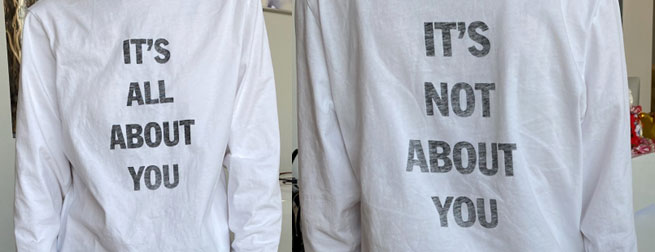
front and back of white t-shirt reading, "IT'S ALL ABOUT YOU" and "IT'S NOT ABOUT YOU," respectively

It’s funny how a simple message on a T-shirt can be humorous and not so funny at the same time.

I smiled when I saw a shirt recently and asked the wearer if I could take a picture. Thinking that was all there was to this moment, I was surprised when hours later I was still thinking about the messages on the T-shirt.

I began to question whether it is a well-intentioned gesture or a hostile act when someone interrupts a conversation or exchange by saying, “It’s not about you.” Is such an interjection meant to open new pathways to communication? Is it meant to focus both parties more directly and intently on the issue at hand?

I’m skeptical about whether bringing a person up short with such a statement is helpful in encouraging the receiver to see the situation from a different perspective. More than likely such a judgment shuts the receiver down in an unhelpful way making it awkward for the exchange to continue in an honest and authentic manner.

The tenor of the conversation changes as feelings unrelated to the original topic intervene. There may be feelings of shame or anger. More often than not, these feelings are pushed down and not shared because the person receiving the statement, “It’s not about you,” likely feels admonished. If this occurs, then it does become all about them.

How should one react when they are the recipient of such a judgment? One way to react might be to apologize for changing the focus of the conversation if that is indeed what happened. Another reaction might be to thank the person for bringing the conversation back to the appropriate focus, assuming the author of the statement knows what the focus should be.

But let’s be real. If there is a habit of only seeing the world from how it affects oneself, being told that “it’s not all about you” changes nothing about a self-centered person’s orientation. Instead, it likely changes the way the person feels about the person who made the observation or judgment.

Granted, there is a lot of ambiguity about the intention and the helpfulness of this statement, but what there is no doubt about is the negative impact of having that statement made if one is not acting in a selfish manner and genuinely wants to have a constructive conversation.

Bringing a person up short with such a statement might be a tactic that is regularly used to shut down a person who has the better argument or to discourage conversation altogether.

Which side of the t-shirt resonates with you? Do you live in a world where “it’s not about you,” or do you live in a world where “it’s all about you”? Does it depend? None of the above?