Category Archives: Students

First-Generation High School Graduates

Maybe you attended a high school reunion recently or talked with someone who attended one. Most likely these reunions are commemorating graduations that occurred 20-50 years ago. It’s likely that the majority of those classmates attending these reunions were the first in their families to receive a high school diploma. Graduating from high school was quite an accomplishment and source of pride for these graduates’ families.

What is stunning and puzzling to me is the number of young people born in the United States who—in 2023—are the first in their family to graduate from high school.

These thoughts led me to these notes from my mother:

What Gwen’s Graduation from High School Meant to Me

Yes, her graduation meant much to me in terms of my life and the chance to make up for disappointments and lost opportunities. It meant that the naysayers and name-callers were wrong about me and my child. It meant that despite the circumstances of her conception and the mess her father and I made of our lives together after her birth, through faith, I knew that God was watching over her. His eyes were on her as he watched over the sparrows.

What Gwen did not know was on the occasion of her high school graduation, I remembered my Grandpapa Agnew, my daddy’s father, who was a slave. With joy in my heart, I thought about how far we had come to finally have someone in our family graduate from high school.

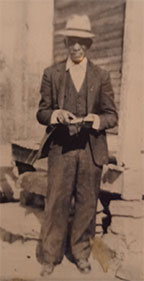
Grandpapa Agnew in a suit and hat with a building in the background
Grandpapa Agnew

I recalled the times when I was a little girl and Grandpapa Agnew stayed with us. I would sit on his lap and he would tell me stories about when he was growing up. The message I got from his stories was about how much better things were for us Negroes now than when he was born and how it was so important that we worked hard to find opportunities to better ourselves and our race.

When Mama and Daddy moved to Memphis, Grandpapa Agnew stayed in Mississippi with his daughter. He visited us when we lived in Memphis and Gwen was a little girl. He had the most beautiful silver, not gray, hair; walked with a cane, and wore a suit and a dress hat. It was such a blessing that he could see his great grandchild, one who would accomplish what he could not have had the imagination to realize.

Banned Books: A Response

Guest post by Marguerite M. (Maggie) Culp in response to “Banned Books” post (10/12/2023).

You got in trouble for reading Gone With The Wind in a physics class? Gone with the Wind?!? Although that is the last book I would expect you to be surreptitiously reading in school, the fact that the story intrigued you—and you were willing to take some risks in order to finish reading it—was a great way to make your point.

Children, young adults, and hopefully a significant number of adults are naturally curious. A good love story set against the background of a war captures everyone’s imagination, even if the story is an attempt to rehabilitate the image of the Confederacy and reframe the Civil War and Reconstruction. Your mother, by the way, showed admirable restraint in the way she handled the situation.

As you know, I was born, grew up, and attended college in the Boston area, so banned books were part of my life from the day I was born. The church to which my family belonged and various civic groups periodically published lists of banned books. When I was old enough, I was asked to raise my right hand in church and swear never to read a banned book. Naturally, the first thing I did was try to locate some banned books, but they were kept in the back room of the local library and unavailable to the general public.

At 14 years of age, I was hired to work part-time at one of the branch libraries in my hometown. After I worked there for a year or so, I decided to slip into the back room and explore a few banned books. I quickly discovered their quality and content varied. Some seemed an absolute waste of paper, others simply did not interest me, and a few were absolutely disgusting. For the life of me, though, I could not figure out why some people considered these books so dangerous that they had to be locked away and people forbidden to read them.

Yes, Catcher in the Rye was disappointing because it had nothing to do with baseball, but it did motivate me to ask my dad a lot of questions about how boys viewed girls and why a writer who presumably had a good vocabulary used so many swear words.

I flat out loved To Kill a Mockingbird and could not understand why anyone would want to stop me from reading it.

Although The Prince by Machiavelli was troubling on many levels, its content did not keep me awake at night the way the headlines in the evening newspaper did.

It was only when I stumbled on a banned summary of the works of Martin Luther during my senior year in high school that I realized there probably were four reasons that governments, churches, or community groups tried to control what other people read: the banned books contained ideas that threatened their world view, their power, their financial security, and/or their sense of self and place in the universe.

I cannot imagine today’s young people are any less resourceful or less curious than we were, which means I share your optimism that they will find their way to the truths contained in many a banned book. It may take them a bit longer, and I think the road will be a bit more complicated than it was for us, but enough will get there in the end to make a positive impact on this country and its future.


Marguerite M. (Maggie) Culp is a higher education consultant and former faculty member, counselor, dean, and senior student affairs officer. She is co-editor of six books including “Student Success in the Community College: What Really Works?

Banned Books

A book worth banning is a book worth reading

Last week was Banned Books Week. In my opinion, most books worth reading have been banned or censored at some time during their circulation. Notice that I preface the previous assertion with, “in my opinion,” because I don’t claim to be an arbiter of what others read. By contrast, it seems that those who seek to censor and ban books think that their opinions matter more than others’.

It’s more than troubling to think that in this century in the United States book banning and censorship are not only tolerated but increasingly sanctioned. I have no quarrel with those who want to restrict access to books, games, movies, or anything they deem inappropriate for those within their guardianship. I think it goes too far when outsiders seek to extend those judgments as to what is appropriate for those with whom they have no relationship.

When I was 16 or 17, I was suspended due to my insatiable desire to continue reading the library-restricted novel Gone With the Wind. The trauma of the suspension is probably blocking me from remembering the exact details of whether it was from school entirely or only from my physics class, but the condition for my return was for a parent to meet with my physics teacher. My mother couldn’t believe that she would have to miss a day of work to come to the school for some kind of foolishness that was so unlike me, who always followed the rules. Although my grades put me in excellent standing in my graduating class, not completing the physics course would have delayed my graduation.

After being warned more than once not to bring the book to class, I could not put it down. In an attempt to hide what I was doing, I positioned myself at a back table in the physics lab and held the book on my lap under the table. I was so engrossed in the novel that I didn’t realize when my teacher was standing next to my lab table. I can’t say what was most fascinating to me about the novel. Whatever it was, it was absorbing enough for me to risk the ire of my teacher.

In contemporizing the narrative of this work of fiction, by all accounts I should not have relished reading it. In retrospect, I wonder how my 16- or 17-year-old-self felt about the contrast between what I was reading and the factual reality of the American Civil War, the elaborately drawn nobility of rich White Southerners, and the portrayal of favored slaves. As damnable as the mythologizing is in this book, I would not be in favor of banning, censoring, or restricting it.

To truly educate for a changing and evolving world, many banned books ought to be required reading with analysis and discussion of the historical, social, and cultural context in which the book was written, as well as the more recent and contemporary thinking in regard to the subject. However, in the current climate of suppression and falsities, teachers dare not attempt to teach students what would certainly broaden their perspectives and require them to interrogate the truths that they have been led to believe. Despite the pessimistic outlook for the social, cultural, and political landscape, I continue to have faith that youth will clear the path to their own enlightenment. It may not come early because of access, but I’m encouraged to think that young readers are the same now as they have always been. Just as I took a risk to read Gone With the Wind, a library-restricted book, they, too, will find a way to read banned, censored, and restricted boo

What the “Fantastic” Thing Is All About

Guest blog by Laurence N. Smith

Since Gwen Dungy’s fantastic blog about me, I have heard from several former colleagues who just wanted to say hello and catch up, and some who wanted to know what the fantastic thing was all about. Among the callers were some who asked what I thought would be the best advice to a new or aspiring student affairs vice president. And since my daughter, a prominent business consultant, unknowingly to me shared Gwen’s blog with some individuals in her network, it opened the door for a few who asked for advice for their own future success.

My first vice presidency was at Chicago State University in 1969. At 29 years of age, I was the youngest administrator by many years. Times were difficult, and especially difficult for students of color who comprised 80 percent of the student body!

Among students, faculty, and administrators there existed a downbeat atmosphere concerning just about everything. The president was focused on bringing in new young talent to change that condition. The litany of what was wrong with the University was a long series of frustrations. I learned very fast never to ask my colleagues, “How are you?”  

It was then that I decided that when anyone asked \how I was that my reply would be “fantastic.” I realized that in the culture of the University it was an unusual reply. I decided to make it even more energized to have greater impact. The simple “fantastic” was replaced by a vigorous “FAANTASTIC!”     

In the early years the reply shocked people and opened the door to exploring change when they asked me why I felt fantastic. It didn’t affect everyone, but even those who thought it was an over-the-top reply were curious why I felt that way or wanted to test if I was in touch with reality.  It enlarged the view and discussion about the University.

Where it had the most significant impact was on students.  For student leadersthe student newspaper reporters and editors, the captains of athletic teams, and others—my feeling fantastic helped them feel fantastic. It fostered a new level of enthusiasm and discussion about the opportunities that were ahead if they embraced the efforts necessary for getting a college degree.   What they experienced, they shared.  It caught on.

And when I became vice president for university marketing and student affairs at Eastern Michigan University, it had the same impact. 

It still sparks curiosity and engagement. Try it out for yourself. When you are asked, “How are you?” respond “fantastic” or “FAANTASTIC.” No matter who you are and what you do, it still works.


Laurence N. Smith is a founder and Senior Partner of New Campus Dynamics with 40 years of experience as a senior university administrator and as a national leader in higher education. He is emeritus Vice President for University Marketing and Student Affairs at Eastern Michigan University. Among his extensive activities, he was founder and chair of the NASPA National Academy for Leadership and Executive Effectiveness and executive editor of NASPA’s online management magazine. In 1999, he was named a NASPA Pillar of the Profession, and in 2002, he was the recipient of the Fred Turner Award for Outstanding Service to NASPA, the equivalent of a Lifetime Achievement Award in the student affairs profession.

A Philosophy of Sorts

Guest blog by David Keymer

Over time I arrived at something like a philosophy to govern my work in student affairs and higher education. Ultimately, all of our expertise points back to a vision of what college and university life should be like, what it should do. Universities and colleges are a special kind of community—a community of learners. The emphasis should be on both words: “community” and “learners.”

The ideas, then, are simple…nothing complicated:

First and foremost, I was there for the students, and the students were there to get an education. In this exchange, then, it was the students who were paramount. If it was about empowering students, it was simply a matter of service for me. That meant that…

  • students should always be able to reach me;
  • it was important that I give good value in whatever I did; and
  • ego was less important than results.

Using power gratuitously is not only wrong, it’s counterproductive. The power I held was the position’s and there for a purpose. It was not mine and, just because I had it by way of the position did not mean I had to use it.

This was especially true as I realized that everyone on campus needed to be in the same business of helping students succeed, academically as well as socially. Parents or prospective students didn’t come on campus and ask where the Vice President for Student Affairs’ office was. They talked to whomever they met. It might be a worker planting flowers in the flower beds outside a classroom building, or a campus police officer passing by, or a stray faculty member or student on the way to class. As a result, I did a lot of walking around talking to colleagues and students to ensure we got our message out that we had the same ends and were serious and proud of our commitment to student success.

Everything I managed to do required other people. It was important, then, that I listen to EVERYone, not take others for granted, and recognize others’ contributions and let them know I appreciated them. That being said, an important piece of effectively working with people is to cooperate, but “never give up your teeth.” The work is too important, and every so often, you may have to take a bite out of someone to convince the other person you’re not kidding.

Relatedly, developing people is as important as spurring them on to work well. It takes time, money, and effort to find and hire someone new for a position. If there were difficulties initially, it wasn’t a matter of giving up, but needing to find out what people did well and what inspired them, then leveraging those strengths and interests.

After all, work should be fun as well as work.


David Keymer served as a chief student affairs officer at SUNY Utica Rome; California State University, Stanislaus; and Zayed University (Dubai and Abu Dhabi) from 1983-2004. For more wisdom gleaned from Keymer’s experience in student affairs across these varied institutions, check out the seven-part series published in 2021 from a set of interviews.

Removing Roadblocks

Many community college students are true immigrants to higher education. To them, going to college is as foreign as finding themselves put ashore in a strange land.

Once they embark upon a college education at the community college, often their main concerns include how to pay for their course work and how to juggle their myriad responsibilities in order to find time to study.

Often, their plans include getting as many courses done as possible at the community college at lower costs before continuing toward their four-year degree.  

They are proud of these hard-earned credits. However, too often they find their safe harbor disrupted when they discover that many of the credits earned at the community college will not transfer or be accepted by their choice of a four-year college.

More than 40 years ago when I worked at a community college, the most time-consuming and frustrating parts of my job as a counselor and academic adviser were to work with students who were being stymied in their progress because the community colleges and four-year colleges could not come to agreement on which courses taken at the community college were “equivalent” to courses at the four-year college. I think now as I did then: If community colleges are “colleges” and faculty who teach the courses are qualified and students meet the requirements, why are there questions about equivalences?

A recent story on Marketplace Morning Report noted that when transferring from a community college to a four-year college, about “43% of college credits don’t end up counting toward a new degree.” The reasons for this lack of cooperation and consistency between community and four-year colleges seem to be about money and hierarchy.

With less funding from states and counties and increasing infrastructure costs for colleges and universities, four-year colleges continue to raise tuition as a source of revenue. Done intentionally or not, having students repeat courses already taken at community colleges is another source of revenue.

Then there is the hierarchy. Community colleges that were created to give opportunities to a broader spectrum of students in their own communities are often described in unflattering terms. Rather than being seen as a way to level the playing field, the hierarchy is preserved when the gatekeepers at four-year colleges stand in judgment as to the worth of the credits earned at community colleges.

Students have little say or control about the transfer of credits and suffer the consequences of being stuck in the middle. If faculty from the two types of institutions cannot agree on what is acceptable in courses of the same or similar names and descriptions, then it may be time for outsiders to interfere further in the business of the professionals in higher education.

If outsiders are allowed to make decisions about what is appropriate to be in the curriculum, how teachers teach, and what books are in the library, why not take this interference further and mandate articulation on course transfer between community and four-year colleges? The time is long overdue for leadership to require that the roadblocks to complete articulation between community and four-year colleges be removed.