Category Archives: NASPA

Notes on a Napkin

Twenty-three years ago—once again finding myself in a restaurant eating alone, a consequence of traveling around the country to be among members in their regions and to make speeches on various subjects—I often jotted my musings on a napkin.

On one such napkin, I wrote about what I wanted to say at the association’s business meeting as an introduction to reporting on the statistics and successes since the last annual meeting:

“We have to attend to the demographics of the profession to insure that what we as an association offer is relevant not just for today and today’s members, but for the future and tomorrow’s members. Student affairs and other support services are projecting the largest number of retirees within the next 5-10 years that the profession has experienced.

“Our challenge is to meet the needs of professionals up and down the demographic ladder. We can do this by broadening our definition of diversity among our membership to include age, gender, race, socioeconomic factors, and different perspectives.

“We need good people who are eyeing retirement to remain active in the profession as mentors and sages. We must find a way to capitalize on the gifts and legacies of our retiring professionals.

“At the same time, we need to look to mid-level, new and potential professionals to rejuvenate the field and the association. Determining what they need from their professional association is a particular challenge. In addition to meeting their professional needs, we want the talents they bring to move the association forward.

“We need to help the burgeoning number of mid-level professionals to assume leadership roles. What is the best way to show them that we need their participation and leadership to accomplish our vision?

“One of our tasks is to emphasize the power of leading from the middle.”

From what I can glean, as an outsider today, the association has been successful in bringing to fruition what were notes on a napkin a long time ago.

White empty napkin and pen on gray background

Mr. Fantastic

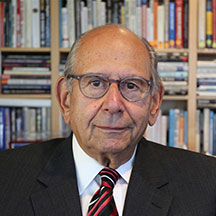
Laurence N Smith

Once in a lifetime, if you’re lucky, you will know a Mr. or Ms. FANTASTIC!

Laurence N. Smith is my Mr. Fantastic! He was the vice president for University Marketing and Student Affairs at Eastern Michigan University from 1975–2000.

I give him this title because he stands out from the rest in every way. He’s always the tallest in the room and the smartest in the room. And when asked how he’s doing, invariably, he responds, “FAANTASTIC!”

Leadership in a volunteer organization based in higher education can be a different experience than what a leader might be able to do in a top-down organization where the people responsible for making the trains run on time are paid and can be released at-will.

When I was in such a leadership position, willing volunteers were the key to success. Many stepped forward to let me know that I could count on them to help me achieve the goals of the organization. They used words like “help you,” “support you,” “here when you need me.”

In my imaginative recall, Larry Smith, towering over the heads of his colleagues, fixed his eyes on me, made a beeline to me, and asked, “What is your vision for this organization?” With confidence, I summarized my mandate from the volunteer board of directors and added my own vision, which could be described as fantastical given the structure and history of the organization. Mr. Fantastic’s eyes communicated, “Are you sure?” The gaze I returned indicated that I was.

Lyrics from songs best describe his response: “Come along with me,” “I’ll take you there,” “I believe I can fly!” My leadership vision was the perfect vehicle for Mr. Fantastic to test drive his ideas about what student affairs administration in higher education could “truly be.”

On the journey with Mr. Fantastic, it was obvious that when we were talking about using listservs to bring our members together in conversation from various locations, he was already thinking about what we now call Zoom meetings. When we were talking about Palm Pilots, he was envisioning what is now Chat GPT. Always looking toward the possibilities for the future, never fearing failure, and always optimistic is my Mr. Fantastic.

And I’m not the only one that found Larry to be fantastic. In 1999, he was named a NASPA Pillar of the Profession, and in 2002, he was the recipient of the Fred Turner Award for Outstanding Service to NASPA. The equivalent of a Lifetime Achievement Award, the Turner Award recognizes NASPA members who have brought honor and dignity to the student affairs profession and to NASPA as an association for a sustained period. Among Larry’s extensive activities, he was founder and chair of the NASPA National Academy for Leadership and Executive Effectiveness and executive editor of NASPA’s online management magazine.

I spoke with Larry recently and told him that to have him as a colleague and friend during my time at NASPA was a blessing of pain and glory. The pain was tempering the projections of where the organization could go and modulating the speed of change in order to be in sync with the volunteer leadership. The glory was the innovations NASPA achieved through its volunteers when we were flying with Mr. FAANTASTIC!

Thank you, Larry. I am truly grateful for your colleagueship and friendship.

After September 11, 2001

After September 11, 2001, everyone had a story about where they were, the efforts they made to get home, and what they did to connect with loved ones upon hearing the devastating news about the attacks made on American soil by foreign terrorists. The senseless tragedy was almost beyond comprehension.

After September 11, 2001, I witnessed a NASPA staff that was shaken but not defeated. Although there were a multitude of anxieties, such as fear of being in Washington, DC, doing work on Capitol Hill, taking the Metro to and from work, flying on behalf of NASPA, and even opening mail because of anthrax, staff members adapted and redoubled their efforts in support of student affairs professionals who were needed more than ever on their campuses.

After September 11, 2001, student affairs professionals served as navigators and provided safe harbors for all members of their campus communities. Using their skills of empathy, understanding, and knowledge of crisis intervention, they were the first responders for students, faculty, and staff. They did what they were trained to do and shared strategies with colleagues across the nation on how best to respond to these unprecedented times, and the increased needs of the student and campus community amidst fear, uncertainty, and a range of reactions, including the bizarre and self-destructive.

After September 11, 2001, NASPA leaders looked beyond the tragedies of the day and sought ways, where possible, to reduce risk on campuses and, unfortunately, to prepare for the aftermath of future senseless tragedies.

After September 11, 2001, what did NOT—and never should—go unnoticed is the commitment of student affairs professionals to working with campus communities to create a climate that promotes learning and a sense of security and belonging in the face of adversity.  

Amazing Grace

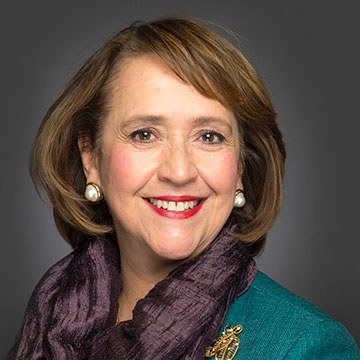
Patricia Telles-Irving

Dr. Patricia Telles-Irvin assumed her position as vice president for student affairs at Northwestern University in 2011—the same year that she began her term as president of the NASPA Board of Directors. As executive director of NASPA, I was aware of the difficult decisions that she had to make and the many responsibilities that she carried ever-so-thoughtfully and gracefully in both of her leadership positions.

When I think of the year that I spent close to her as a colleague, friend, and confidant, I realize even more in retrospect that she was the epitome of love, kindness, and compassion. She was amazing grace, a gift to the world. I am privileged and honored to have known her and to call her friend.

RIP PTI 2019

Standing on the Shoulders of Giants – Honoring Dr. Bobby Leach

Leach

Dr. Bobby Leach
NASPA President
1985-1986

NASPA has a brand new award for equity, diversity, and inclusion, and it is named in honor of Dr. Bobby E. Leach, who served as NASPA’s first African American president (what would today be the board chair) from 1985-1986.

It was my honor to accept the “inaugural” Bobby E. Leach Award this past month at NASPA’s 2017 Annual Conference in San Antonio. Dr. Leach was an extraordinary man who accomplished much in his life. Extremely well educated, he attained an undergraduate degree in mathematics and science by the age of 21, and a Masters Degree and a Ph.D. after also excelling in military service.

His work life included serving as a high school principal for 10 years, associate dean of students at Wofford College from 1970-1973, and dean of students at Southern Methodist University from 1973-1976.

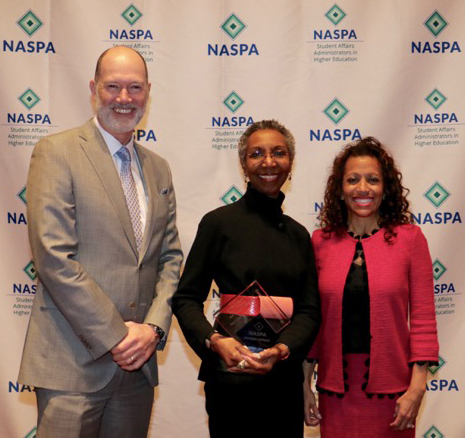
Bobby E. Leach Equity, Diversity, and Inclusion Award Recipient Gwen Dungy with NASPA President Kevin Kruger and Board Chair Lori White.

Bobby E. Leach Equity, Diversity, and Inclusion Award Recipient Gwen Dungy
with NASPA President Kevin Kruger
and Board Chair Lori White.

In 1978, Dr. Leach was the first Black administrator hired at Florida State University, and the highest ranking African American in the Florida State administration. He served as vice president for student affairs at Florida State until 1988. He passed away much too soon in 1989. In 1991, Florida State University named its new Student Recreation Center in his honor.

Following are brief remarks I made about Dr. Leach at the NASPA 2017 Awards Luncheon when I accepted the award named in his honor:

Reflections on Cool Passion: Challenging Higher Education

NASPA’s latest book Cool Passion: Challenging Higher Education by Arthur Chickering will be available to the public in mid-March.

I just finished reading every line of this extraordinary work. I was hooked by the title even before I began to read. The opening paragraph of the preface is sheer poetry!

Chickering gives us an incredible gift as he shares his personal experiences, values, and beliefs, as well as his professional reflections. It is fitting that he shares a holistic perspective that is in line with his foundational philosophy of student affairs and the premise of promoting learning that lasts.

There is so much in this book that will appeal to a diversity of people who are at different stages of their life and to those who are working with students who are finding their way. For example, the Wesleyan University story will resonate with those who are having a rough beginning. To me, it speaks to having someone believe in you and the power of will. This part of the book says a lot about the influence of every educator on campus, including the deans in the admissions office.

Chickering’s candidness about developing self-esteem as a result of small acknowledgements and recognitions is so important to hear because of late the so-called “self-esteem movement” has put a negative connotation on any efforts to address self-esteem issues with students and colleagues.

As I read about the evolution of Chickering’s thinking about what variables had an impact on students’ learning, I realized that all of the insights that theorists and I have had about teaching and learning were already there in the Goddard educational philosophy. Chickering’s work continues to demonstrate how those insights can be put into action.

I take heart in the fact that though Chickering was never a student affairs professional, in his daily work, his insights have served the profession well. I was never a “student affairs professional” in the strict sense of the term, and I hope my insights have been beneficial to the profession.

The professional reflections Chickering and his colleagues share make this book required reading for graduate programs throughout higher education. What an incredible gift Art Chickering has given to higher education and all educators!

Take a breath and keep doing your good work…

Take a breath and do not feel defensive. When the reporter from The Chronicle of Higher Education called to get my thoughts on the conclusions drawn from the Delta Cost Project’s report on the higher education workforce, I took a breath and did not become defensive. The conclusion of the report is that the big increase in the higher education workforce is attributable in large part to what is labeled “Student Services.” The question is whether the expenses are justifiable or unnecessary bloat.

I told the reporter that if one looked at the numbers under the classifications “Professionals” and “Student Services” and compared the numbers to full-time faculty, one would get the sense that more resources were going toward student services professional staff than to faculty. However, there is a problem with labeling what are student services.

The Lumina-funded study we did at NASPA a couple of years ago about resources expended on student services was a clear demonstration that what is described as student services is all over the place, depending on the college or university. Further, if one reads what is labeled as student services in the Delta Cost study, it’s obvious that student services cannot be aggregated and referenced as one would the classification of “faculty.” The bottom line, though, according to the study, is that “hiring practices favor non-instructional professional positions.”

I assured the reporter that one would be hard-pressed to find a college or university president who would choose to fund student services if there were a choice between the academic program and student services. Upon investigation, one will likely find that increases in student services are related to governmental regulations and avoiding the risks of liability.

The general conclusion from this study adds kindling to the smoldering between academic and student affairs, and I encourage student affairs professionals to not be defensive but to do the job you were hired to do. There is too much work to be done to spend energy justifying your existence or explaining the reality of your work to those who have already prejudged.